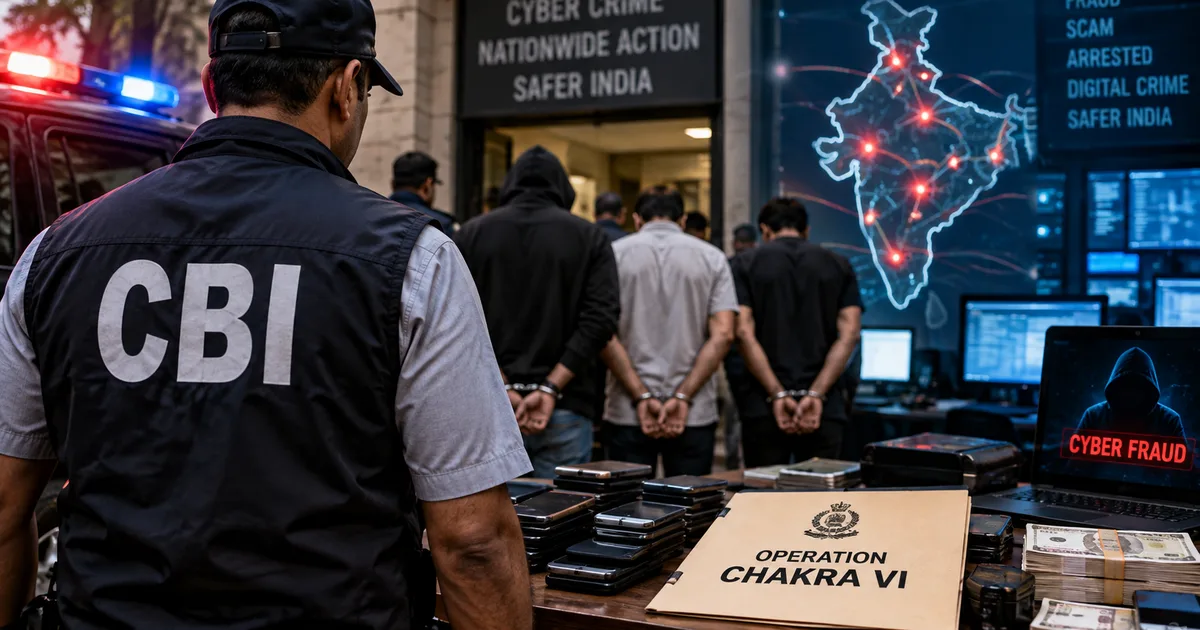
If you've been reading the news lately, you probably saw headlines about the CBI Operation Chakra VI 2026. This is a massive, coordinated hit on the exact scammers who have been terrorizing Indians with fake "digital arrests" over the past few years. Look, I get calls almost weekly from older relatives panicking because someone claiming to be from the CBI, customs, or the telecom department told them their Aadhaar is linked to a money laundering case. It's terrifying. But this week, the actual Central Bureau of Investigation decided to strike back.
I want to explain exactly how these scams work and why this crackdown matters for internet safety in India.
What exactly is CBI Operation Chakra VI 2026?
Basically, the CBI didn't just go after one or two guys in a basement. They mapped out an entire organized crime network spread across the country. We're talking about highly coordinated teams that specialize in tricking people into believing they're under arrest via video call. And they run these operations like a corporate office, complete with scripts and target numbers.
The numbers behind the raid
The scale here is wild. The CBI conducted coordinated searches at 89 locations across 20 different states. Honestly, the numbers here are a bit fuzzy because some reports mention 80 locations in 16 states initially. But the net widened quickly as they interrogated the first batch of suspects. They didn't just freeze bank accounts. They went into the physical call centers and homes of the people running these syndicates.
They've already arrested at least three main players. And these aren't just low-level callers reading off a prompt. We're talking about individuals accused of laundering massive fraud proceeds. One specific operation involved laundering over Rs 2 crore through mule accounts using fake Supreme Court arrest warrants. It's sophisticated stuff. They forge documents that look incredibly real to the untrained eye, complete with official government emblems and fake signatures of real IPS officers. In my experience, even smart people freeze up when they see a police logo on their screen.
When you look at our Latest Tech News coverage, you see a clear pattern. Cybercriminals are moving away from simple phishing emails. They're going straight for high-pressure psychological manipulation now.
They know that a fake email from a bank might get ignored. But a video call from a guy in a police uniform gets immediate attention.
How the digital arrest scam actually works
I know it sounds complicated. It isn't. It's actually a very simple script executed with terrifying confidence. If you don't know the playbook, it's incredibly easy to fall for it. I've seen doctors and senior corporate executives fall for this exact scam because the fear tactics are so intense.
The setup
First, you get a call. Often it's an automated voice recording claiming to be from FedEx, Blue Dart, Mumbai Police, or Customs. They tell you a package sent in your name to an international destination was intercepted. They claim it contains illegal drugs, fake passports, expired credit cards, or massive amounts of foreign currency. Or, in a different version, they claim your Aadhaar card was used to open a bank account in another state. And they say that account has been linked to a massive money laundering operation.
You panic. You tell them you know nothing about it. You haven't sent a package anywhere. You haven't opened an account in that state (which makes sense, actually). They listen calmly. They say they understand your identity might have been stolen. They offer to transfer you to the local police to file a report and clear your name.
The lockdown
This is where the digital arrest begins.
The call is transferred. They force you to get on a Skype or WhatsApp video call. And when you connect, the person on the other end is sitting in a fake police station setup. They have the Indian flag in the background and they're wearing a khaki uniform. There is a lot of police radio chatter playing on a speaker in their room to make it sound authentic. They show you fake ID cards and forged arrest warrants bearing official logos on their screen.
They tell you that you're officially under digital arrest for national security reasons. You can't disconnect the call or tell your family. They keep you on camera for hours. Sometimes this extends to days. They forbid you from sleeping. They break you down mentally. They demand access to your bank statements and ask you to read out your fixed deposit amounts.
Then, they offer a way out. They tell you that to prove your innocence, you need to transfer all your savings into a secure RBI account or a secret government vault account for verification. They promise that if the money is clean, it'll be returned to you within 24 hours.
Thing is, the money never comes back. The moment you hit transfer on your UPI or net banking app, that cash is gone. It gets funneled through ten different accounts in five minutes. Then it gets withdrawn as cash from an ATM in another state or converted to cryptocurrency.
Why this crackdown matters for ordinary users
Honestly, this is one of the more useful things the authorities have done recently about cybercrime. For a long time, it felt like these scammers operated with total impunity. You'd lose your life savings and file an FIR at your local station. And you'd never hear back. The money was immediately moved through layers of crypto or mule accounts outside the jurisdiction of your local cops.
The CBI Operation Chakra VI 2026 changes the narrative. By hitting 89 locations simultaneously, the CBI is disrupting the core infrastructure. They're seizing the computers, the scripts, the fake uniforms, and the mobile phones used for WhatsApp calls. They're cutting the head off the snake instead of just chasing the tail.
And we need this action now more than ever. Indian users are getting hit from all sides with data leaks. Just look at the recent TCS Security Alerts 2026. Even corporate data isn't always safe. When our personal details leak, they end up in the hands of these scammers. This gives them the information they need to sound convincing on the phone. They already know your name and sometimes your partial PAN number before they even call you. Add in our reliance on messaging apps. We saw this with the recent WhatsApp Down August 2026 incident. You realize how dependent we are on these platforms where the scammers hunt daily.
You should also make sure your official documents are secure. Always use the official DigiLocker app to store your Aadhaar and PAN cards. Never share full PDFs with random contacts on WhatsApp (annoying, I know, but necessary). Scammers often use stolen Aadhaar details to register the SIM cards they use for these crimes.
How to protect yourself from fake arrests
You need to be completely paranoid when you answer a call from an unknown number. You can't give anyone the benefit of the doubt anymore. Here's the deal:
- No Indian law enforcement agency will ever arrest you over a Skype or WhatsApp video call. The concept of a digital arrest does not exist in the Indian Penal Code or the new Bharatiya Nyaya Sanhita. It is completely made up.
- The CBI, Police, Customs, or RBI will never ask you to transfer your personal funds to a safe account for verification. That is always a scam. Government agencies freeze accounts. They do not ask you to empty them.
- If someone claims to be a police officer and demands you stay on a call, hang up immediately. Real police will come to your house with a physical warrant if you are actually in trouble. They don't do interrogations on Skype.
- Do not trust Caller ID. Scammers use caller ID spoofing software to make it look like the call is coming from the official 112 helpline, the Mumbai Police headquarters, or the TRAI office. The number on your screen means absolutely nothing.
- Never share your screen during a video call with a stranger. They use screen sharing to read the OTPs arriving via SMS on your phone, which they then use to authorize bank transfers.
"If you receive a call threatening you with digital arrest or demanding money to clear your name in a parcel scam, disconnect immediately. True law enforcement does not operate this way. Block the number and inform your family."
It's that simple. Just hang up. Don't try to argue with them. Don't try to prove your innocence. The longer you stay on the phone, the more time they have to find a weak point.
Where to report if you get scammed
If you or a family member ends up caught in one of these traps, speed is absolutely everything. Don't wait out of shame or embarrassment. The faster you act, the higher the chance of recovering at least some of your money. I'm not sure exactly why people wait so long to report this, but hesitation is your enemy here.
First, call the national cybercrime financial fraud helpline at 1930 immediately. If you call within the first few hours, there's a small chance they can freeze the transaction in the banking system before the scammers withdraw the cash or move it to untraceable crypto wallets.
Second, file a detailed complaint on the official government portal: cybercrime.gov.in. Make sure you have all your evidence ready. Take screenshots of the WhatsApp numbers they used and the bank accounts you transferred money to. The more data you provide, the easier it is for agencies to map the network.
You should also regularly check our Scam Alerts & Safety section. We update it constantly because the tactics these groups use change every few weeks. Yesterday it was FedEx. Tomorrow it might be something entirely new.
Operation Chakra VI is a massive win for Indian internet users. Seeing the CBI actively hunting down these syndicates provides a lot of relief. But you have to remember that the scammers who didn't get caught in these 89 locations are already changing their scripts and buying new SIM cards. The police can only do so much. Your ultimate defense is your own awareness.
Stay alert. Never transfer money to a cop on a video call.