India's retail investing scene is completely out of control right now. Everyone with a smartphone and a PAN card is throwing money at SME and mainboard IPOs. We just saw Advit Jewels get subscribed nearly 80 times on day three. Caliber Mining is seeing huge grey market premiums. The fake Bigshare IPO allotment UPI mandate failed SMS scam 2026 is catching thousands of these eager investors off guard. Scammers know exactly how anxious you get waiting for that allotment status. They exploit the panic of a failed transaction to empty your bank account.
I get it. You block Rs 14,900 or more on Google Pay or PhonePe. You wait for days. You check the grey market premium every morning. The allotment date arrives and you hear nothing. Then your phone buzzes.
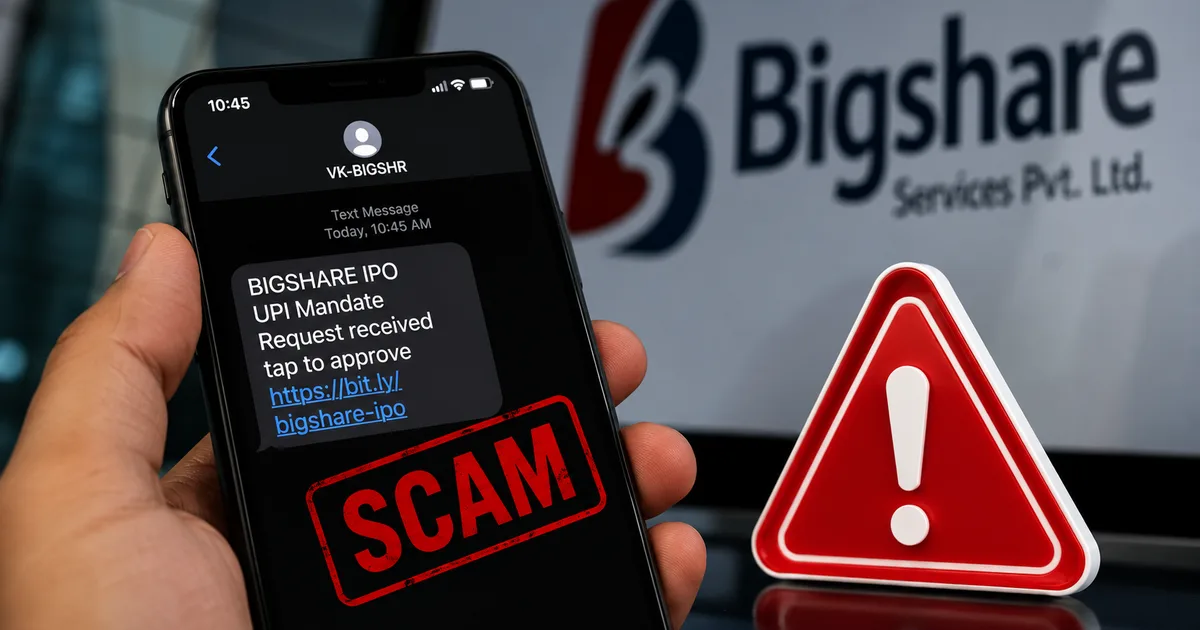
It's an SMS from an official-looking sender ID. It says your UPI mandate failed and your allotment for the recent IPO is canceled unless you re-verify immediately. Your heart sinks. Honestly, nobody wants to lose the chance at a massive listing gain. So you click the link. That one click is exactly what the scammers want. (In my experience, panic makes us all do dumb things.)
How the mandate scam actually works
Basically, the entire operation is built on timing. Scammers track the IPO calendar religiously. They know exactly when Aritas Vinyl or Enviro Infra Engineers opens for subscription. And they know the exact date Bigshare Services is supposed to announce the allotment. They launch their SMS campaigns on that specific day.
The panic message
You get a text message that looks incredibly authentic. The sender ID might be spoofed to read something like AD-BGSHRE or VM-IPOALT. It's a sketchy trick. The text usually reads something like this: "Dear Investor, your UPI mandate for recent IPO application failed due to technical issues. Your allotment of 1 lot is on hold. Re-verify mandate within 2 hours to avoid cancellation. Click here: [malicious link]."
If you applied for multiple IPOs recently, you might actually be waiting for an allotment. You might even have faced genuine UPI mandate glitches in the past. It happens. Bank servers get overloaded on the last day of a popular issue, which makes sense, actually. The scammers rely on this reality to make their lie believable.
The fake portal
You tap the link. Boom, you land on a website that looks identical to the real Bigshare Services allotment status page. It has the same logo. It has the same drop-down menu for selecting the company name. It has the same input fields for your PAN or application number. (I'm not sure exactly why it's so easy to clone these sites, but it is.) You type in your details to check your status.
This is where the trap snaps shut. The site won't show your real status. Instead, it throws an error message claiming your bank rejected the UPI block. Then it prompts you to "click here to re-authorize mandate."
The account drain
When you click that button, you get redirected to your actual UPI app. Google Pay or PhonePe opens up. You see a payment request. The scammers often label this request as "Bigshare Mandate Verification" or "IPO Block." But look closely at the amount. It isn't a block. It is a direct money transfer request.
Sometimes they ask for the exact IPO lot size, like Rs 14,400 or Rs 15,000. Other times they ask for a small test amount like Rs 10 to "verify your account." So you enter your UPI PIN. The money leaves your account instantly. It goes straight to the scammer. There is no mandate. There is no allotment. Your money is gone.
The role of grey market premium hype
You can't ignore how much the grey market premium drives this fraud. When an SME IPO like Caliber Mining shows a strong premium, people lose their minds. The greed takes over. You start calculating your profits before the shares even hit your demat account.
Scammers watch the same grey market websites you do.
They know exactly which IPOs have the highest premiums. They specifically target applicants of those high-GMP issues. When you think you're about to double your money in three days, your critical thinking skills drop significantly. You're far more likely to believe a message that says your allotment is in jeopardy because the fear of missing out is so intense.
This is why you have to detach your emotions from the allotment process. It's a lottery system. If you get it, great. If not, the money gets unblocked. There's absolutely no scenario where acting frantically on a text message will secure your shares. I think people forget this too often.
Red flags you should never ignore
Honestly, spotting this fraud is easy once you know what to look for. But panic blinds us.
- Registrars do not send SMS threats. Bigshare Services, KFintech, and Link Intime will never text you threatening to cancel your allotment if you don't click a link in two hours. They just don't operate that way.
- The URL is always wrong. The official Bigshare portal is bigshareonline.com. Scammers use weird variations like bigshare-allotment-update.in or random URL shorteners. Always look at the address bar.
- UPI mandates do not work like this. If a mandate fails during the application process, your broker app will notify you. Once the issue closes, you cannot fix a failed mandate. The allotment process is already running. SEBI rules do not allow late mandate verifications.
- You only enter your PIN to send money. Never enter your UPI PIN to check a status, receive a refund, or verify a block after the issue closes. A genuine UPI mandate request explicitly shows that it is a mandate creation, not a direct payment.
This tactic isn't limited to just Bigshare. We're seeing identical strategies used everywhere. The Fake KFintech IPO Allotment Link SMS Scam 2026: Protect Your Demat Account follows the exact same playbook, just with a different registrar's name slapped on it.
Verifying the real Bigshare services website
I see people falling for fake domains all the time. The scammers are getting incredibly good at cloning websites. They copy the HTML. They copy the CSS. They copy all the images. But they can't fake the actual domain name.
Before you enter your PAN or application number anywhere, look at the address bar at the top of your browser. The official website is exactly bigshareonline.com. Not bigshare-ipo.com. Not bigshareonline.in.net. If there are extra dashes, weird extensions, or spelling mistakes, close the tab immediately. It's a mess.
And check for the lock icon. But don't rely on it entirely. Many people think a padlock in the address bar means the site is safe. That's outdated advice. Anyone can get a free SSL certificate now. A padlock just means your connection to the scammer is encrypted. It doesn't mean the site is legitimate.
Sometimes the fake portal goes a step further. After stealing your money, they ask you to upload your Aadhaar card or link your DigiLocker account to 'process the refund'. Don't do this. They're building a full profile to take out loans in your name. (Annoying, I know.)
Steps to protect your bank account
Look, you have to change how you handle IPO communications. The current system is full of holes that scammers exploit.
Stop checking your allotment status through links in text messages or emails. Just stop. It's a bad habit that will eventually cost you money. When allotment day arrives, go directly to the registrar's official website by typing the address into your browser. Or check the status on your stock broker's app. Zerodha and Groww update the allotment status directly in their interfaces. So does Upstox.
Check your bank account directly. If you want to know if you got the allotment, log into your banking app. See if the blocked amount has been debited or unblocked. That's the only absolute proof. If the money is gone, you got the shares. If it is unblocked, you didn't. You don't need a third-party website to tell you this.
Educate your older relatives. Senior citizens are diving into the IPO market right now. They're far more likely to trust an official-sounding text message. Sit down with them. Explain how UPI mandates actually work. Show them the difference between a payment request and a mandate block.
If you spend a lot of time in investing groups on WhatsApp or Telegram, be extremely careful. Scammers infiltrate these groups and post fake allotment links. They know everyone is desperate for updates. The numbers here are a bit fuzzy, but the scale of this is huge. We detailed how this works in our report on the Fake MV Electrosystems IPO Allotment Link WhatsApp Scam 2026: Protect Your Bank Details.
What to do if you already clicked
If you entered your PAN or DP ID on a fake site but didn't enter your UPI PIN, you're mostly safe from immediate financial loss. But the scammers now have your data. They'll likely target you with more sophisticated phishing calls in the future. Stay alert.
If you actually entered your UPI PIN and lost money, you need to move fast.
First, open your UPI app and block the transaction if possible. This is rarely successful. Next, call the national cybercrime reporting helpline at 1930 immediately. Don't wait. The faster you call, the higher the chance they can freeze the scammer's destination account before the money is withdrawn. If you ask me, calling 1930 is your only real shot.
When you call 1930, you need your bank account number and the transaction reference number. You also need the exact time of the fraud. The operator will file an immediate freeze request with the destination bank. This system works. But only if you call within the first few hours.
After calling, file a detailed formal complaint on the official government portal at cybercrime.gov.in. Keep all screenshots of the SMS, the fake website, and the transaction details. You'll need these for the police report and your bank.
According to RBI guidelines, if you report unauthorized transactions immediately, your liability can be limited. But because you technically authorized the payment by entering your UPI PIN, banks often fight these claims. That makes prevention your best defense.
Call your bank's customer care and report the unauthorized transaction. Ask them to block your UPI ID and any linked debit cards just to be safe. You can always issue new ones later.
I highly recommend reading the latest advisories from CERT-In. They constantly update their guidelines on dealing with UPI fraud and securing compromised devices. You can find more general security advice in our Scam Alerts & Safety hub.
The IPO market is a great way to build wealth if you're smart about it. Don't let a moment of panic ruin your financial progress. Slow down. Verify everything. Never let an SMS dictate your actions.