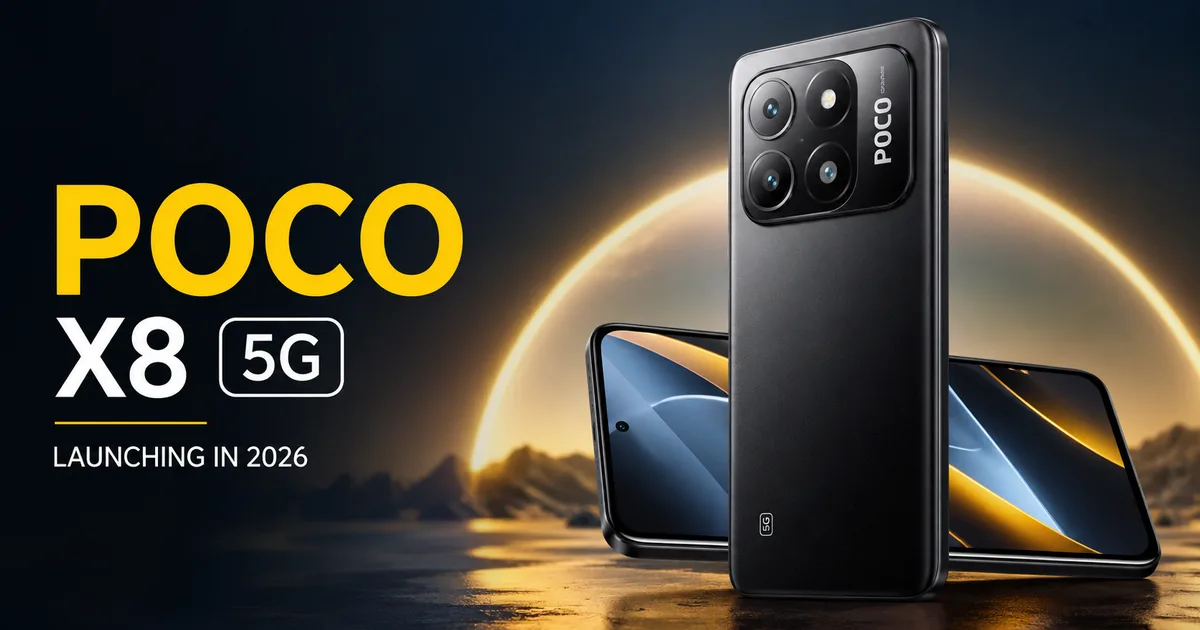
You probably heard the rumours, and yes, they're mostly true. The Poco X8 5G India launch 2026 is officially happening on September 4, and the specs are frankly a mess. I've been tracking smartphone batteries for years, and we're finally hitting that point where manufacturers are just showing off. We're looking at a 9,000mAh battery on the standard model and a ridiculous 10,000mAh cell on the Power variant.
Honestly, I'm torn on this.
Having a phone that can easily survive a three-day train journey from Delhi to Kerala without touching a power bank sounds amazing. But my wrists are already complaining about the weight. Let's break down what Poco is actually giving us here. There's a lot more to these phones than just massive batteries glued to a screen.
Our entire lives run on our phones now. Think about it. You need enough juice for UPI payments at the local tapri or showing your Aadhaar via DigiLocker at the airport. You also need it for streaming Hotstar during your metro commute. Battery anxiety is a real Indian problem. Especially when those summer power cuts hit without warning (annoying, I know). So maybe Poco is actually onto something here by just brute-forcing the problem with bigger cells. I think it makes sense.
Poco X8 5G expected price and positioning
Based on multiple tipster leaks this week, the standard Poco X8 will likely hit the shelves between Rs 28,000 and Rs 30,000. The bigger Poco X8 Power is expected to be around Rs 35,000.
This pricing strategy makes a lot of sense. Right now, Poco has a sketchy gap in their lineup. Their M-series handles everything under Rs 25,000. Then there's a massive jump to the X8 Pro which starts at Rs 39,999. They desperately needed something in the middle. If you're shopping in this segment, you might want to check out the Redmi Note 17 Pro 5G India launch to see how the sister brands compare.
Thing is, at Rs 30,000, the standard X8 is entering a very crowded market. Indian buyers expect premium cameras or fast charging at this price point. Poco seems to be betting that sheer endurance is the deciding factor. People are tired of charging their phones twice a day. They aren't trying to win the spec sheet war on every single front. They just want to win the battery war completely.
Poco X8 AI camera features and design language
Let's talk about the design first. Poco is doing something interesting here. The standard X8 has a dual-tone orange finish with a smaller rectangular camera module. It looks aggressive. That is entirely on brand for them.
The camera setup on the base model is actually quite practical:
- A 50MP primary sensor with optical image stabilisation (OIS)
- A 16MP front-facing selfie camera
- Dual-certification (likely meaning some form of specialized tuning, though they are keeping the exact details quiet)
I'm glad they included OIS. A 50MP sensor is useless if your hands shake while taking night shots. The AI camera features baked into HyperOS 3 are expected to handle heavy scene optimization. This helps a lot in high-contrast Indian lighting conditions. Think bright sunlight washing out faces in group photos. The AI software usually compensates for that by blending multiple exposures instantly. It also handles edge detection for portrait mode much better than older algorithms. They're leaning hard into AI to process images quickly without draining the battery.
The X8 Power goes a different route aesthetically. It has a yellow finish with a massive "Power MAXXING" tagline and a square camera module. It also upgrades the front camera to 32MP and adds an 8MP ultrawide on the back. That is great for group shots during Diwali or family weddings. I'm not sure exactly why they went with the massive tagline, but it works.
The 9,000mAh battery: Who actually needs this?
Look, a 9,000mAh battery is no joke. The base Poco X8 pairs this with 67W wired charging. It will probably take just over an hour to go from zero to full. That is perfectly acceptable when the battery lasts two or three days. You also get 22.5W reverse charging.
(I know, reverse charging sounds like a gimmick, but try using it to charge your TWS earbuds when you're stuck in Bangalore traffic. It's an absolute lifesaver.)
The X8 Power bumps this up to a 10,000mAh cell. It has 100W charging and 27W reverse charging. Poco claims it gets 3.5 days of battery life. I'll believe that when I see it in real-world testing. But the math roughly checks out. If you're comparing this to other upcoming phones, it makes the batteries in the OnePlus 14 India launch look tiny.
But there's a catch. A 10,000mAh battery is heavy. Really heavy. If you read the latest tech news regularly, you know that phone weights have been creeping up. This one might feel like carrying a literal brick in your pocket. This phone is clearly aimed at heavy users or cab drivers. Anyone who hates battery anxiety will love it. For the rest of us, it might be overkill.
Display and processor specifications
Both phones have very solid screens.
The base X8 has a 6.83-inch 1.5K AMOLED display with a 120Hz refresh rate. What actually caught my attention is the peak brightness. Up to 3,500 nits. This means you won't be squinting to read WhatsApp messages when walking under the afternoon sun in Delhi. That brightness is usually reserved for flagship phones.
For protection, they're using Gorilla Glass Victus 2. This is premium tier glass on a mid-range phone. It won't survive a drop from a second-floor balcony. But it handles everyday pocket scratches from keys and coins much better than older glass. In my experience, you still want a screen protector anyway.
Performance is where the two models split significantly. The standard X8 gets the Snapdragon 6s Gen 4. Leaked AnTuTu scores put it around 829,000 points. That's plenty of power for everyday apps or multitasking. You get LPDDR4X RAM and UFS 3.1 storage.
The X8 Power steps up to the Snapdragon 6 Gen 5. It is paired with faster LPDDR5X RAM and UFS 4.1 storage. If you play heavily demanding games like BGMI or edit video on your phone, this is the one you want. The faster storage alone makes app loading noticeably quicker.
Network connectivity and cooling systems
When you pack a processor and a massive battery into a chassis, heat management becomes a real problem. Especially in India, where ambient temperatures can easily hit 40 degrees in summer. Poco usually includes large vapor cooling chambers in their X series. I expect nothing less here. They need to dissipate heat quickly. Otherwise that 100W charging is going to throttle down to 30W just to keep the phone from melting.
And on the network front, both devices support comprehensive 5G bands for India. Whether you're on Jio's standalone network or Airtel's non-standalone 5G, you should get seamless connectivity. The Snapdragon modems are generally very reliable for holding onto signal in patchy areas. This is a big deal if you commute daily on trains.
HyperOS 3 and the software experience
We need to talk about software. Xiaomi and Poco have completely moved away from MIUI. Both these phones will launch with HyperOS 3 out of the box.
HyperOS is significantly lighter and less bloated than the old MIUI days. The animations are smoother. Background task management is much less aggressive. This means your apps will actually stay open in the background instead of reloading every time you switch back to them. I've noticed fewer pre-installed spam apps recently. This is a massive relief for anyone who hates constant unwanted notifications.
Poco is also promising a solid software commitment. The exact number of Android version updates hasn't been officially confirmed yet. The numbers here are a bit fuzzy, honestly. We're expecting at least two major Android updates and three years of security patches. That's the bare minimum these days for a phone in the Rs 30,000 bracket.
Poco X8 Power 5G release date and availability
Poco India confirmed the official launch happens on September 4, 2026, at 12:00 PM IST. You'll be able to buy it on Flipkart.
Poco India, a subsidiary of Xiaomi, is gearing up for a smartphone launch this September. The maker teased new X series phones, the X8 5G and X8 Power 5G, set to launch on September 4, 2026.
I'd expect the actual sale to start a week after the announcement, probably around September 11. They'll likely push some bank offers with HDFC or ICICI cards to bring the price down by Rs 1,500 or Rs 2,000 during the first few days. Keep an eye out for exchange bonuses too. Poco usually gives aggressive trade-in values to push early sales.
The real competition: Realme P4 Power
Poco isn't the only brand playing the massive battery game. The Realme P4 Power is their most direct rival right now.
Basically, the Realme phone already exists in this space. It has a 10,001mAh battery with 80W charging. It also uses the MediaTek Dimensity 7400 Ultra. It has a 144Hz screen compared to Poco's 120Hz. If you check our tech explainers, you'll see that Dimensity chips are really good at managing heat during long gaming sessions.
So which one do you pick? It basically comes down to charging speeds and software preference. Poco gives you slightly faster 100W charging on the Power model and HyperOS 3. Realme gives you a slightly smoother screen and a MediaTek processor. If the Poco X8 Power launches at Rs 35,000 as expected, buyers will have a tough choice to make.
The Poco X8 series is a highly targeted product. It's built for heavy users or frequent travellers. People who just hate having battery anxiety will love it. If you don't mind a bulky phone, the September 4 launch is definitely one to watch.