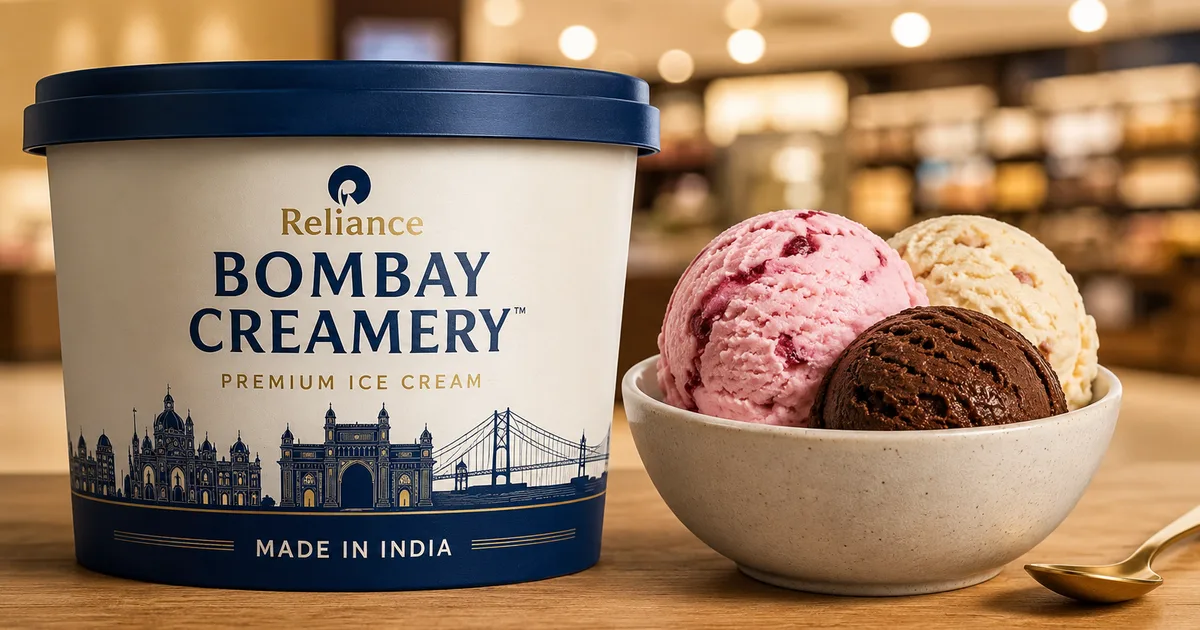
Look, if you live in India, you already know the Ambani playbook. They find a massive market, strip away the premium pricing, launch a product at a disruptive price point, and watch competitors scramble. We saw it with Jio's free data. We saw it with Campa Cola. And now the exact same strategy is playing out in your local freezer. The Reliance Bombay Creamery Ice Cream 2026 launch is official. Mukesh Ambani's FMCG arm just dropped a brand new ice cream line starting at literally 10 rupees.
The business strategy behind this is fascinating. A 10-rupee cone looks simple. But there's a massive supply chain and tech story hiding behind that price tag.
The real dairy versus frozen dessert war
To understand why this launch matters, we have to talk about what you're actually eating when you buy cheap ice cream in India.
Have you ever looked closely at the wrapper of a 10-rupee or 20-rupee treat? Half the time, it doesn't even say "ice cream" on the front. It says "frozen dessert" instead. Honestly, the Food Safety and Standards Authority of India has super specific rules about this stuff. For a product to legally call itself ice cream, it has to be made with actual dairy fat from milk or cream.
If a company replaces that dairy fat with cheaper vegetable oils like palm oil, they have to label it a frozen dessert. Brands do this because vegetable oil is way cheaper than milk fat. It completely changes their profit margins. So when you buy a cheap treat on a hot day, you're usually just eating flavored, frozen palm oil (gross, I know).
Reliance is making a deliberate point here. They're heavily marketing Bombay Creamery as being made with real dairy cream. And offering actual milk fat at the 10-rupee price point is aggressive. They're forcing the competition to match the quality or risk losing their market share to a better product.
Decoding the 10-rupee pricing strategy
Let's talk about the numbers.
Ten rupees is a magical price point in India.
It's the spare change in your pocket. It's the price of a cutting chai. Basically, it's a price that requires zero hesitation. Reliance Consumer Products Limited is pushing this under their 'Global Quality at Affordable Price' banner. They're launching with all the standard formats you'd expect. We're talking about cups, cones, sticks, and tubs.
T Krishnakumar, the Director of RCPL, explained their angle clearly on September 1.
"We built Bombay Creamery around one simple idea that dairy shouldn't need shortcuts. RCPL is not just entering the ice cream category, we're committing to it. Made with real dairy cream, Bombay Creamery guarantees the promise of genuine taste of a real ice cream every single time, at a price every Indian family can afford."
This is a direct shot at the frozen dessert market. In my experience, they're just saying you don't need to compromise on quality just because you only have a 10-rupee coin.
How Reliance is building its FMCG empire
You have to look at this in the context of what Reliance is doing overall. They're systematically attacking every aisle in the kirana store.
First, they bought Campa Cola. They priced it aggressively to take on Pepsi and Coca-Cola. They introduced a massive 2-liter bottle for the price of a standard 1.25-liter bottle from the competition. It was a brutal volume play. That move forced the established giants to slash their prices locally just to keep their products on the shelves. Now they're going after the massive summer market with ice cream. They're doing this through RCPL, which is the fast-moving consumer goods arm of Reliance Industries. If you've been keeping up with the latest tech news, you know that Reliance has the logistics network to pull this off. Selling ice cream is actually really hard. You need a completely unbroken cold chain.
The product has to travel from a factory to a regional distributor to a local kirana store without ever melting once.
Reliance already has JioMart and thousands of Reliance Smart stores. They have the supply chain infrastructure mapped out. They can just use their existing trucks and warehouses to move ice cream efficiently. This gives them a massive advantage over a new startup trying to enter the market. You can read more about their corporate growth in our piece explaining the Reliance Industries Q1 2026 results and how their ecosystem is expanding.
The kirana ecosystem and digital payments
Let's talk about how you actually buy things at the local kirana store today. Five years ago, a 10-rupee ice cream was a cash transaction. You handed over a coin. Today, you scan a QR code and pay with UPI.
The digitization of the Indian retail sector has completely changed the game for companies like Reliance. When you buy that Bombay Creamery cone and pay via PhonePe, Google Pay, or Paytm, you're generating data. And Reliance is deeply integrated into the digital payment ecosystem with Jio Financial Services. They understand consumer spending habits better than almost anyone else in the country.
They can track exactly which PIN codes are buying the most ice cream on a Tuesday afternoon. This level of granular data lets them optimize their supply chain in real time. They just shift inventory to where demand is highest.
Also, Reliance is pushing hard to digitize kirana stores with their JioMart partner program. They provide point-of-sale machines and inventory management software to small shop owners. If a shop owner is already using Reliance's software to manage their business, it's incredibly easy for Reliance to push their own products into that shop's inventory. They can offer bundled discounts. Buy a certain amount of Campa Cola, get a discount on Bombay Creamery stock. The older dairy brands simply don't have this kind of holistic control over the retail technology stack.
The brutal reality of cold chain infrastructure
The logistics of selling ice cream in India are notoriously a mess.
We deal with extreme summer temperatures. We have frequent power cuts in tier-2 and tier-3 cities. Plus there's terrible traffic that can delay transport trucks. Maintaining a continuous cold chain from the factory floor to the customer's hand is an engineering nightmare. Traditionally, ice cream companies have to invest heavily in providing chest freezers to kirana stores. They also have to make sure those freezers stay cold even when the power goes out. This is a massive capital expense.
Reliance has an advantage here because of their huge footprint of Reliance Smart Point stores. These stores already have power backup systems and commercial-grade refrigeration. By using their own retail network as the initial launchpad, they skip the hardest part of the cold chain puzzle. As they expand, they can just use the logistics network they've spent billions building for JioMart grocery deliveries.
The economics of the Indian dairy market
The timing of this launch is interesting from an economic perspective too. Milk prices in India have been all over the place over the last few years.
The cost of cattle feed, transportation, and processing have all gone up. This put pressure on the profit margins of traditional dairy cooperatives. When the cost of raw milk goes up, ice cream manufacturers face a tough choice. They can either raise prices (which hurts sales), or they can substitute milk fat with vegetable fat. Amul recently had to adjust prices across their product range because of rising procurement costs. The whole sector is heating up right now. Just look at the recent buzz around the Milky Mist IPO 2026. It shows how much investor appetite exists for Indian dairy and FMCG companies.
Reliance stepping into this environment with a product made of real dairy cream at just 10 rupees is a bold financial move.
They're basically subsidizing the cost of the ice cream to buy market share. They have the financial runway to sustain thin margins or even losses on this product line for years. A smaller, independent ice cream manufacturer absolutely can't afford to do this. It's a classic loss-leader strategy. The goal is to get consumers hooked on the brand and push competitors to the breaking point.
Flavors and the Indian palate
While the formats are standard, winning the Indian consumer requires more than just a good price. The Indian palate is highly regionalized when it comes to sweets.
What works in Gujarat might not work in Tamil Nadu. Brands like Havmor and Naturals have built cult followings by offering localized flavors like tender coconut, sitaphal, and roasted almond. I'm not sure exactly why, but Reliance hasn't released the full list of every flavor Bombay Creamery will offer. But entering Western India first suggests they'll target regional preferences like saffron, pistachio, and mango.
To win over Indian consumers, an ice cream brand has to deliver on several fronts:
- Provide standard, high-volume options like chocolate, vanilla, and strawberry for cost-conscious buyers and children.
- Offer premium, localized flavors that cater to regional tastes, such as saffron, sitaphal, Rajbhog, or roasted almond.
- Maintain consistent texture and quality even during the peak summer rush when local cold chains are heavily stressed by power cuts.
- Ensure the packaging stands out in small, crowded chest freezers that are typically stuffed with competing brands.
I want to see if they stick to the basic vanilla, chocolate, and strawberry trio to keep manufacturing costs low. They might also invest in complex, localized flavors. The mass-market approach usually favors the basics. But Indian consumers are increasingly demanding premium flavors even at lower price points.
Vantara Creamery is a totally different thing
There's a bit of confusion online right now. The Ambani family actually launched another ice cream brand earlier this year.
Back in May 2026, Anant Ambani's wildlife conservation project, Vantara, launched something called Vantara Creamery. Some people think this is the same thing as Bombay Creamery. It isn't.
Vantara Creamery is a high-end, artisanal ice cream positioned as a luxury product. It focuses on unique Indian flavors and nostalgia. And it launched at Jio World Drive. Bombay Creamery is the mass-market, 10-rupee product meant for the average kirana store. They're completely separate operations.
The impact on Amul, Mother Dairy, and Kwality Wall's
The Indian ice cream market is crowded and very competitive. You have giants like Amul, Mother Dairy, and Kwality Wall's. Plus there are strong regional players like Arun Icecreams in the south, Havmor in the west, and Creambell in the north.
Amul has always dominated the real milk narrative in India. They aggressively advertise that their products are real ice cream, not frozen desserts. They literally built the cooperative dairy movement in India. Reliance coming in with a real dairy product at 10 rupees is a direct challenge to Amul's stronghold. If a massive corporate entity starts subsidizing the cost of milk fat, the cooperative model is going to feel intense strain.
The regional players are going to feel the pressure too. When a company with Reliance's marketing budget decides to enter a category, they can afford to run massive ad campaigns. They can also offer better margins to shopkeepers to push their products. Kirana store owners care about margins. If Reliance offers them a better cut on a 10-rupee ice cream than the competition does, they'll put Bombay Creamery right at the front of the freezer.
Where can you actually buy it?
Right now, you might not find it in your local shop if you live in Delhi or Chennai. The initial rollout is mostly focused on Western India.
This makes sense logistically. Western India is a massive market for dairy and ice cream. It's also closer to Reliance's core operational bases in Gujarat and Maharashtra. But RCPL has confirmed they're planning a pan-India rollout soon.
It'll probably hit Reliance Smart Superstores and JioMart first. That's simply because they control those retail channels. Getting a freezer into an independent kirana store takes time, but they definitely have the distribution muscle to do it.
Why this is a tech and logistics story
I write tech explainers for a living, so you might wonder why I care about ice cream. I care because modern FMCG is basically a tech game.
Scaling a perishable product across India requires serious data analytics. You have to predict demand based on local weather patterns. You need IoT sensors in your delivery trucks. This ensures the temperature never drops below freezing. You also need a massive digital backend to manage inventory across hundreds of thousands of small shops (which makes sense, actually).
Reliance is applying the same data-driven approach they used for Jio's telecom network to the FMCG market. They know exactly what consumers are buying through their JioMart data. They know the price points that trigger purchases. Basically, they're using data to build consumer products.
If you ask me, the next few years in the Indian FMCG space are going to be chaotic for the established brands. When you have a player willing to squeeze margins to near zero to get customers, the old rules of retail just stop working. We'll have to see if the taste actually lives up to the marketing hype. A 10-rupee price point is great. But Indian consumers are picky about their sweets. If they manage to deliver a genuinely creamy, good-tasting product for ten rupees, the competition is in trouble.