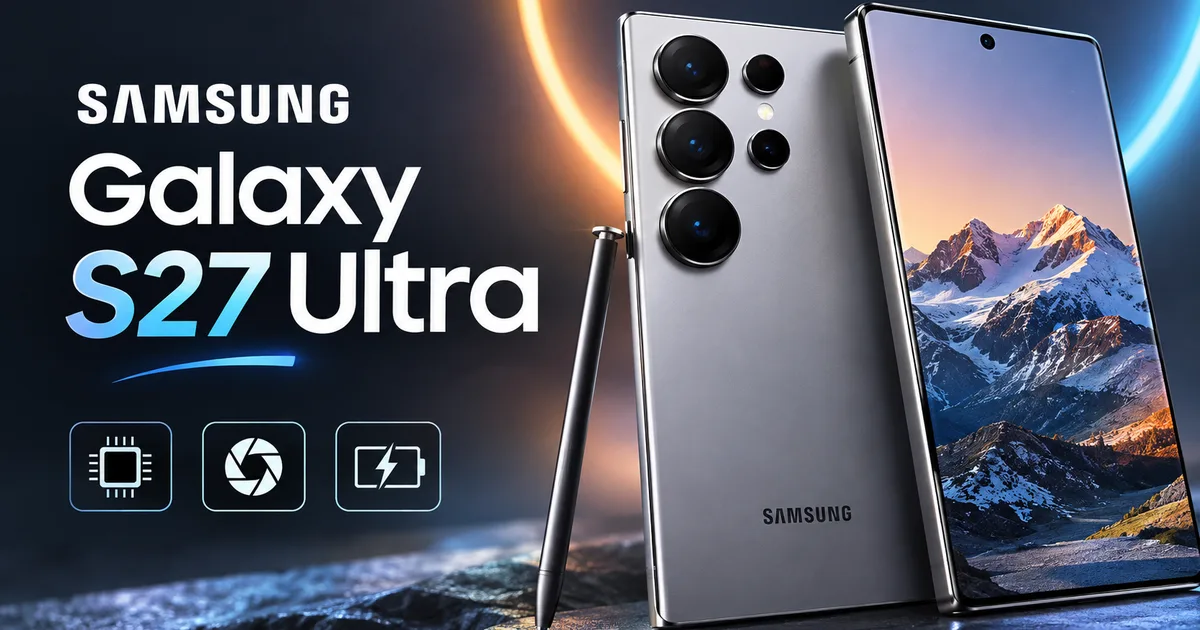
If you've spent any time shopping for a premium phone over the last two years, you already know the pattern: minor camera tweaks and a price tag that creeps closer to the ₹1.5 lakh mark every single cycle. Now, fresh regulatory filings and trade manifests around the Samsung Galaxy S27 Ultra suggest Samsung wants to change that rhythm for its early 2027 flagship lineup. The device has surfaced across European trade databases and physical factory dummy models, giving us a dependable look at what is changing under the hood.
I spent the morning digging through trade manifests on the NBD platform and regulatory listings from Safety Korea. Honestly, this is one of the more practical hardware updates Samsung has planned in years. If you ask me, the company finally seems focused on fixing physical annoyances that have bugged owners since 2024, rather than merely chasing synthetic benchmark numbers (annoying, I know). You can keep track of these shifts in our latest consumer tech news hub as more certification data drops.
Between a bigger battery and a revised rear camera bump, the upcoming flagship looks ready to fix real everyday complaints. But there's also the question of price. It never seems to go down.
A practical camera bar redesign that fixes wireless charging
Anyone who's used an S25 Ultra or S26 Ultra with magnetic wireless accessories knows the frustration. It's a mess. The floating camera rings look neat on a billboard, but they take up way too much vertical room on the glass. Magnetic Qi2 chargers and power banks constantly bump into the lens rims. That bad contact causes uneven heating and slower charging speeds.
Dummy chassis units built from leaked factory CAD files show a distinct camera bar redesign that pushes the sensor island higher up on the back panel. Nokiamob and Android Headlines both reported on these physical models. They confirmed that the entire camera island sits inside a unified, raised housing instead of separate isolated rings.
The physical measurements from these CAD models come out to 163.76 mm tall and 78.25 mm wide, with a depth of 7.97 mm. For comparison, the S26 Ultra is 163.6 mm by 78.1 mm, with a 7.9 mm thickness. So the footprint is practically identical.
What changes is where the bulk sits. By shifting the sensors upward, Samsung creates clean clearance across the lower two-thirds of the back panel. That leaves plenty of room for Qi2 magnetic pucks and car mounts to snap on flat without resting crooked against a camera bezel.
The dummy also shows that the S Pen slot stays tucked into the bottom left corner. Samsung was never going to kill the stylus. But seeing the physical silo confirmed on CAD shells puts that worry to rest.
"The revised camera bar places the sensors higher on the rear panel, leaving more unobstructed space below the module for magnetic accessories and Qi2 charging pucks." (Nokiamob hardware report)
There's another practical upside here. In my experience, desk wobble is infuriating. Sticking the cameras inside a wider bar helps steady the phone on a table. The aggressive wobble from older floating lens layouts made typing on a flat desk annoying unless you slapped on a thick case.
Processor split: Snapdragon 8 Elite Extreme or Exynos?
For years, Indian buyers have played silicon roulette with Samsung. One year we get Snapdragon. The next year we get Exynos. Forums inevitably melt down over thermal throttling and battery drain.
European import-export records on the NBD trade platform show the exact chipset assignments for the S27 lineup:
- The standard Galaxy S27 (SM-S952B) and S27 Plus (SM-S956B) list Samsung's 2nm Exynos 2700 processor with 12GB of RAM.
- The newly introduced Galaxy S27 Pro (SM-S957B) lists Qualcomm's SM8950, known commercially as the Snapdragon 8 Elite Gen 6.
- The top-tier Galaxy S27 Ultra (SM-S958B) lists Qualcomm's SM8975, which corresponds to the overclocked Snapdragon 8 Elite Extreme Gen 6 silicon.
Look, that's a massive relief if you plan to drop top rupee on the Ultra. TelecomTalk reported that Samsung tested regional Exynos 2700 chips to trim manufacturing costs, but NBD logs show the SM8975 for global Ultra variants. In recent years, Samsung has consistently given Indian Ultra buyers Qualcomm silicon, even when regular models got Exynos.
Qualcomm builds the SM8975 with higher clock speeds on its main Oryon CPU cores than the standard chip in the S27 Pro. That means better frame rates during long gaming sessions and snappier on-device AI tasks. If you followed our breakdown of earlier Galaxy S27 Ultra leaks, you'll remember concerns about chip parity. Well, the import data shows the Ultra gets Qualcomm's top-tier bin without shortcuts.
All four models in the NBD filings list 12GB of RAM and 256GB of storage. I'm not sure exactly why Samsung refuses to make 16GB the standard on a ₹1.3 lakh phone, but they clearly prefer saving that RAM bump for the pricier storage models.
Display and battery: privacy screen tech and a 5,700 mAh cell
The screen stays at 6.9 inches. It's a huge phone, no doubt about it. Still, the flat glass and slightly rounded frame edges make reading on it with one hand manageable enough.
Livemint reported on an interesting privacy display system planned for the panel. The technical details here are a bit fuzzy right now, but the idea is simple: you hit a toggle in quick settings, and the screen blocks side-angle viewing. If you commute on the Delhi Metro or sit in packed coffee shops, that sort of feature is gold. Entering your UPI PIN or checking your bank balance won't feel like a public performance anymore.
Then there's the battery. It's easily the best upgrade on the entire spec sheet.
Filings on the Safety Korea platform reveal a battery with model number EB-BS958DBY. That part number belongs to the Ultra, and the rated capacity points straight to a typical 5,700 mAh battery.
Think about that for a second. Samsung kept the Ultra lineup frozen at 5,000 mAh all the way from the Galaxy S20 Ultra up to the S26 Ultra. Six generations without touching nominal capacity. That's wild. A jump to 5,700 mAh, paired with the power savings on Qualcomm's Extreme silicon, should easily deliver two days of battery life under normal use.
Charging speed, though, is still conservative. Certification records show standard 45W wired charging (which makes sense, actually). Next to 80W or 100W speeds from OnePlus and Vivo, 45W looks slow on paper. But Samsung cares far more about battery longevity and heat control. That matters a lot during harsh Indian summers, where aggressive charging cooks lithium cells fast. You can read our detailed smartphone hardware explainers to understand how different thermal management profiles protect long-term battery health.
Expected Samsung Galaxy S27 Ultra price in India
Flagship pricing in India has gotten out of hand. When Samsung launched the S24 Ultra, the base 256GB model started at ₹1,29,999. Following generations quickly pushed the tag past ₹1,34,000.
Between the bigger battery and Qualcomm's steep price for Extreme chips, expect the base model to start at ₹1,34,999 or maybe ₹1,39,999.
Here is how the expected price ladder shapes up across storage variants:
- 12GB RAM with 256GB storage: ₹1,34,999 to ₹1,39,999
- 16GB RAM with 512GB storage: ₹1,49,999 to ₹1,54,999
- 16GB RAM with 1TB storage: ₹1,69,999 to ₹1,74,999
Thing is, nobody in India really pays full sticker price on day one. Samsung almost always offers ₹8,000 to ₹10,000 instant cashback on cards from HDFC and ICICI during the pre-booking window. Throw in trade-in bonuses through Cashify or Samsung Shop, alongside nine-month no-cost EMI schemes, and your actual out-of-pocket cost will likely sit around ₹1,22,000 to ₹1,25,000.
If those numbers make you wince, you're not alone. That's why options like the recent Galaxy S26 FE release exist for folks who want Samsung's software without dropping laptop money.
Samsung Galaxy S27 Ultra India launch date and availability
Samsung sticks to its winter calendar like clockwork. The company usually hosts its global Unpacked keynote between late January and mid-February.
New reports from TelecomTalk and Digit point to a late February 2027 debut. Samsung will unveil the Galaxy S27 Ultra right alongside the standard S27 and the new S27 Pro model.
Indian pre-orders will almost certainly go live the same evening the event wraps up. Samsung's official web store usually gets exclusive paint jobs like Titanium Blue and Light Pink. Open sales on Amazon India and Flipkart, as well as offline spots like Reliance Digital and Croma, should kick off about ten to twelve days later in early March 2027.
Samsung assembles its Indian market Galaxy S units at its factory in Sector 81, Noida. Putting the phones together locally under the Make in India initiative saves the company from paying the hefty 22% basic customs duty on fully imported handsets. That tax break doesn't make the phone cheap, but it keeps local pricing stable when the rupee fluctuates.
Should you wait for the Galaxy S27 Ultra?
Upgrades just aren't what they were five years ago. If you're holding an S25 Ultra or S26 Ultra, skip this one. You don't need to spend another ₹1.35 lakh. Your camera is sharp, and your screen is great. Plus, One UI updates will deliver most of the new software tricks to your phone anyway.
The math changes completely if you're holding an S22 Ultra or an old Note phone. Your battery has probably taken a beating over hundreds of charge cycles, and those curved screens from years back are still terrible for palm rejection. Moving to the S27 Ultra gives you that 5,700 mAh battery and a flat display that finally works with magnetic gear without fuss.
Basically, keep an eye on certification filings as 2027 gets closer. If Samsung sticks to that 5,700 mAh capacity and keeps Snapdragon in India, this might actually be an upgrade worth buying.