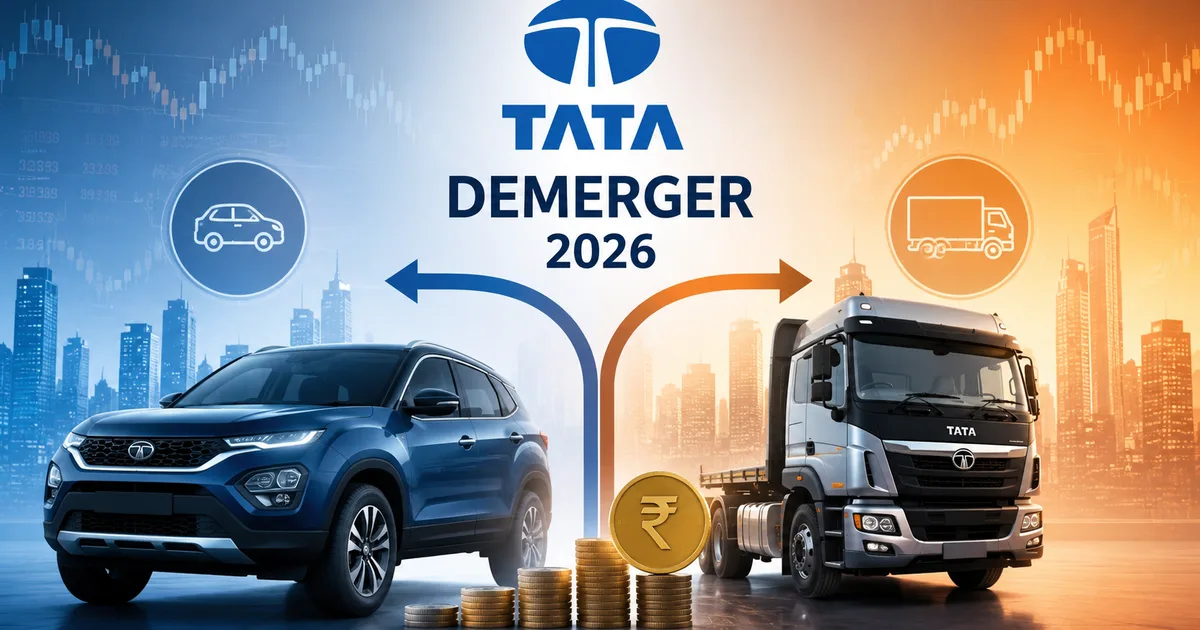
Look, if you opened your Zerodha or Upstox app recently and almost dropped your phone, I get it. Seeing a solid blue-chip stock suddenly down by 40 percent is terrifying. But before you panic sell, we need to talk about the Tata Motors Demerger 2026.
This isn't a crash. It's a planned corporate split. Tata Motors is taking its massive business and slicing it cleanly into two separate listed companies. One company handles the passenger cars you see on the roads every day. The other handles the heavy commercial trucks and buses.
I've been getting messages from friends asking if the Tata group is in trouble. They aren't. The company is just trying to unlock more value for existing shareholders. Honestly, the way the stock market handles these splits is deeply confusing for retail investors.
So I'm going to break down exactly what happened to your shares. We'll look at the 1:1 split ratio, why your commercial vehicle shares are currently missing from your portfolio, and what the tax rules look like if you decide to sell.
Why your Tata Motors shares dropped 43 percent
Let's clear up the biggest misunderstanding first. Your money didn't evaporate.
When a company demerges, its total market value gets divided between the new entities. Before this split, you held one share of Tata Motors that represented everything. It represented the Nexon EV and the massive Prima trucks.
Now, that single pie is cut into two pieces.
The stock exchanges adjusted the price of the original Tata Motors stock to reflect that it no longer contains the commercial vehicles business (which makes sense, actually). That's why the share price dropped from around Rs 900 to below Rs 450. The missing value is going to show up in your account as shares of the new commercial vehicle company.
It's simple math. The record date for this split was October 14, 2025. If you held Tata Motors shares in your demat account on that day, you're eligible for the 1:1 split.
For every one share of Tata Motors (face value of Rs 2) you owned, you get one share of the new Tata Motors Passenger Vehicles (TMPV). And you also get one share of TML Commercial Vehicles (TMLCV). Both have a face value of Rs 2.
Where are my commercial vehicle shares?
This is the part making people nervous. The passenger vehicle business started trading under the new ticker TMPV on Friday, October 24. You can see it in your trading app right now. But the commercial vehicle shares are nowhere to be found.
Here's the situation. Demergers take time to fully execute on the Indian stock exchanges. While TMPV is already trading, TMLCV is going to take another 45 to 60 days to officially list.
The shares are credited to your demat account in the backend. You just can't trade them yet. They won't show a live market price until the listing day. This is standard procedure for the BSE and NSE, but brokers really do a terrible job explaining this to regular people.
Don't stress about the missing shares. Just wait a couple of months.
The logic behind splitting cars and trucks
You might be wondering why they bothered to do this at all. Honestly, it makes a lot of sense when you look at how these businesses actually operate in India. Building and selling passenger cars is a completely different game from selling commercial trucks. In my experience, mixing them just causes headaches.
The passenger vehicle side is all about consumer trends and flashy features. Tata is aggressive here. If you look at our recent coverage on the Tata Curvv EV 2026, you can see how much they're investing in battery technology and premium design. They're fighting Hyundai and Maruti Suzuki for every single sale.
Commercial vehicles operate on macro-economic cycles. Truck sales depend on government infrastructure spending and freight rates. A fleet operator buying 50 trucks doesn't care about ambient lighting. They care about fuel efficiency and payload capacity.
By separating them, the management teams can focus entirely on their specific markets. Investors can also choose which business they actually want to own. Maybe you love the EV story but hate the cyclical nature of truck sales. Now you have the option to just buy TMPV.
"The demerger will help both companies operate with greater agility and accountability. They have different capital requirements and growth profiles."
That's exactly what market analysts are saying across the board. Financial firms like CLSA already initiated coverage on the new structure with positive outlooks.
Tax traps and the PV-loss CV-gain twist
We need to talk about taxes. The Income Tax Department always gets its cut.
The actual event of the demerger is tax-neutral. You don't owe any capital gains tax just because the shares split and appeared in your account. The tax liability only triggers when you actually sell the shares.
But calculating your purchase price for the new shares is tricky.
The cost of your original Tata Motors shares is split between the TMPV and TMLCV shares based on a specific ratio determined by the company. You'll need this ratio to calculate your long-term or short-term capital gains when you eventually sell. I'm not sure exactly why they don't just print it on the statement, but you have to look it up.
News18 recently interviewed some folks who are warning about a strange scenario right now. Because of how the market values the two businesses, some investors might end up showing a capital loss on their passenger vehicle shares while sitting on a massive capital gain for their commercial vehicle shares.
If you sell them at different times, this could severely mess up your tax planning for the financial year. I strongly recommend talking to a chartered accountant before you dump one set of shares and keep the other. It can get sketchy.
If you're looking for more deep dives into complex financial topics, we have a whole section of Tech Explainers you should check out. We recently covered the HSBC International Funds SIP Reopening 2026 which has a lot of Indian mutual fund investors confused as well.
What happens to Jaguar Land Rover?
Jaguar Land Rover (JLR) is the massive British luxury carmaker that Tata Motors bought years ago. It brings in a huge chunk of their total revenue.
Under the new structure, JLR sits inside the passenger vehicle company, TMPV. This makes the passenger vehicle stock heavily dependent on global luxury sales. If the economy in Europe or China slows down, JLR feels the pain. And that will drag down TMPV.
You aren't just betting on Indian car buyers. You're betting on rich people in London and Beijing buying Range Rovers (annoying, I know).
How the market is reacting to the demerger
The initial reaction has been volatile. When a stock price gets cut in half mechanically, algorithms and retail investors sometimes panic. This leads to weird price movements in the first few days of trading.
But the underlying business hasn't changed. Tata Motors is still selling the same number of cars and trucks today as they were the day before the split.
I think this split is going to be good for the company in the long run. The commercial vehicle business is a cash cow. It generates steady money. The passenger vehicle business requires massive investments in electric vehicle platforms and software. Keeping them together meant the truck profits were constantly subsidising the car division's R&D costs.
Now, both companies have to stand on their own.
If you're holding the shares, the best thing you can do right now is absolutely nothing. Let the dust settle. Wait for the commercial vehicle shares to officially list on the exchanges in December or January. Once both stocks are trading normally, you can evaluate their individual performance and decide if you want to keep them. Panic selling because your portfolio tracking app shows a 40 percent loss is the worst financial decision you could make this week.
This is just the reality of investing in Indian equities sometimes. Corporate actions like splits and demergers create temporary chaos. The paperwork is annoying. The tax calculations get more complicated. Your trading app looks like a mess for a month.
But the actual value of your investment remains intact.
The Indian commercial vehicle market is going through its own massive transition right now. We're seeing a push towards LNG and electric buses for public transport. Tata has been winning state transport contracts left and right for electric buses. That entire operation falls under TMLCV.
When you look at the infrastructure push happening across India and the new highways, TMLCV is positioned right in the middle of it. It's an infrastructure play as much as it is an automotive stock.
On the flip side, TMPV is fighting a fierce battle in the passenger segment. Mahindra is breathing down their necks in the SUV space. Maruti Suzuki is finally waking up to the EV threat. Tata's early lead with the Nexon EV is under attack from all sides. So TMPV is going to need a lot of cash to stay competitive. They have to build new EV battery plants and keep refreshing their car models faster than before.
By separating the two, investors who just want the steady, predictable returns of the commercial truck business don't have to worry about the capital expenditures required to build the next generation of electric SUVs. And investors who want high-growth exposure to the Indian consumer market can buy TMPV without having their returns diluted by the slower-growing truck business.
I've spoken to a few retail investors who are annoyed by the extra work this creates. Now you have to track two different earnings calls, read two different annual reports, and manage two different sets of tax calculations. Yes, it's a headache.
But if it results in better capital allocation by the management, it should translate to better shareholder returns over the next five years. The numbers here are a bit fuzzy right now, but it makes structural sense.
Just remember to check your email for the official communication from the company or your depository participant like NSDL or CDSL. They'll send you a statement confirming the credit of the new TMLCV shares. Keep that email starred or saved somewhere safe. You'll definitely need it when you sit down to file your income tax returns next year.
What you need to do right now
If you're an existing shareholder, I've put together a quick checklist of things you should be doing while you wait for the new shares to list:
- Check your email for the NSDL or CDSL holding statement confirming the credit of TMLCV shares.
- Log into your broker app like Zerodha or Groww and verify that your TMPV shares are showing correctly under the new ticker.
- Download the official scheme of arrangement document from the BSE website so you have the exact cost of acquisition split ratio for your taxes.
- Do not place any sell orders for TMPV out of panic just because your portfolio shows a steep percentage drop.
I know the temptation to react to red numbers on a screen is strong. I've made that mistake myself in the past. But corporate actions require patience.
Another thing to watch out for is the dividend payout. Tata Motors recently fixed the record date for their FY26 final dividend. This is separate from the demerger action. It is another reason why you need to keep a close eye on the official communications rather than just looking at the daily stock price chart.
The financial media loves to sensationalize these things. You'll see headlines screaming about a stock crash. You'll see YouTube thumbnails with shocked faces and big red arrows pointing down. Ignore all of it.
The mechanics of the stock market can be messy. When a massive conglomerate decides to split itself in half, the plumbing takes a while to adjust. The exchanges have to update their systems. The depositories have to move digital certificates around, and the brokers have to update their user interfaces.
It takes time.
For now, the Tata Motors Passenger Vehicles stock is trading live. It includes the domestic cars and the Jaguar Land Rover business. It is a pure play on the consumer automotive sector.
The Tata Motors Commercial Vehicles stock is sitting quietly in your demat account, waiting for its turn to list. Once it does, you'll own a piece of India's largest truck and bus manufacturer.
Both of these companies have solid fundamentals. The split doesn't change the fact that they are building products people and businesses actually need.
So grab a cup of chai, close your trading app, and let the market sort out the plumbing over the next two months. You still own the exact same percentage of the underlying businesses that you did before the split.