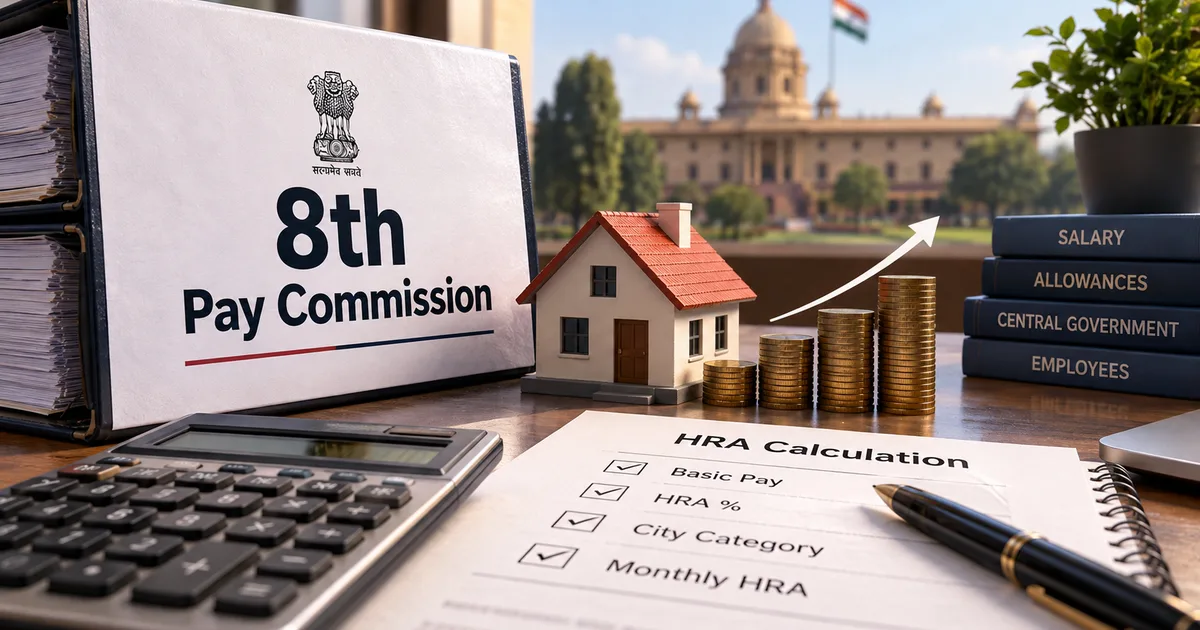
Figuring out your 8th Pay Commission HRA calculation for 2026 is probably driving you slightly crazy. I get it. We hear numbers thrown around in the news every single day. Some headlines say your salary will double. Others say you'll lose money because of delays. The truth is somewhere in the middle. So we need to sit down and look at the actual math.
Look, the transition from the 7th CPC to the 8th CPC isn't a simple copy and paste job. The government has different priorities now. And the economic landscape in India has changed. Inflation hits your wallet every single time you buy groceries or pay rent in cities like Bengaluru or Mumbai. This is exactly why House Rent Allowance matters so much to central government employees right now (which makes sense, actually).
A lot of people think a 2.0 fitment factor means their entire take-home pay just doubles.
It doesn't. Your basic pay gets multiplied, which sounds great. But allowances like HRA are calculated as a percentage of that new basic pay. If the percentage drops, your gross salary hike shrinks. That's basic math. Honestly, it catches a lot of people off guard.
The Dearness Allowance trigger explained
You might be wondering why everyone is suddenly obsessed with the 8th Pay Commission in 2026. It comes down to a specific rule about Dearness Allowance. Historically, there was an understanding that when DA crosses the 50 percent mark, the government should revise the pay structure. Well, DA hit that mark. So the employees are waiting.
In the past, crossing this DA threshold meant that certain allowances automatically bumped up. Your HRA in an X category city might jump from 27 percent to 30 percent. But the underlying basic pay is exactly the same until a brand new pay commission is officially formed and implemented.
Employees are feeling the financial pressure. Real inflation in India is just aggressive.
Food prices, school fees, medical bills, and rent in urban areas have gone up drastically since 2016 when the 7th CPC rolled out. A tiny percentage bump in HRA on a decade-old basic pay doesn't cover a new rental agreement in Gurugram today. I think the government knows this.
What the unions actually want for HRA
Before you run your own numbers, you need to know what the employee federations are fighting for. The All India NPS Employees Federation recently put forward a list of very specific demands. They aren't asking for vague increases. Instead, they have a formula based on current living costs.
They proposed the following for the new HRA slab:
- 36 percent for X category cities. These are your major metros like Delhi, Mumbai, Chennai, Bengaluru, Hyderabad, and Kolkata.
- 24 percent for Y category cities. Think places like Pune, Jaipur, Lucknow, Chandigarh, and Nagpur.
- 12 percent for Z category cities. This covers most other towns and rural postings across India.
They're also pushing for a minimum monthly transport allowance and a specific HRA for pensioners.
That last one is a big deal. Pensioners usually don't get HRA. But the rising cost of renting a house in old age is becoming a mess to ignore, especially for those who never managed to buy their own property.
The All India NPS Employees Federation has demanded HRA revision, minimum monthly transport allowance, DA hike, and salary increase for central government employees.
Honestly, these demands make sense. Anyone trying to rent a decent 2BHK in an X category city right now knows that the current HRA barely covers half the rent. Landlords increase rent by 10 percent every single year. And your government housing allowance just doesn't keep up. In my experience, it's a massive source of stress.
How HRA classification works in India
You can't calculate your HRA if you don't understand how the government classifies your city. These city categories aren't random at all. They're based entirely on population data from the census.
This creates a very interesting situation right now. The government is still relying heavily on older census data for many of these classifications. The delay in the 2021 census complicates things. If new census data is finalized before the 8th CPC is implemented, many Y category cities might suddenly become X category cities because their population finally crossed the 50 lakh threshold (which is huge).
Cities like Ahmedabad or Pune might see official boundary expansions. If you live in the developing suburbs of these cities, your posting might suddenly qualify for a higher HRA tier.
This matters. Moving from a Y city classification to an X city classification immediately jumps your HRA percentage. That's a massive pay raise without you ever getting a promotion.
The brutal cost of delaying the 8th CPC
The government is taking its time. Reports suggest the salary revision might only happen in late 2027. That delay isn't just a minor inconvenience.
It's costing you actual money right now.
A recent Livemint report broke down the numbers, and they're grim. The delay could cost lower-ranked staff up to Rs 3.45 lakh in lost HRA and transport allowance. Why does this happen? Because when the pay commission is finally implemented, the government usually backdates the basic pay arrears. But they rarely backdate allowance arrears like HRA. So you just lose those months of higher allowances forever.
This is exactly why you need to understand what the 8th CPC fitment factor actually means for your wallet. You have to plan your finances knowing that those arrears might not be as fat as you hope. And the longer the wait, the more allowance money you lose. The numbers here are a bit fuzzy, but the loss is real.
Step-by-step guide to calculating your new HRA
Grab a calculator or open the app on your phone. We'll figure out your expected HRA based on the 2.0 fitment factor and the union demands. I'll walk you through this exactly like one of our regular how-to tech guides so you don't get lost in the math.
- Find your current basic pay. Pull out your latest salary slip. Look for the exact line that says "Basic Pay". Don't look at gross pay or net pay. For a Level 1 employee, this might be Rs 18,000. For a Level 5 employee, it might be around Rs 29,200.
- Apply the expected fitment factor. Multiply your current basic pay by 2.0. Some employees hope for a 2.86 factor, but 2.0 is the realistic number being discussed by financial analysts right now. So if your basic pay is Rs 29,200, your new basic pay becomes Rs 58,400.
- Determine your city category. Are you posted in an X, Y, or Z city? This dictates your percentage. X cities are the most expensive. Z cities are the cheapest. If you just got transferred, make sure you use your new posting location for the calculation.
- Apply the proposed HRA percentage. Take your new basic pay from step 2. Multiply it by 0.36 for X cities, 0.24 for Y cities, or 0.12 for Z cities.
That final number on your screen is your expected monthly HRA under the 8th Pay Commission proposals.
Running the numbers for different pay levels
I ran a few scenarios based on the data we have today. Looking at actual numbers makes this much easier to digest.
Level 1 employee in a Z category city
Let's start at the entry level. A Level 1 employee currently has a basic pay of Rs 18,000. With a 2.0 fitment factor, the new basic pay jumps to Rs 36,000. That sounds great on paper.
Now calculate the HRA for a Z category city. We multiply Rs 36,000 by 12 percent. That gives us Rs 4,320 per month.
Under the current system, their HRA is much lower. So this is a decent jump, but it isn't going to buy you a mansion in a rural district.
Level 5 employee in an X category city
According to The Economic Times, a Level 5 employee could see a massive jump in their housing allowance.
Assume the current basic pay is Rs 29,200. Multiply by 2.0, and you get a new basic pay of Rs 58,400. Because they live in an X category city like Delhi or Mumbai, we apply the 36 percent HRA rate.
Rs 58,400 multiplied by 0.36 equals Rs 21,024 per month.
Right now, that same employee gets around Rs 7,884 for HRA using the old 27 percent rate on the old basic. The difference is huge. News reports state they could get up to Rs 15,800 per month extra HRA. This math proves exactly how that headline number was generated.
Level 8 employee looking at the long game
A Level 8 employee stands to gain a lot over the next decade. The Times of India reported that a Level 8 employee could earn up to Rs 28.89 lakh extra over 10 years just from the salary revisions.
A big chunk of that massive number comes from the revised HRA. When your basic pay is higher, every single percentage point of HRA translates to thousands of actual rupees in your bank account every month.
Why the gross salary jump feels disappointing
I need to be straight with you. A lot of government employees are going to be disappointed when they see their first paycheck under the 8th CPC. They hear "2.0 fitment factor" and assume their Rs 60,000 salary will magically become Rs 120,000.
It won't happen that way.
Right now, you get a massive Dearness Allowance on top of your basic pay. When a new pay commission kicks in, that accumulated DA is merged into the new basic pay. It essentially resets to zero. So while your basic pay doubles, your DA drops from 50 percent back to zero percent immediately (annoying, I know).
This means your overall gross salary might only go up by 15 or 20 percent in reality. If you want to see exactly how this impacts your specific grade, you can use our calculating your new basic pay guide to run your own custom numbers.
What you should do while you wait
We'll be reading latest tech news and financial updates about this for the next two years. The government will form committees. And the unions will protest. News channels will run endless evening debates about the national budget.
Don't plan your family finances around these projected numbers just yet. Don't take out a massive home loan for a flat in Noida or Gurugram assuming your HRA is going to triple next month. The banks won't care if the pay commission gets delayed until 2028. You still have to pay the EMI every month. If you ask me, that's too sketchy of a risk.
Wait for the official gazette notification. Keep an eye on the fitment factor discussions. And keep tracking the union demands. The difference between a 30 percent HRA and a 36 percent HRA might not sound like much to a politician on TV. But it pays for your electricity bill and your kid's tuition.
The 8th Pay Commission is coming. The math is clear. Just be patient and plan smartly.