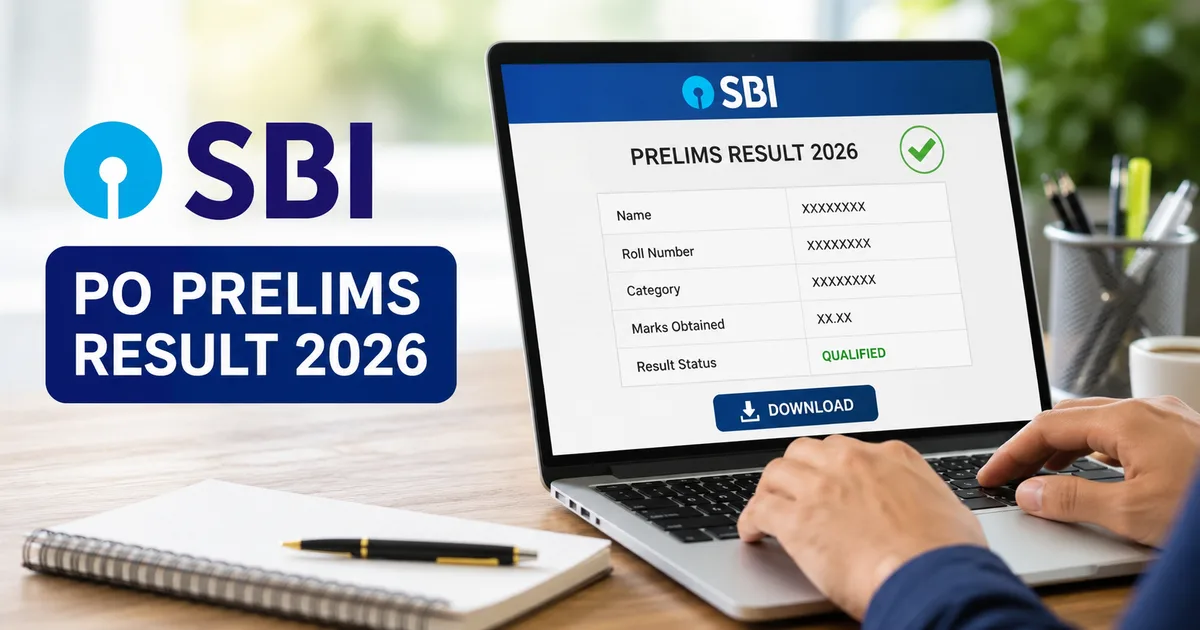
Look, if you appeared for the exams on August 1 and 2, you're probably refreshing the official website right now. The SBI PO Prelims Result 2026 is officially out for the 1,500 probationary officer vacancies. You can check it directly on sbi.bank.in or sbi.co.in.
I remember taking one of these banking exams years ago. The server inevitably crashes. It's a total mess. But this time around, State Bank of India released a roll number-wise PDF list for the shortlisted candidates. That helps. You don't always need your login credentials immediately just to see if you made the cut.
Thing is, this year's result leaves you with a very tight window. The mains examination is scheduled for September 12. That's barely any time to celebrate. So, you need to know your status immediately.
Here's how to check your scorecard, get the PDF, and understand the category-wise cut-offs.
Step-by-step guide to download your scorecard
Honestly, navigating public sector bank websites tests your patience. The SBI portal is better than most. But it still has quirks. If you're on a phone, I highly recommend switching to a laptop or desktop computer. The PDFs are huge. And the formatting often breaks on smaller screens.
Here's exactly what you need to do to check your results.
- Open your web browser and go to the official SBI careers portal at sbi.co.in/web/careers or bank.sbi/careers. Do not search for the result on Google and click random links. Stick to the official URLs.
- Look at the top right corner of the page. You will see a "Join SBI" dropdown menu. Click that.
- Under the dropdown menu, select "Current Openings". This section lists all the ongoing recruitment drives.
- Scroll down until you find the notification for "Recruitment of Probationary Officers (Advertisement No. CRPD/PO/2026-27/01)". It might be buried under a few other notices, so keep your eyes open.
- Click on the plus icon next to the Probationary Officers heading to expand it.
- You will see a link that says "Preliminary Exam Result (Roll Number wise PDF)". Click this to download the list of shortlisted candidates.
- Open the PDF on your computer. Press Ctrl+F on a Windows PC or Cmd+F on a Mac. Type in your 10-digit roll number to see if it is on the list.
- To see your actual marks and the official cut-off, look for another link in the same section that says "Download Prelims Scorecard".
- Clicking the scorecard link will take you to a login page. Enter your Registration Number or Roll Number. Then enter your Date of Birth in the DD-MM-YYYY format.
- Enter the CAPTCHA text shown in the image and click "Submit". Your scorecard will appear on the screen. Download it immediately as a PDF and print a copy.
(I know, sounds complicated. It's not. It just takes a few clicks if the server is actually responding.)
Technical fixes if the SBI website is not loading
The official website is going to be incredibly slow today. With lakhs of candidates trying to check their SBI PO Prelims Result 2026 at the exact same time, the servers are under massive strain. In my experience, they almost always crash.
If the page takes too long, don't keep hitting refresh. That just makes the server load worse.
Instead, try clearing your browser cache and cookies. Sometimes your browser loads a cached version of the page, which causes errors. You can also open an Incognito or Private window to load things fresh.
If you get a "Site cannot be reached" error, maybe change your DNS settings to Google DNS or Cloudflare. But the easiest fix is just waiting a few hours. Trying late at night or early morning works best. Internet traffic across India drops a lot by then.
Understanding the category-wise cut-off marks
So you downloaded your scorecard. The first thing you'll probably look at is the cut-off section.
A cut-off is just the minimum score to qualify for the next round. For the SBI PO exam, the prelims are purely qualifying. Your marks here don't count towards the final merit list. You just need to cross the line.
The cut-off varies every year based on a few factors. The total number of vacancies is 1,500 this time. Then there's the difficulty of the shifts across August 1 and 2. And obviously, the total number of candidates who actually showed up matters too.
Since there are negative marks for wrong answers, the cut-off rarely goes incredibly high. You lose 0.25 marks for every incorrect answer. The paper was moderately difficult based on initial candidate reports. The quantitative aptitude section was particularly sketchy.
Here's a rough breakdown of expected category-wise cut-offs this year. Keep in mind, the numbers here are a bit fuzzy. They're just estimates based on past trends and feedback, not the official final numbers.
- General Category: Around 58 to 61 marks out of 100.
- OBC Category: Expected to be between 56 and 59 marks.
- EWS Category: Similar to OBC, hovering around 56 to 59 marks.
- SC Category: Likely in the range of 50 to 53 marks.
- ST Category: Expected to be somewhere between 43 and 46 marks.
If you cleared the cut-off for your specific category, congratulations. You're moving on to the mains. If you missed it by a fraction of a mark, I know it hurts. But normalization can sometimes cause these fractional differences.
How SBI calculates marks using normalization
You might wonder how the bank ensures fairness when candidates take the exam across shifts with varying difficulty.
They use a statistical process called normalization. (Which makes sense, actually).
Basically, if your shift had a tougher quantitative aptitude section compared to someone else's, the bank adjusts the scores. This levels the playing field. They look at the average scores of candidates in each shift and apply a formula to standardize the marks.
This means your final score on the scorecard might be slightly higher or lower than your raw calculated score. It's completely normal. So don't panic if the numbers don't match the mental math you did right after the exam.
What to do if you forgot your registration details
This happens to almost everyone. You fill out the application months in advance. By the time the results roll around, the registration number is nowhere to be found.
Don't worry. You can easily recover it.
First, check your email inbox. Search for "SBI PO Registration" or emails from "ibps.in". The bank always sends a confirmation email with your registration number and password when you apply. Check your spam folder too.
Second, check your SMS messages. Search your texts for "SBI". You should have a text confirming your successful application.
If you still can't find it, go to the login page for the scorecard. There's usually a "Forgot Password" or "Forgot Registration" link. You need to enter your registered mobile number and email ID. The system sends your details straight to you. Just make sure your Indian phone number is active and can receive SMS.
While we're on the topic of documents, you might want to read our SBI PO Admit Card 2026: Step-by-Step Download Guide and Exam Day Instructions. It covers everything you need to know about carrying the right IDs for the upcoming mains exam.
Beware of fake result links and WhatsApp scams
This is a massive problem in India right now. Whenever a major exam result is announced, scammers get straight to work.
You might receive a WhatsApp message or a Telegram forward claiming to have a direct server link for your SBI PO result. These messages often include an APK file or a link to a website that looks exactly like sbi.co.in. It's a scam.
Don't click them. And definitely don't install any apps they send you.
These are phishing attempts designed to steal your login credentials or drop malware on your phone. They might ask for your Aadhaar number or UPI PIN. Sometimes they even want your bank details under the guise of verifying your identity. SBI will never ask for your bank account number or ATM PIN to show an exam result. Never.
State Bank of India never asks for your personal banking details or OTPs to check exam results. Always use the official sbi.co.in website.
Always type the URL directly into your browser. If you spot a scam, report it to the National Cyber Crime Reporting Portal at cybercrime.gov.in or call the 1930 helpline. For more tips on staying safe online, check out our other How-to Tech Guides.
Preparing for the upcoming mains exam on September 12
If your roll number is on that PDF, you need to shift gears immediately. The SBI PO Mains exam is on September 12. You have very little time to prepare.
The mains exam is a completely different format. It tests your reasoning, data analysis, general awareness, and English language skills much more rigorously. Plus, there's a descriptive paper at the end where you have to type an essay and a letter on a computer. (Annoying, I know).
Here's what you should focus on right now.
- Stop reading new books. Revise what you already know.
- Take at least three full-length mock tests before the actual exam. This will help you manage your time during the grueling three-hour test.
- Read the current affairs from the last six months, focusing heavily on banking and financial awareness. The RBI guidelines, UPI transaction limits, and recent government schemes are always tested.
- Practice typing on a standard desktop keyboard. Most of us are used to laptop keyboards or phone screens. The descriptive test requires you to type fast on a clunky, traditional keyboard in a noisy exam hall.
Using DigiLocker for your document readiness
If you clear the mains, you'll eventually face the interview and document verification rounds. It's a smart move to get your documents sorted right now.
I highly suggest setting up your DigiLocker account if you haven't already. DigiLocker is an Indian government initiative under Digital India. It lets you store digital versions of your educational certificates and your Aadhaar card. You can add your PAN card too.
You still need physical copies for the final verification at the SBI branch. But having them on DigiLocker ensures you always have a verified backup. If a physical certificate gets damaged or lost during travel, your DigiLocker copy is legally valid under the IT Act.
Just download the DigiLocker app, link it with your Aadhaar number, and fetch your class 10th and 12th marksheets from your respective education boards.
A final word on handling exam results
If you didn't clear the prelims this time, take a day off. It's perfectly fine to feel disappointed. But remember, the banking recruitment cycle in India is continuous.
You have the IBPS PO and IBPS Clerk exams lined up. There are various insurance exams throughout the year too. I'm not sure exactly why they schedule them so close together, but it gives you options. Take a look at the Latest Tech News to distract yourself, then get back to studying. The syllabus is mostly the same. Your SBI prep will definitely help you in the upcoming exams.
And keep an eye on your email for further instructions from SBI about the mains admit card.