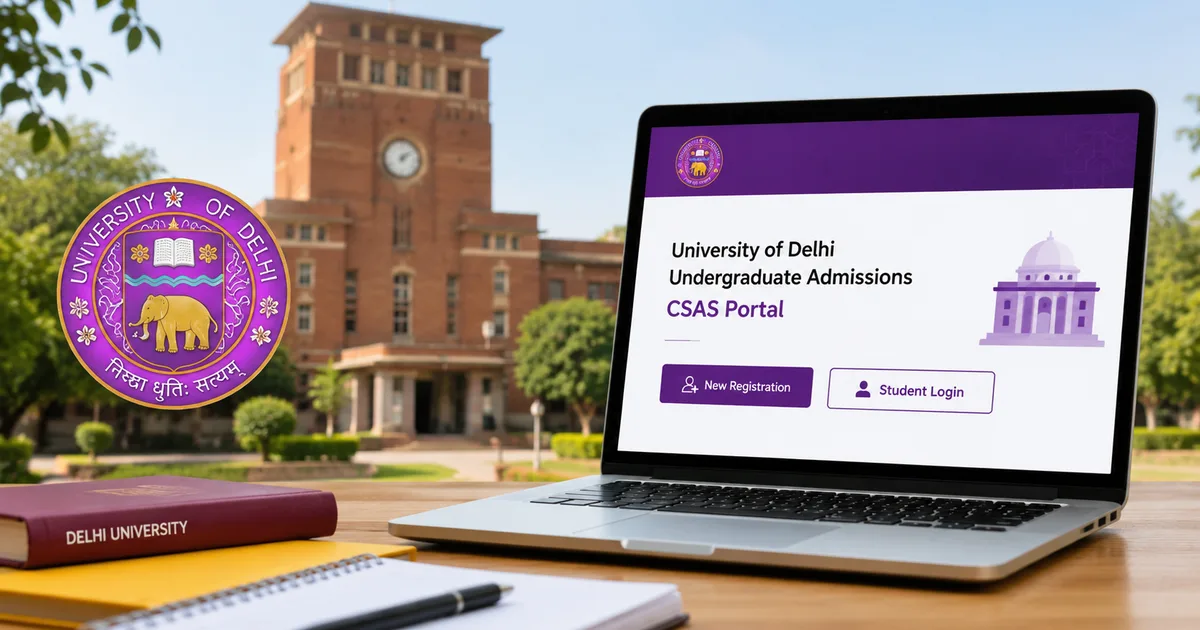
If you're a Class 12 graduate looking to secure a seat at Delhi University, you're probably feeling the heat. The summer weather in Delhi is brutal, but the sheer panic of navigating the college admission cycle is worse. The entry point to your college life is the Delhi University CSAS Portal UG 2026, which is launching this week. With over 72,000 undergraduate seats across 70-odd colleges, the competition is intense. You can't just submit a form and hope for the best. You'll need to understand how the Common Seat Allocation System works, because a single error during registration can cost you your dream college. You can read our admission guides to get a head start.
I've seen students with amazing board marks miss out on top colleges like Hindu or St. Stephen's. Why? They just messed up their forms. Honestly, it looks crazy complex on paper. But it's manageable if you go step by step. Since the new academic session starts on July 21, 2026, the university is on a super tight schedule, and you've to be quick. In my experience, if you don't know the system, you're toast.
Understanding the DU admission process and timelines
Delhi University doesn't do direct admissions based on Class 12 marks anymore. That era is long dead. It's all CUET now. But scoring high is only half the battle. The other half is the Common Seat Allocation System, or CSAS. If you ask me, this process is where students stumble. The university runs it in three phases.
So, what are these phases?
- Phase 1: Registration on the CSAS portal, where you upload your personal details and academic marks.
- Phase 2: Program and college preference filling, where you choose the courses and colleges you want to join.
- Phase 3: Seat allocation and admission, where the system allocates seats based on merit and your preference list.
Thing is, you can't skip any of these phases. Miss Phase 1? You can't do Phase 2. And if you don't fill preferences in Phase 2, you won't get a seat in Phase 3. It's a straight line. Delhi University says the portal is opening right after CUET UG results are out. Since they want classes to start on July 21, 2026, the registration window will probably be super short (which makes sense, actually). You've to stay alert and get your papers ready.
How to register on the Delhi University CSAS Portal UG 2026
When the portal opens, you've to visit the official website at admission.uod.ac.in. Don't trust random links on social media. There's always a risk of sketchy sites trying to steal your data or steal your money.
Look, the registration process isn't rocket science. But you've to focus.
First, create an account. You'll use your CUET UG application number and password to log in. The system is going to pull your name and photo from the National Testing Agency database. If there's a spelling mistake in your name on the CUET card, you can't change it here. It's locked.
Second, you'll enter your personal details. This includes your email and phone number. Make sure they're active. You'll get all updates and OTPs on this email. If you use your cyber cafe guy's email, you'll miss alerts. Honestly, I've seen this happen. It's a total mess to fix.
Third, fill in your academic details. This is where your Class 12 marks go. They've to match your marksheet exactly. Even though admissions depend on CUET scores, Class 12 marks are a tie-breaker. If two students have the same CUET score, the one with the higher Class 12 percentage gets the seat.
Documents you need before starting your Delhi University UG admissions
You can't upload just any file. Delhi University is very strict about formatting and validity. If your caste certificate is outdated, they'll reject you instantly. There's no grace period.
Here's the deal: you should pull your documents from DigiLocker if you can. It's faster and verified. You can read our educational explainers on how digital storage and government identity portals work. If you don't have DigiLocker, you'll have to upload scanned copies.
- Class 10 marksheet and passing certificate (which proves your date of birth).
- Class 12 marksheet (self-attested, unless pulled directly via DigiLocker).
- Category certificate (SC, ST, OBC-NCL, EWS, PwBD) if you're applying under a reserved quota.
- ECA or Sports certificate if you're applying through extracurricular channels.
- A valid ID proof like Aadhaar card, PAN card, or passport.
For category certificates, watch the dates. OBC-NCL and EWS certificates must be issued after March 31, 2026. Upload a 2025 certificate? The portal will reject it. You'll get pushed to the general category. And that means you might lose your seat. Honestly, getting that certificate renewed on time is the smartest thing you can do this summer.
Also, check the file sizes. PDFs and JPEGs must be between 100KB and 500KB. Don't use mobile scanners that add watermarks. Your scans must be clean.
CSAS UG registration fees and online payment
CSAS UG registration fees and online payment
Once you've filled your details and uploaded the documents, you'll have to pay the fee. The portal won't submit your form without it. And remember, this fee is non-refundable. If you decide not to join DU later, you won't get this money back.
Let's look at the application pricing:
- UR/OBC-NCL/EWS candidates: Rs 250
- SC/ST/PwBD candidates: Rs 100
- Additional fee for sports or ECA quota: Rs 100 per category
You can pay using UPI, credit cards, debit cards, or net banking. UPI or credit cards are best since they've the lowest transaction failure rates. If your payment fails and the money gets deducted, don't panic. The system usually reconciles it within 24 hours. But don't wait until the last day. If the server crashes on the final night, you'll be stranded.
Make sure you save the receipt. It's your only proof of payment if there's a dispute later.
How to enter your CUET UG score registration details
Now, let's talk about the actual scores. You don't need to manually type in your CUET UG score for each subject. The CSAS portal links directly with the NTA database.
So, how does it work?
When you log in, the portal auto-fetches your normalized scores and percentiles. And it pulls the subjects you took.
But here's the catch.
You've to map your Class 12 board subjects to the CUET papers you took. For example, if you studied Physics in Class 12, you've to map it to the Physics paper in CUET.
DU has a strict rule: you can only apply for courses where you've appeared in the corresponding subjects in both Class 12 and CUET. If you took the History exam in CUET but never studied it in school, DU won't count that score. It's a harsh rule, but they don't make exceptions.
Verify the mapped subjects carefully. If you map Chemistry to Biology by mistake, the system rejects your eligibility for BSc courses. Once you click submit, there's no going back.
Preference filling and seat allocation in DU UG admission 2026
Once Phase 1 closes, Phase 2 starts. This is where the real game of chess begins. You'll be asked to list your preferences for colleges and courses.
Don't make the mistake of listing only top colleges. If you've a score of 650 out of 800, listing only SRCC or LSR is a guaranteed way to end up with zero seats. You need a mix of dream colleges and backup choices.
Honestly, you should list as many combinations as possible. If you're eligible for 50 courses across 30 colleges, you can submit up to 1,500 preferences. Do it. There's no extra cost for listing more.
The system's going to run an allocation algorithm. It looks at your rank and preference list. If your first choice is full, it looks at your second. If that's full, it goes to the third choice.
"Candidates should fill maximum preferences to increase their chances of seat allocation. Under-filling preferences often leads to no seat allotment, even for students with decent scores." (Delhi University Admission Branch Advisory)
Once you're allocated a seat in Phase 3, you've to accept it. If you don't click that "Accept Admission" button, you'll be kicked out of the entire counseling process. You won't get another chance. After accepting, the college will check your documents online and approve the admission. Finally, you'll pay your fees online to secure your seat. You can read more about university news updates to keep track of allocation rounds.
Final tips to avoid common registration mistakes
When you're dealing with a system as massive as DU admissions, glitches happen. Don't leave everything to the last minute. So keep a digital folder on your desktop with all your scanned documents, marked with clear names like 'Class_12_Marksheet.pdf'. Avoid public computers if you can. If you must use a cyber cafe, make sure to log out and clear the browser history. Also, check the registration status on your dashboard. If the payment shows as successful and you see 'Submitted', you're good.