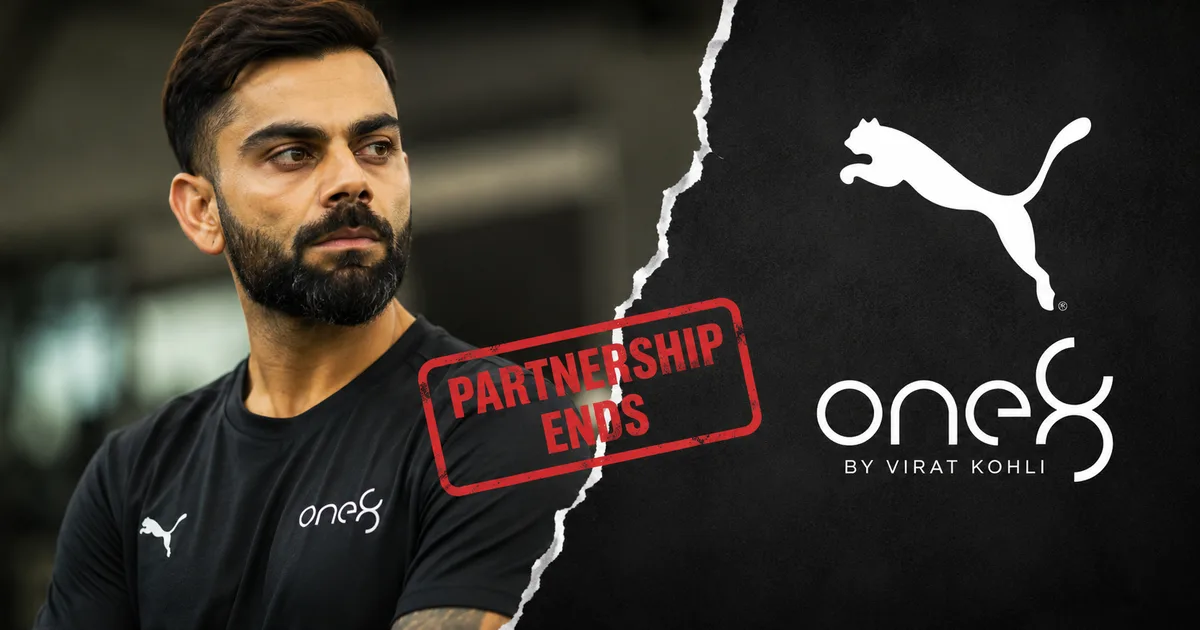
If you walk into any mall in Mumbai, Bengaluru, or Delhi, you can't miss the Puma store. For years, the prominent display featured Virat Kohli's signature brand. But things changed recently. The long-running one8 Puma partnership ended, sending shockwaves through the Indian sports merchandise industry. It was a massive partnership. We are talking about a deal that was reportedly worth Rs 110 crore. When news broke that Kohli walked away from a rumored Rs 300 crore extension, everyone wanted to know why. It's a bold move. But when you look closely at the details, it's clear that this is about a bigger ambition: owning the business, not just endorsing it.
For years, Indian athletes followed a standard playbook. You sign a multi-year deal, wear the gear, shoot a few TV commercials, and collect a fat check. It's a safe route. And it's predictable. But Kohli has always been different, both on and off the field. By rejecting Puma's extension, he decided to pivot. Mint reported that the cricketer chose to join a domestic startup as an investor and co-owner (which makes sense, actually). That company is Agilitas Sports. If you haven't heard of them yet, you will soon. They're building a full manufacturing and retail pipeline right here in India.
Honestly, I was skeptical when the news first broke. Why walk away from guaranteed millions? Especially from a brand like Puma that dominates the Indian premium sportswear market. But then I looked at the numbers. Forget the endorsement fees. This is all about equity. In the old model, Puma ran the show. They designed and manufactured the one8 lineup before distributing it. Kohli got a royalty cut. Now, he wants to own the product itself, not just be the face of the brand.
That's a massive shift.
The breakdown of the Puma deal
Let's look at the numbers. The original deal back in 2017 changed the game for Indian sports. It was a Rs 110 crore deal for eight years. Over the years, one8 became a big part of Puma India's sales. It was around ten percent of their total. So when SportsPro reported that Kohli rejected a $35 million extension (roughly Rs 300 crore), it raised eyebrows. Puma India denied it at first, though the details are a bit fuzzy. But the contract was ending anyway, and Kohli wanted something else.
Why say no to Rs 300 crore? It sounds crazy. If you ask me, it's wild. But when you're Virat Kohli, your brand power is at its peak. Every pair of sneakers sold makes Puma richer. Kohli wanted to change that equation. According to reports in The Times of India, Kohli invested Rs 40 crore in Agilitas Sports. This is a hands-on investment, not a passive brand ambassador deal. He's putting his own cash into the business. He's clearly serious about this new path.
And he's not alone. His wife, Anushka Sharma, also joined the company as an investor. She's working on a new one8 yoga and fitness line for women. This moves the brand beyond just cricket and running, into the broader wellness space. It's a smart play. Women's activewear is growing fast in India, after all.
Why the Agilitas Sports deal changed the game
To understand this, you've got to see who's running Agilitas. The company was founded by Abhishek Ganguly. He used to run Puma India as Managing Director. He's the guy who built Puma into India's top sportswear brand. He knows the distributors and factory owners, plus all the retail partners. When Ganguly left Puma to start Agilitas Sports, he wanted to make shoes in India instead of importing them.
Agilitas isn't starting from scratch. They acquired Mochiko Shoes (a massive manufacturer, by the way), which is one of the largest footwear makers in India. Mochiko makes shoes for international brands like Adidas and Reebok. By owning Mochiko, Agilitas controls the factories. They design and make the shoes, getting them onto shelves in a fraction of the time global giants take. That's a huge advantage. You don't wait for container ships or worry about import duties. So you make it in Noida, then sell it in Bengaluru.
That's the whole strategy. India's digital payments and logistics infrastructure make it easy to reach customers directly. Through UPI and fast courier networks, a direct-to-consumer brand can scale fast. You don't need physical stores on day one. You can sell online first to build a community before expanding.
The Indian sportswear market is shifting from simple endorsement deals to deep equity partnerships. Athletes want to own the intellectual property they build.
I think this is a positive development for Indian manufacturing. For decades, we imported premium sports gear. Now, we're making it ourselves. And we're doing it with Indian design and Indian capital. It's about time.
A closer look at the new footwear collection
So what does the product lineup look like? The first major launch under this partnership is the new one8 sneaker collection. They didn't go for cheap, generic shoes. Instead, they went for premium lifestyle sneakers designed for urban Indian youth. To launch this collection, they chose a unique distribution strategy. If you ask me, it was a brilliant move. They partnered with District, a digital platform for premium brands. It was a risky bet, but it paid off handsomely.
The results were immediate. Once online bookings opened, the initial stock sold out within minutes. This happened before the official launch event in Delhi. It shows the incredible pull of the Kohli brand (which is massive, honestly). People bought the shoes sight unseen because they trusted the design. The sneakers have clean lines and retro-inspired designs made from premium materials. They're priced competitively compared to global brands, so they're accessible to college students and young professionals who want style without paying international import premiums.
The new footwear strategy focuses on three areas:
- Lifestyle sneakers designed for daily wear in Indian weather conditions.
- Performance running shoes engineered for local running tracks and gym training.
- An upcoming activewear and yoga line co-created with Anushka Sharma.
This is just the beginning. The plan is to take the brand global. With Agilitas' manufacturing capabilities, they can produce high-quality footwear at a lower cost. They can export these products to markets in the Middle East, Southeast Asia, and Europe. It's an ambitious plan, but with Ganguly's execution track record and Kohli's popularity, it's entirely possible.
How this affects the everyday Indian consumer
What does this mean for you when you buy shoes? First, it means more choice (which is always good). For a long time, if you wanted high-quality sneakers, you had to pay Rs 8,000 to Rs 12,000 to international brands. Homegrown brands were usually seen as cheap or low-quality. Agilitas is trying to bridge that gap. They want to sell quality shoes at a price point that makes sense for the Indian wallet, targeting the Rs 4,000 to Rs 6,000 range.
Second, you get a better fit. Most global shoes are designed for Western or East Asian feet. Indian feet are generally wider. Because Agilitas manufactures locally, they can customize the molds specifically for Indian foot shapes. It sounds like a minor detail, but it makes a huge difference in comfort when you're wearing them all day.
I've tried many sneakers over the years. The biggest issue with imported shoes is often their durability. Our roads are dusty, and our monsoons are harsh. Shoes designed for clean European streets often fall apart here. Local manufacturing allows one8 to choose materials that handle Indian conditions better. It's practical design for real-world usage.
The business model shift from endorsement to equity
This deal is a big transition for the Indian sports business. Historically, athletes were treated as marketing expenses. A brand would pay players a fixed fee from their marketing budget. Then, they'd use the athlete's face to sell the products. The player had zero say in design and pricing, plus the overall strategy. If the brand did well, the corporate executives got rich, and the player just got their annual fee. Once the contract ended, the player walked away with absolutely nothing.
The Agilitas Sports deal changes that. By investing Rs 40 crore, Kohli became a minority shareholder in the company. He's now a co-owner. If Agilitas grows and eventually goes public, Kohli's equity could be worth far more than any endorsement contract. He's building long-term wealth instead of chasing short-term income. This is the model pioneered by athletes like Michael Jordan in the US. Personally, I think it's exciting to see Indian athletes adopting it.
It's also a win for the startup ecosystem. Having a high-profile investor like Kohli brings credibility to Agilitas. It attracts more venture capital and top-tier talent. Other sportspersons will likely follow suit (which would be huge for local brands). We might see cricketers, badminton players, track athletes, and footballers partnering with Indian startups to build their own brands instead of signing away their rights to global conglomerates.
What lies ahead for one8 and Agilitas
Look, the road ahead is going to be tough. Building a brand from scratch is hard work. Puma has decades of brand equity and massive marketing budgets. Competing with them head-on requires constant innovation. In my experience, the initial hype of a sold-out sneaker launch is the easy part. The real test is repeat purchases. Will customers actually buy a second pair? Will the quality hold up after six months of daily wear? These are the questions Agilitas must answer.
But the foundation is solid. The partnership brings together Abhishek Ganguly's business acumen and Mochiko's manufacturing power, backed by Virat Kohli's unmatched brand reach. It's a formidable combination. As they roll out new collections and expand their retail footprint, they're changing how Indian consumer brands operate.
If you want to read more about business shifts in Indian technology and retail, check out our explainers. Also, feel free to explore the latest news or check out our guides for more practical insights.