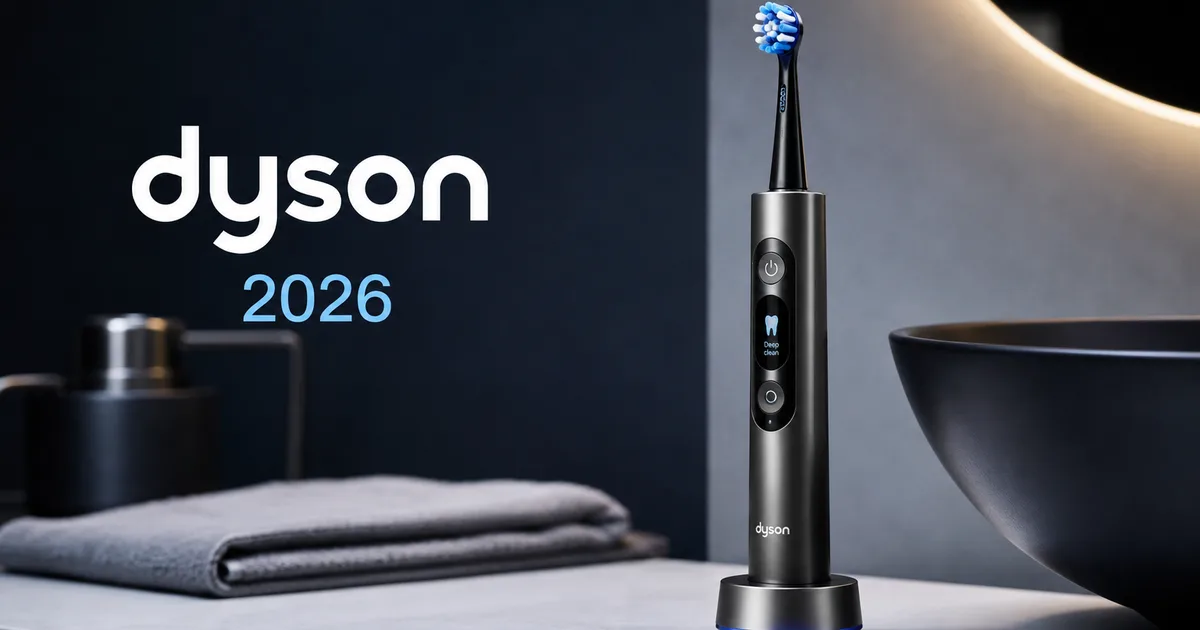
I thought I had seen it all when it came to smart home gadgets. We have fridges that tweet, washing machines that connect to Wi-Fi, and fans that cost as much as a decent smartphone. But Dyson just pulled a massive curveball. They made a toothbrush. The new Dyson Toothbrush 2026 is exactly as over-engineered and expensive as you might expect.
Officially called the CameraJet, this is a $499 piece of tech that literally watches you brush. Honestly, when I first read about this, I thought it was a joke. It's not. But it is going to make you seriously question how much you care about dental hygiene.
So, let's talk about it. What exactly is a smart toothbrush supposed to do? And does anyone in India actually need this thing? I think the answer is complicated.
What the Dyson CameraJet features actually are
Dyson is famous for vacuum cleaners and hair dryers. Now they've crammed all that engineering into a bathroom essential. This isn't just a brush that spins fast. It is a highly engineered machine.
The core of the CameraJet is exactly what the name suggests. It has a tiny 100,000-pixel macro lens camera built right into the brush head. Yes, a camera. A camera that lives in your bathroom. And it goes inside your mouth.
But it gets weirder. It has a water jet system too. Not like a separate flosser that you keep on your sink. The flosser is built directly into the brush head.
Dyson says the camera captures 28 frames per second. While you brush, a machine-learning model analyzes the live feed. It's looking for gaps between your teeth. When it finds one, it fires a targeted burst of mouthwash. They call this Gap Optical Targeting. In theory, you're brushing and flossing at the same time.
I have to admit, that sounds cool on paper. But then you remember you're putting a camera in your mouth. (Which is a bit sketchy, actually.)
Streaming your molars to your phone
Everything needs an app these days. The CameraJet connects to your phone via Wi-Fi and Bluetooth. And this is where the camera really comes into play.
Open the MyDyson app while you brush, and you get a live video feed from inside your mouth. You watch a close-up broadcast of your plaque being scrubbed away.
Do you want to see that? I'm not entirely sure I do. I've never once stood at my bathroom sink and wished for a live feed of my bicuspids. It's just weird.
Thing is, the practical use here is coverage mapping. The app gives you personalized feedback. It shows you exactly which spots you missed. And it shows where you need to brush better. If your brushing technique is a mess, this app will call you out on it.
People on social media had a field day. One user on Instagram joked, "Can I stream YouTube with it?" Another asked why we need a camera just to brush our teeth. And obviously, the privacy questions came up fast.
Are there privacy issues with a camera toothbrush?
Look, I get it. Having a camera on a device you leave in your bathroom feels invasive. Especially a Wi-Fi-connected one.
Dyson addressed this right out of the gate. They say the camera only turns on when you use the live view in the app. It also runs when the automatic jet looks for gaps. They state that none of the images are recorded. Nothing is saved on the toothbrush. Nothing goes to the cloud.
Is that enough to put people at ease? Maybe. But in a world where everything gets hacked eventually, some people will probably just stick black tape over the lens. Which ruins a very expensive buy. I completely understand the paranoia though.
The engineering behind the water jet
If you ignore the camera for a second, the water jet mechanism is fascinating. Most water flossers shoot a continuous stream of water. They're messy and loud. You have to hover over the sink while water drools out of your mouth.
Dyson went a different route. The CameraJet holds 12.5ml of mouthwash in a tiny tank in the handle. It has a diaphragm pump. When the camera spots a gap, it fires a burst of liquid. Just 0.15ml at a time. Dyson says this wider cone covers more plaque. It also uses less pressure than a standard flosser. That should be gentler on your gums.
And because of how the pump is built, it works even if you tilt the brush horizontally to reach your back teeth. It's classic Dyson over-engineering. You can adjust the brushing intensity from the app. You can pick between automatic and manual jetting too.
By the way, if you love reading about tech upgrades, you might want to check out the CMF Buds Neo 2026 India Launch details. They're doing some interesting things with ANC at a much more reasonable price.
How it compares to the competition
Before Dyson showed up, the heavyweights were Philips with their Sonicare line and Oral-B with their iO series. Both companies have had smart toothbrushes for years. They cost anywhere from ₹15,000 to ₹25,000 in India.
But those brushes rely on accelerometers and gyroscopes. They guess where the brush head is in your mouth based on how you tilt the handle. The app shows a 3D model of a mouth. It turns white as you brush. It works decently well. But it is basically a rough estimation.
The CameraJet doesn't guess. It looks directly at your teeth. It is the difference between navigating a city with a paper map and using real-time satellite imagery. It is a massive leap in accuracy.
Honestly, the Philips and Oral-B models are much lighter. Fitting a camera, a 12.5ml water tank, a pump, and a battery into a handle means the CameraJet is going to be bulky. We don't have the exact weight yet. But looking at the photos, it looks like a small torch. It doesn't look like a normal toothbrush.
Battery life and daily maintenance
This brings up the reality of living with a device like this. It isn't just about brushing anymore. It's about maintenance.
You have to make sure the water tank is filled before you start. The 12.5ml tank holds exactly enough for one session. So you're filling this thing twice a day. And then you have to clean it so the internal pump doesn't get clogged with dried mouthwash residue. (Annoying, I know.)
Then there's the battery. Running a Wi-Fi connection, an AI processor, a camera at 28 frames per second, a motor, and a diaphragm pump takes a lot of power. Dyson hasn't fully detailed the battery life yet. I'd be shocked if it lasts more than a week on a single charge. If you travel frequently, you're definitely going to need that charging dock.
And let's not forget the brush heads. Like any electric toothbrush, you have to replace the bristles every three months. The head has a camera cutout and a jet nozzle. Because of that, I suspect the replacement heads for the CameraJet are going to be incredibly expensive. The numbers here are a bit fuzzy right now. But you might be paying thousands of rupees every few months just to keep using your brush.
If you want to read more about how tech is changing everyday objects, dive into our Tech Explainers hub.
What comes in the retail box
When you spend this kind of cash on a bathroom appliance, the unboxing experience matters. Dyson knows this. They treat their hair dryers like luxury jewelry. The CameraJet gets similar treatment.
The Dh1,949 package in the UAE gives us a good idea of what the Indian bundle will look like. It includes the toothbrush handle itself, the specialized brush heads, a charging dock, and a travel case. But they also throw in their own Dyson-branded toothpaste and mouthwash.
Yes, Dyson makes toothpaste now.
We don't know the exact formulation of their toothpaste yet. We also don't know if you strictly need to use their proprietary mouthwash to stop the pump from jamming. But printer companies make their real money on ink cartridges. I suspect Dyson is applying the same logic to mouthwash. If you have to buy special Dyson mouthwash at a premium to keep your warranty valid, the running costs of this toothbrush will skyrocket.
Dyson CameraJet price in India and availability
This brings us to the biggest hurdle. The price.
Globally, the Dyson CameraJet launched at $499.99. In the UAE, it is priced at Dh1,949. If you convert that directly to Indian Rupees, you're looking at around ₹47,000.
But things in India are rarely a direct conversion. Once you factor in import duties and GST, this thing could easily cost over ₹50,000 when it officially lands here.
Fifty thousand rupees. For a toothbrush.
You can buy a really good smartphone for that money. You could buy a decent laptop. Or you can buy a toothbrush that needs you to charge it, fill it with a special mouthwash, and connect it to your Wi-Fi.
Who is this actually for?
So, who goes out and buys a ₹47,000 toothbrush? I can think of a few specific groups. In my experience, these high-end devices always find an audience.
First, gadget enthusiasts. The people who buy the absolute top-tier model of everything. If you already have a smart home setup and the latest VR headset, you probably want your toothbrush to have an IP address too.
Second, people with serious dental anxiety or poor oral hygiene habits. Let's be honest, most of us lie to our dentists about how often we floss. Flossing is annoying. It hurts your fingers and it takes time. The CameraJet automates the worst part of dental care. If you have a history of painful cavities, spending ₹47,000 to ensure your teeth are perfectly clean might feel like a reasonable medical investment.
For parents trying to get their teenagers to brush properly, this could be interesting. Handing a kid an app that gamifies brushing might actually work. It shows them exactly where they missed plaque. But giving a teenager a highly expensive gadget to hold over a sink full of water is a risky game.
And speaking of gadgets, if you're keeping an eye on new tech hitting the market, check out the Vivo T5 5G India Launch 2026 details for something a bit more mainstream.
Will dentists recommend it?
I spoke to a dentist friend about this concept. His reaction was mixed.
Dentists love anything that gets people to clean between their teeth. The water jet feature is a good idea. Water flossers are highly recommended by dental professionals. They flush out bacteria that regular brushing misses.
But the camera might be overkill. Most dental professionals will tell you that a standard ₹2,000 electric toothbrush is enough. You use it correctly for two minutes twice a day along with regular string floss. That is enough to maintain perfect oral health. You don't need AI to find a gap in your teeth. You just need to be thorough.
But humans are bad at being thorough. We get distracted and we rush. We completely miss the back corners of our mouths. The CameraJet removes the human error element entirely.
The future of personal care tech
Dyson entering the dental space is a big deal. They don't just launch products for fun. They clearly see a gap in the market for high-end personal care.
It makes you wonder what else is coming. We already have AI fitness trackers like the Google Fitbit Air Fitness Tracker 2026 and now camera toothbrushes. Will we get smart nail clippers next? AI-powered cotton swabs?
The CameraJet runs on 16 million lines of code. Think about that for a second. Your toothbrush requires software updates. It has more computing power than the computers that put a man on the moon. And its sole purpose is to squirt 0.15ml of mouthwash at a piece of spinach stuck between your teeth.
It's absurd. And it's brilliant. It is everything that is both wrong and right with consumer technology today.
Final thoughts on the new Dyson toothbrush
I don't think the average Indian consumer needs the Dyson CameraJet. Not even close. If you want better oral hygiene, you're far better off buying a standard electric toothbrush for ₹2,000. You just have to actually remember to floss every night.
But I'm glad the CameraJet exists. It pushes the boundaries of what these devices can do. The Gap Optical Targeting system is clever. I'm not sure exactly why it took so long for someone to build this. If this technology eventually trickles down to a ₹5,000 device in five years, it could change how everyone takes care of their teeth.
Until then, if you have fifty grand burning a hole in your pocket and a deep desire to watch a live broadcast of your own gums, Dyson has exactly what you need. Just charge it before you go to bed.