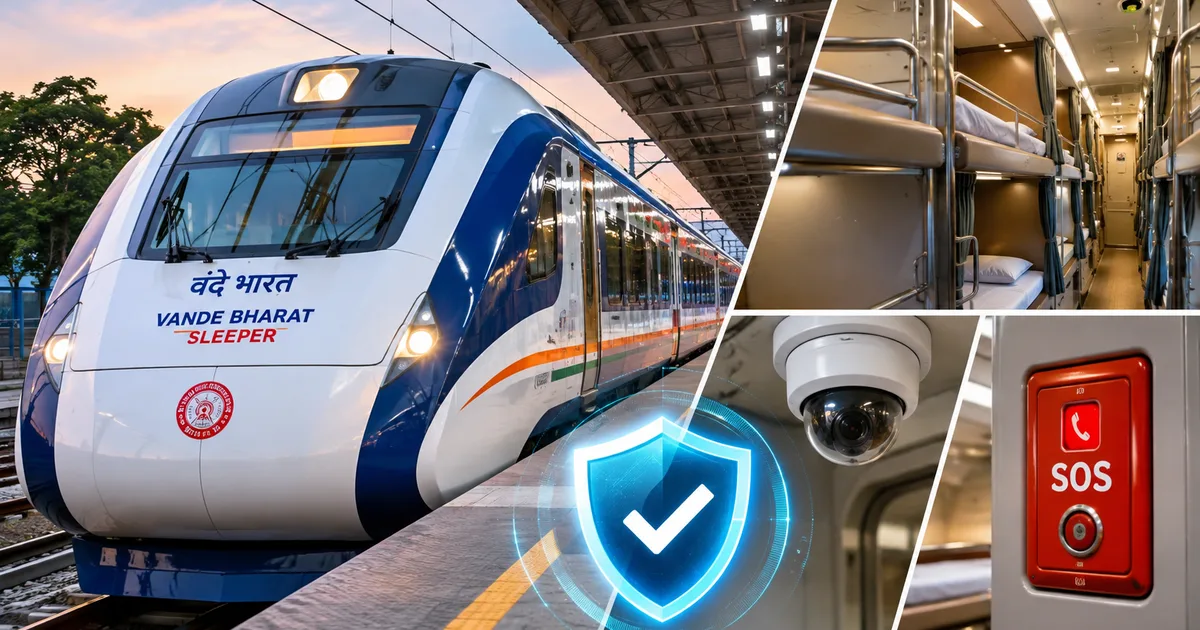
You've probably booked an overnight train in India and woken up around 3 AM to sudden, aggressive braking, wondering what was happening on the tracks ahead. When you're lying flat on a berth at 130 km/h, every rumble feels amplified. With the new 16-coach semi-high-speed rakes hitting test tracks between Hazrat Nizamuddin and Palwal at 160 km/h, passenger curiosity has shifted from luxury upholstery to structural survival. Understanding the Vande Bharat sleeper safety features gives you a clear picture of how modern rolling stock actually handles track obstacles and human error.
When you sit in an executive chair car, your feet are planted on the floor and your eyes are open. Sleeping on an upper berth at night is completely different. You can't brace for impact when you're dead asleep. It's just impossible. In my experience, even routine braking can roll you toward the edge if the loco pilot taps the brakes too hard. That basic physical reality forced Indian Railways and the Integral Coach Factory (ICF) to rethink crash mechanics and electronic overrides from scratch.
Here's the deal. Modern train safety basically splits into distinct layers. First, there's active electronic prevention to stop collisions before they happen. Then there's passive mechanical crashworthiness to absorb kinetic shock if metal ever hits metal. And finally, you have onboard hazard controls that tackle fires and toxic smoke.
How Kavach 4.0 stops collisions automatically
Most train accidents happen because of signaling mistakes or bad weather. Take North India in December and January. Dense winter fog drops visibility to under ten paces. Loco pilots on routes like the Delhi-Varanasi Vande Bharat Sleeper run often crawl forward, squinting to spot yellow and red signals through freezing mist. That's nerve-wracking work. And that's where Kavach 4.0 changes the game.
Kavach is an indigenous Automatic Train Protection (ATP) setup approved by the Research Design and Standards Organisation (RDSO). Think of it as a digital co-pilot talking to the tracks and adjacent locomotives every split second. It's fast. It doesn't ask for permission, either. If the pilot misses a signal or fails to act, the system takes over the brakes directly.
According to Research Design and Standards Organisation trial specifications, Kavach 4.0 must initiate emergency pneumatic braking within 500 milliseconds of detecting an unauthorized signal pass, bringing a 16-coach rake to a controlled halt without manual pilot intervention.
So how does this hardware actually communicate in real time?
- Radio Frequency Identification tags clamped directly onto rail sleepers every one kilometer transmit precise track identity, train direction, and exact location coordinates.
- Locomotive computers calculate the train's braking distance curve continuously based on current speed, track gradient, and trailing coach weight.
- Stationary radio towers operating on ultra-high frequencies broadcast signal aspects directly into the driver cab display unit.
- Two trains approaching each other on the same track exchange direct radio telemetry to trigger synchronized braking long before headlights become visible.
I looked closely at how Kavach 4.0 differs from older editions. (The technical specs are pretty dense, but the core difference is network speed.) The earlier 3.2 iteration occasionally had trouble with handover lag when a train crossed telecom boundaries between regional rail divisions. Version 4.0 fixes that by running optical fiber networks alongside trackside towers. That cuts signal lag down to under half a second. During high-speed trial runs between Hazrat Nizamuddin and Palwal, engineers pushed the 16-coach rake to 160 km/h and simulated red-signal breaches. The pneumatic disc brakes kicked in without a hiccup. The digital safety net held up, even when the crew did nothing.
You can read more about how the network expands across busy trunk lines in our detailed guide on the Indian Railways Kavach 4.0 rollout.
Crashworthiness engineering inside the 16-coach rake
Electronic systems can fail, or they run into untracked obstacles like fallen boulders or stray cattle. When an unavoidable impact occurs, everything depends on coach shell physics. For decades, traditional ICF blue coaches had a bad reputation during derailments because of telescoping. That's the horrific scenario where an uncoupled coach climbs up and slices straight through the cabin ahead. It was devastating. That lethal failure mode drove engineers to adopt strict crashworthiness standards for new sleeper sets.
The Vande Bharat sleeper uses semi-permanent anti-climbing couplers paired with crushable crumple zones at both ends of every carriage. These couplers do something clever. Under minor shunting impacts, internal draft gears absorb normal operational jolts smoothly. But when hit by severe kinetic energy, calibrated shear pins snap cleanly. That force redirects straight into sacrificial deformation tubes, so coaches don't climb vertically over each other.
Basically, the train destroys its own non-passenger sections to protect your berth.
The coach structure itself is made from austenitic stainless steel, engineered to deform progressively like an accordion. The vestibules and lavatory blocks at coach ends are crumple zones. Meanwhile, the central cabin where you sleep is a rigid survival cell. Computer stress simulations conducted by RDSO show that even during a 110 km/h collision with a stationary buffer, the passenger living volume remains intact. Honestly, seeing that simulation data in person is what convinced me about this frame.
Things look noticeably different underneath the carriage as well:
- Heavy-duty bogie yaw dampers eliminate lateral high-speed hunting oscillations that frequently destabilize trains on curved track beds.
- Wheel slide protection units monitor rotation speeds across all 64 axles, pulsing brake calipers rapidly to prevent wheel lockups and flat spots on rails.
- Axle box temperature sensors feed continuous thermal readings into the train computer, alerting depot technicians to bearing friction hours before mechanical failure.
Our broader collection of railway technology explainers walks through how axle sensors and Bogie Mounted Brake Systems operate across different rolling stock generations.
Fire protection and toxic smoke defense systems
Fire on an overnight train is terrifying. You're asleep behind privacy curtains or locked coupe doors, shoes off, completely disoriented in the dark. In real railway disasters, open flames rarely cause the initial casualties. Toxic carbon monoxide and hydrogen cyanide gases from burning wire insulation or plastic moldings can poison passengers within two minutes. That's why the sleeper rake adopts strict European fire standards known as EN 45545-2 at the highest hazard rating, HL3.
Every mattress and interior wall panel is made with fire-retardant polymers, right down to the seat fabrics and rubber window gaskets. They snuff themselves out the moment an ignition source disappears. And when exposed to high heat, they generate almost zero opaque smoke and emit very little acidic gas.
What impressed me most during technical disclosures is the automated aerosol fire suppression network installed inside power switchboards and battery boxes. Most train fires start in overheated electrical cabinets under the coach or behind pantry walls (a sketchy problem on older rakes). Traditional water sprays can't touch electrical fires safely. And carbon dioxide systems risk suffocating passengers if gas leaks into berths.
The aerosol units work through chemical interference. When thermal sensors spot a temperature spike above safe thresholds, canisters discharge an ultrafine mist of solid potassium-compound micro-particles. These particles react chemically with combustion free radicals. That halts the chemical fire reaction in under ten seconds, and it does it without draining ambient oxygen from the car.
Smoke detection inside passenger bays operates on aspirating technology. Tiny suction tubes draw air samples continuously from ceiling vents into laser-based optical chambers. If a traveler lights a cigarette in a toilet or an unauthorized heating element shorts out in a pantry cupboard, the system flags the exact coach coordinates on the guard's central console. At the same time, automatic fire dampers inside the central HVAC ducts slam shut. That stops the air conditioning from circulating toxic fumes between adjacent sleeper cabins.
Interior passenger safeguards and emergency egress
Safety inside a moving sleeper train also comes down to daily passenger habits. On older express trains, people habitually lean out of open doors while the train flies through stations at 110 km/h. It's reckless. On the Vande Bharat sleeper, plug-type exterior doors seal flush with the outer body shell. Central electrical interlocks prevent the train from moving until all doors latch shut. Once speed tops 5 km/h, the doors stay firmly locked (which, honestly, is about time). And that alone eliminates one of the biggest causes of accidental track falls during station departures.
Inside the compartments, several dedicated systems handle unexpected crises:
- Emergency talk-back intercoms installed next to berth doorways connect passengers directly to the loco pilot and train captain during medical or security incidents.
- Tempered double-glazed safety windows incorporate quick-break impact points beside emergency rescue hammers mounted in clear wall cases.
- Luminescent floor evacuation path strips guide disoriented travelers toward gangway exits even if the main 110V auxiliary lighting bus cuts out.
- CCTV cameras monitor vestibules and public gangways around the clock without infringing on the personal privacy of individual sleeping berths.
- Touch-free automatic bio-vacuum lavatories reduce slip hazards and keep greywater securely contained throughout long intercity journeys.
Where track realities challenge new tech
Look, it's easy to get carried away by advanced technical specifications on paper. The hardware inside these new rakes is genuine progress, but Indian railway tracks present real-world obstacles that no coach shell alone can solve. Millions of cattle graze near rural rail corridors, and unauthorized level crossings persist. Plus, people still walk across active tracks all the time.
When a train travels at 160 km/h, hitting a 400-kilogram stray bull creates immense structural shock. The aerodynamic fiberglass nose cone of the Vande Bharat locomotive absorbs that impact to protect vital traction motors and brake conduits underneath. But the train still ends up sidelined for composite repairs. The exact official budget numbers for total track fencing are a bit fuzzy, but Indian Railways has started erecting metal beam barriers along high-density stretches. Thousands of route kilometers remain exposed.
As services prepare for tough, long-haul journeys like the upcoming Bengaluru to Mumbai sleeper corridor, track maintenance and strict depot inspections will determine passenger safety just as much as onboard electronics. The safety hardware built into the train is a solid shield. Still, if you ask me, real safety won't be complete until the ground infrastructure gets the exact same priority as the rolling stock.