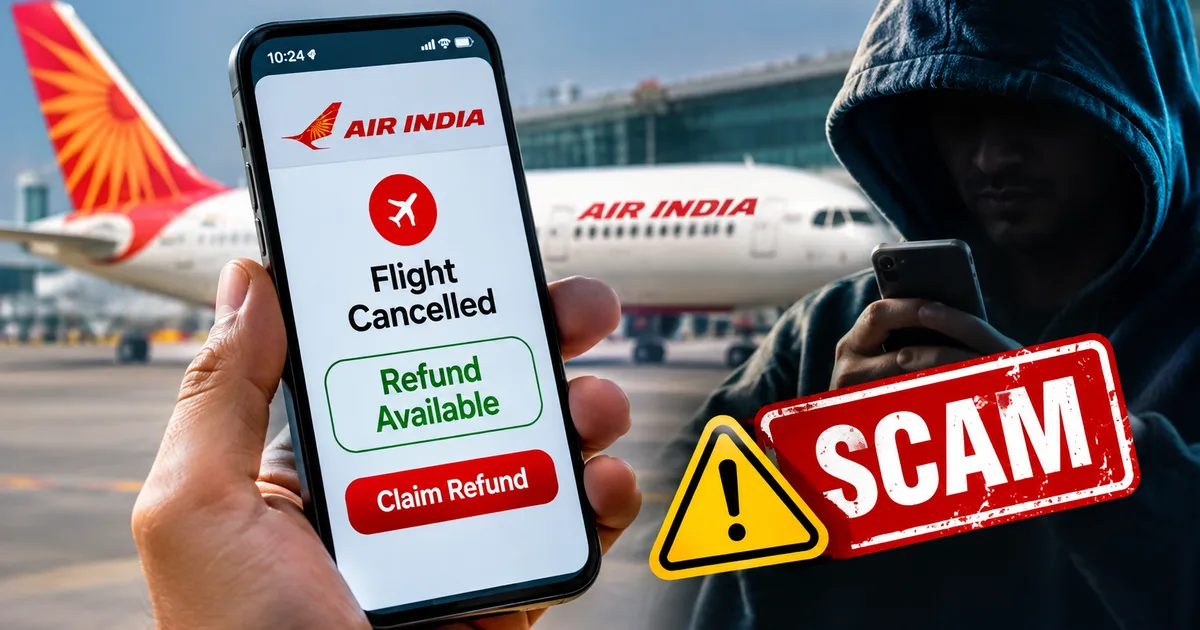
You're standing in line for a cab outside Terminal 3, or maybe sitting at a departure gate with two duffel bags and a cup of lukewarm airport chai, when your phone buzzes with a text. The message says your Air India flight is cancelled and offers an immediate full refund of ₹14,200 if you verify your account details right now. You freeze. Flight cancellations happen constantly, especially when dense winter fog blankets Delhi or international routes face sudden disruptions like the recent Middle East airspace suspensions to Jeddah and Riyadh. In that split second of panic, clicking the link feels like the only sensible thing to do. That's where the trap snaps shut. The fake Air India flight cancellation refund scam has become one of the most aggressive travel frauds targeting Indian passengers in 2026. It drains bank accounts through spoofed customer care desks and manipulated UPI payment requests.
Look, losing a flight ticket hurts. But losing your entire monthly savings because someone spoofed an airline text hurts infinitely worse.
At GetInfoToYou Tech, we track digital financial threats across the country, and our latest scam alert investigations show that cybercriminals have refined this exact playbook. They don't wait for people to stumble onto sketchy websites anymore. Instead, they actively hunt stressed passengers during peak festival travel and unexpected route cancellations. If you ask me, they know that urgency is the easiest way to bypass every bit of common sense you have.
What the fake Air India cancellation scam actually is
Commercial airlines reschedule or cancel flights for normal operational reasons all the time. Air India regularly adjusts its timetable when severe weather strikes or when airspace restrictions emerge, as seen when flights to Dammam and Riyadh were suspended, alongside flights to Madinah. When genuine cancellations happen, airlines initiate automatic refunds directly to the original payment source. You don't have to fill out third-party forms. And you never have to jump through digital hoops.
Scammers take that genuine airline policy and turn it into a trap.
Basically, it's an impersonation racket. Fraudsters pose as Air India customer support executives or fake ticketing agents. They reach out through WhatsApp messages, spoofed SMS sender IDs, phone calls, or sponsored search ads on Google. Their pitch sounds completely reasonable on the surface. They claim your flight can't depart, the airline wants to return your ₹7,500 or ₹18,000 fare without cancellation penalties, and you just need to complete a two-minute verification on your phone to release the settlement.
The exact numbers are hard to pin down because many victims feel too embarrassed to report losses under ₹10,000 (the numbers here are a bit fuzzy, to be fair). Still, cyber cells across Delhi and Bengaluru, as well as Hyderabad, have logged hundreds of complaints this year. Fraudsters aren't guessing in the dark. Some buy leaked passenger manifests from shady travel sub-agents. Others monitor public complaint threads on social media where frustrated flyers openly paste their six-character PNR codes. Once a scammer has your name and six-character booking reference, their phone call sounds terrifyingly authentic. Honestly, I think that's why this scam works so well.
How fraudsters run this refund trap step by step
The initial hook arrives via WhatsApp or SMS
It begins with an unsolicited alert. The message mimics official airline communication down to the red and gold branding, often displaying headers like "AIRIND-Alert" or arriving from a WhatsApp business profile with the familiar Maharaja logo. I've seen these messages myself, and they look alarmingly genuine.
The text warns you that flight AI-804 or your specific booked sector is cancelled due to operational constraints. To avoid losing your money, you're told to tap a short link or call a helpline number within two hours. That deadline is deliberate. When you believe your family vacation or client meeting is collapsing, you don't pause to verify the sender. You just react.
The fake customer service executive takes your call
If you call the number, a polite voice answers right away. The agent speaks fluent English or Hindi and knows all the standard aviation terms. They quote your flight route back to you without hesitation. And they apologize sincerely for the inconvenience caused by the operational delay.
Then they drop the hook. They tell you that while the airline initiated the refund, your bank blocked the incoming credit due to an updated RBI settlement rule. I'm not sure exactly why this specific excuse works so well, but on a noisy phone call while you're traveling, it sounds plausible. (which makes sense, actually, because nobody really understands interbank settlements). To release the stuck funds, they claim they must route the amount directly to your active UPI ID or debit card.
The remote access application trap
Here's where things turn dangerous. The caller asks you to open Google Play Store and install an app to generate a refund token. They don't send you a sketchy APK file that might trigger security warnings. Instead, they instruct you to install legitimate remote desktop software like AnyDesk or TeamViewer QuickSupport.
Once you install the app and read out the nine-digit access code, you've handed them total control over your phone screen. They can see your notifications and watch every tap you make. In my experience, this is the exact moment where the game is lost. They'll ask you to open your mobile banking app or DigiLocker to confirm your identity. While you think they're helping you authenticate, they're quietly noting your account balances and login credentials.
The UPI collect request and drained savings
If you refuse to install a remote desktop app, the scammer switches to another tactic. They claim they'll send your refund via PhonePe or Google Pay.
A notification pops up on your screen. But instead of a credit alert, it's a reverse UPI collect request. The scammer tells you, "Sir, please approve the request and enter your six-digit UPI PIN to accept the refund into your account."
This is the biggest lie in Indian digital payments. Look, receiving money never requires your UPI PIN. The moment you punch in those six digits, ₹15,000 or ₹50,000 vanishes from your bank account instantly. And if they have remote access to your device, they don't even need you to approve it twice. They initiate immediate IMPS transfers to mule accounts spread across different states, and they empty your savings in under three minutes.
The Reserve Bank of India and national cyber crime agencies have repeated one golden rule for years: you never have to scan a QR code or enter your UPI PIN to receive money. Any call or message asking for your PIN to process an airline refund is 100 percent fraudulent.
Major warning signs you should watch out for
Scammers rely on rushing you before your common sense kicks in. If you ask me, whenever someone creates artificial panic during travel, that's your signal to stop. If you spot any of these red flags, disconnect immediately:
- The message comes from a standard 10-digit mobile number rather than a verified airline SMS header or official green-tick WhatsApp account.
- The caller asks you to install third-party screen sharing software like AnyDesk, TeamViewer, or RustDesk from the Play Store.
- You're asked to enter your UPI PIN or scan a QR code on PhonePe, Paytm, or Google Pay to receive your ticket fare.
- The web link provided leads to an unfamiliar address instead of the official portal, much like the deceptive links seen in the fake income tax refund scam that trick taxpayers.
- The representative demands a nominal processing fee of ₹5 or ₹10 via UPI to activate your refund queue.
- The agent pressures you with an artificial deadline, insisting your refund will lapse permanently if you don't act within fifteen minutes.
How to protect your bank account and refund money
Staying safe boils down to understanding how legitimate commercial airlines handle ticket refunds. Air India never asks passengers to perform manual UPI handshakes to receive compensation.
If a flight is cancelled, verify the status yourself. Don't click links inside text messages. Open your browser, type the official Air India website at airindia.com directly into the address bar, and navigate to the Manage Booking section. Enter your six-character PNR and your last name. That dashboard shows you the absolute ground truth about your flight. In my experience, taking two minutes to check the official portal saves days of headache.
If your flight was genuinely cancelled, here's what actually happens:
- If you booked directly through Air India, the airline initiates the refund back to the credit card, debit card, or netbanking account used during purchase within 5 to 7 business days.
- If you booked through an online travel portal like MakeMyTrip, Cleartrip, or EaseMyTrip, the refund reaches the portal, which then credits your original payment mode according to their own settlement schedule.
- You never need to speak with an outside agent, install utility apps, or provide bank verification details.
What if you realized you walked into the trap midway? Act instantly. Disconnect your mobile device from Wi-Fi and mobile data to cut off any remote screen connection. Open your primary banking application on another device and freeze your debit cards. You can also review our digital banking protection guides to learn how to instantly disable UPI services across your bank accounts through netbanking.
Fraud rings use serious psychological pressure, similar to the aggressive coercion tactics uncovered in digital arrest video call fraud. They rely on fear to cloud your judgment. Don't let their false urgency push you into handing over your credentials.
Where to report airline refund fraud in India
If you lost money or shared sensitive credentials with an impersonator, every minute counts. Fraudsters transfer stolen money through layers of digital wallets and mule accounts within twenty minutes of a successful breach.
Your first step must be to dial the 1930 national cyber helpline immediately. This toll-free number connects you directly to the Indian Cyber Crime Coordination Centre (I4C). When you report the fraudulent transaction promptly, law enforcement triggers the Citizen Financial Cyber Fraud Reporting and Management System. That system alerts the receiving bank to freeze the beneficiary account before the criminal withdraws cash at an ATM.
Acting within the golden hour gives you the highest chance of recovering your hard-earned money.
Next, submit a comprehensive digital complaint on the central government portal at cybercrime.gov.in. Keep your bank account statement, transaction reference numbers (UTR), call logs, and screenshots of WhatsApp chats ready for upload. (annoying, I know, but police need that paper trail).
The Indian Computer Emergency Response Team (CERT-In) regularly issues alerts against fake airline customer care portals and malicious search engine listings at https://www.cert-in.org.in/. You can also report phishing domains and rogue customer service numbers directly to their incident desk to get those fraudulent sites taken down permanently.