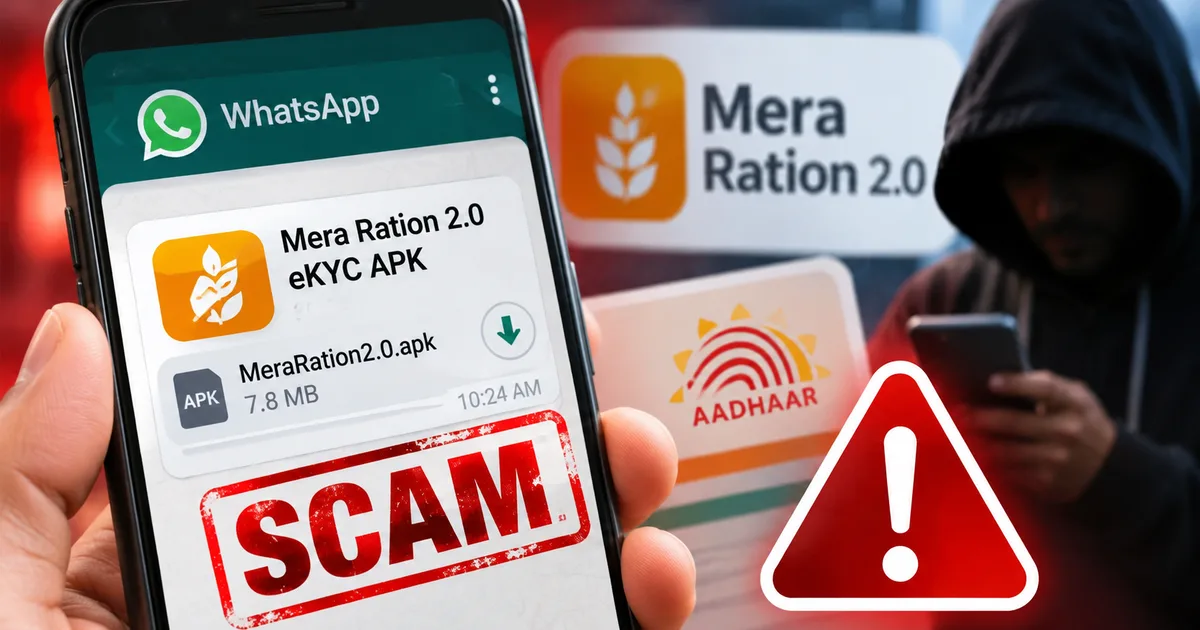
If an unknown number pings your phone with a warning that your monthly grain quota will stop unless you complete biometric verification through an attached Android file, stop. Don't tap that file. Fraud networks across India are running the Fake Mera Ration 2.0 Aadhaar eKYC WhatsApp APK Scam 2026, using panic about ration card cancellation to push phone-hacking malware onto personal devices. Tens of thousands of families depend on monthly subsidized wheat and rice under the National Food Security Act. Cybercriminals know this fear well, and they exploit it ruthlessly.
I saw one of these messages on my uncle's phone last week. The sender used the official national emblem as their profile picture and gave a strict 24-hour deadline, quoting fake sections from government orders. It looked convincing at a casual glance. Really convincing, actually. But the whole thing was just a trap designed to clean out his State Bank of India account.
Honestly, this is one of the nastiest scams doing the rounds right now. In my experience, attacks that prey on everyday welfare benefits hit the hardest because they target families who can least afford to lose their savings.
What the Mera Ration 2.0 scam is
It always starts with a random WhatsApp text. The sender uses an unknown number, usually with the Indian tricolour or a government logo as the profile picture. The message claims the Department of Food and Public Distribution launched Mera Ration 2.0, requiring cardholders to update their family Aadhaar records right away. And sitting right there in the chat is a sketchy installer named something like Mera_Ration_eKYC.apk or Ration_Update_2026.apk (a dead giveaway, honestly).
The text warns that your ration card will be cancelled immediately if you don't install the app before the end of the month. It's a blatant threat. If you ask me, that kind of pressure is the dirtiest part of the whole trick, because honest beneficiaries panic at the thought of losing the grains that feed their families.
Look, here's how official systems actually work.
State food departments and the central government never distribute .apk files through chat apps like WhatsApp, Telegram, or SMS. Real government apps go through official app repositories or verified state portals ending in gov.in.
When someone sends you an installer file directly through a chat window, it's malicious software. No exceptions.
How the ration card eKYC fraud works step by step
I'm not sure why scammers prefer this specific malware strain, but they follow a set playbook to breach your phone and siphon cash through UPI and net banking. Basically, it's a trap.
- The attackers broadcast thousands of messages to leaked phone number databases using virtual numbers. The message states that your ration card is pending verification under the latest national public distribution rules.
- The message instructs you to click and install the attached file. Because Google Play Protect blocks unknown installations by default, the message includes step-by-step instructions telling you to open device settings and enable installation from unknown sources.
- Once installed, the fake app displays an authentic-looking splash screen mimicking the national food security portal. It asks you to enter your ration card number, Aadhaar number, and mobile number.
- The app asks for extensive system permissions. Most dangerously, it demands access to your SMS messages, phone notifications, and the Accessibility Service permission.
- Once you approve those permissions, the fraudsters possess full background control over your device. The app reads all incoming SMS messages silently. When the scammer initiates a fund transfer of ₹10,000 or ₹25,000 from your linked bank account via UPI or net banking, the app intercepts the one-time password and forwards it to the hacker server. You won't even see the SMS banner.
- After wiping out available bank balances, the app frequently crashes your phone screen or hides its own launcher icon, preventing you from uninstalling it easily.
In my experience, this playbook isn't new. We've documented nearly identical patterns across our scam alerts and fraud updates over the past year, especially attacks like the fake PM Kisan APK scam that similarly preyed on rural and semi-urban beneficiaries. The tactics barely change, but they keep finding new victims.
Warning signs of a fake Mera Ration app download
Catching these signs early saves your savings. Scammers rely on pure panic, hoping you'll tap download before checking the details. So take a breath. I think taking just ten seconds to pause is usually enough to spot how sketchy the whole thing is.
- The message arrives on WhatsApp from an unknown number with a standard commercial or personal SIM, rather than an official government SMS sender ID with verified headers.
- The file ends with the extension
.apkinstead of directing you to an official listing on the Google Play Store or an official state food department website. - The text creates artificial urgency with countdown timers, threats of immediate card deletion, or claims that your family will lose grain subsidies starting tomorrow.
- The app requests Accessibility Service permissions during setup, which an informational identity app never needs.
- The message claims you need to pay a small processing fee of ₹50 or ₹100 via UPI to activate your ration quota. Genuine eKYC verification is entirely free.
If you notice even one of these red flags, delete the message. Block the sender immediately. Don't engage with them at all.
How legitimate ration card Aadhaar eKYC actually works
A lot of people get tricked because real ration card Aadhaar verification drives actually happen across different Indian states. It's an ongoing process. State governments run these drives to weed out fake cards so foodgrains reach genuine families. But the official setup doesn't look anything like a sketchy WhatsApp download.
In the real world, authentic verification happens mostly in person. You visit your local Fair Price Shop. The dealer uses an electronic Point of Sale machine equipped with an Aadhaar biometric scanner. Every family member listed on the ration card places their thumb or looks into the iris scanner (I know, standing in line at the dealer is annoying, but it keeps your money safe). The device verifies the biometric data against the UIDAI database in real time. That's all there is to it. No strange apps. And definitely no third-party download links.
Some states allow online verification, but strictly through official food portals ending in .gov.in or the official Mera Ration app on Google Play. For full instructions on verifying safely, check our detailed Mera Ration 2.0 guide. If you ask me, walking into your local ration shop is still your safest bet by far. And remember, the legitimate process costs exactly zero rupees.
Thing is, government officials will never message you on WhatsApp asking for your OTP or bank details. Ever.
What to do if you already installed the rogue file
If you already installed that fake Mera Ration file on your Android phone, it's a mess, but don't panic. You have to act within minutes. Every second counts. Don't wait around for unauthorized bank alerts to start rolling in.
- Turn on Airplane mode immediately to sever mobile data and Wi-Fi connections. This prevents the malware from transmitting intercepted data or receiving commands from the scammer command server.
- Remove the malicious app using Safe Mode. Power off your phone, then press and hold the power button and volume down button simultaneously until the safe mode watermark appears on your screen. Go to your Android settings, open the apps menu, locate the suspicious application, and select uninstall. Safe mode stops third-party apps from running background defenses that block uninstallation.
- Check device administrator settings under security to ensure the rogue app didn't grant itself persistent administrative control. If it did, revoke those admin permissions before tapping uninstall.
- Use a separate, clean device or a family member phone to log into your bank accounts. Change your net banking passwords, UPI PINs, and card security codes immediately.
- Call your bank helpline to temporarily freeze your debit cards and net banking access if you suspect the app captured your credentials. For more technical safety walkthroughs, browse our collection of step-by-step tech guides.
In my experience, speed is everything here (annoying as the recovery steps are, I know). Cut that network connection immediately. It shuts down the attacker cold before they can touch your savings.
Where to report ration card cyber fraud
If scammers did manage to siphon cash from your account, quick reporting gives you the best shot at getting it back. Fortunately, India has dedicated systems set up to track down both telecom and financial fraud.
Dial the national 1930 cybercrime helpline right away. The 1930 helpline connects straight to the Citizen Financial Cyber Fraud Reporting and Management System. If you report the fraud within the first two hours (what officials call the golden hour), the system can actually freeze the stolen funds across recipient accounts and payment gateways before criminals pull cash out of an ATM.
Next, lodge a formal complaint on the official national cybercrime portal at cybercrime.gov.in. Make sure you upload screenshots of the WhatsApp chat, the sender's phone number, the APK file name, and your bank statement showing the unauthorized debits. Keep that complaint acknowledgment number safe. You'll need it for your local police records.
Honestly, the total stolen nationwide is hard to pin down (the numbers here are a bit fuzzy because many victims never report smaller fraudulent debits), but police teams across several states have already logged hundreds of complaints. You should also flag the sender's number on the Department of Telecommunications Sanchar Saathi portal using the Chakshu tool. It helps authorities blacklist rogue phones and shut down fraudulent SIM cards. Meanwhile, CERT-In (https://www.cert-in.org.in/) constantly warns citizens against sideloading random Android apps sent over chat platforms.
Share this warning with your family and housing society groups. Scammers only win when people panic. If you ask me, once you know what to look for, their trick falls completely flat.