I never thought I'd want a camera on my face. Then I saw what the Meta Smart Glasses 2026 can actually do. Mark Zuckerberg just announced a new set of $299 AI glasses. This time they dropped the Ray-Ban branding completely. They're simply called Meta Glasses, built in partnership with eyewear giant EssilorLuxottica.
The US price translates to roughly Rs. 25,000. But anyone buying electronics in India knows that's never the final price. With GST and import duties, you're probably looking at something closer to Rs. 35,000 when they officially land here.
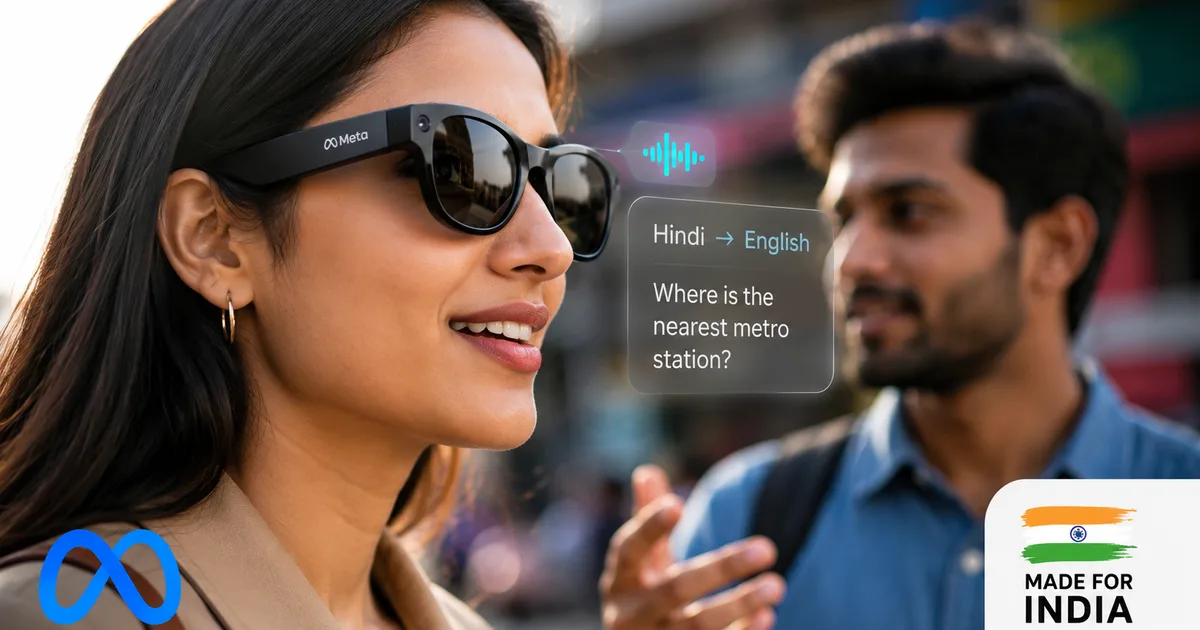
Honestly, the biggest feature this year is live translation. We've had translation apps on our phones for ages. But pulling out your phone and pointing a camera at a menu feels weird in the middle of a conversation. So Meta wants to remove that friction completely.
How live AI translation works on Meta glasses
You look at a sign in French. Then you ask the glasses what it says. The AI translates it instantly. And it works for spoken conversations too. You can talk to someone speaking a different language and hear the translation straight through the built-in speakers.
I think this is a super practical use of tech. It goes way beyond the basic photo and video capture we saw in older smart glasses. Basically, it is a universal translator built into a standard pair of glasses (which is wild, honestly).
The developer community is also building some crazy third-party tools for this hardware. For instance, some developers made a tool called Hand Wave. It uses the camera on the Meta smart glasses to read sign language and convert it into text and speech. The coolest part is that it runs locally. The glasses process the sign language through a lightweight neural network right on the device itself. They don't stream your video feed to cloud servers constantly. I'm not sure exactly why other companies haven't done this sooner, but it's a massive win for accessibility.
If you're interested in local language tools, you should read our Bhashini AI app guide to see how government tools compare for Indian languages. The Bhashini project is doing similar translation work specifically for local dialects.
The translation feature on the Meta glasses runs on their in-house AI models. But they have serious competition right now. Google is building the exact same thing. They announced their own Android XR glasses with Gemini AI at I/O 2026. And they partnered with Samsung and Qualcomm to build the hardware. Google also confirmed they're working with brands like Gentle Monster and Warby Parker for the frames.
Thing is, Google is splitting their release into two categories. Audio glasses launch first this fall. Display glasses will follow later. They also showed off a live translation feature that actually matches the speaker's original tone and pitch. Plus, Google confirmed support for third-party apps like Uber, WhatsApp, Doordash, and Mondly. So Meta is going to have to hustle to compete with Google's massive app ecosystem.
India availability and local features
Meta hasn't given an exact release date for the Meta Smart Glasses 2026 in India yet. But they're definitely testing the waters for a full launch.
Just last month, Meta added live cricket updates to their older Ray-Ban and Oakley smart glasses just for Indian users. You get voice-narrated score alerts, wicket updates, player stats, and match summaries while you're walking down the street. They know cricket is the fastest way to convince Indians to try new tech.
In my experience, they'll probably push these new glasses hard during the upcoming festive season. The Diwali shopping window is huge for consumer electronics here. But they face local competition that knows the market way better.
Indian competitors are building cheaper alternatives
Look, you don't even have to wait for Meta. Indian companies are already launching their own smart glasses right now.
Jio just revealed Jio Frames. These are made-in-India smart glasses. They have a multi-lingual AI voice assistant and a camera on the stem for hands-free tasks. Jio has a long history of undercutting global brands on price. They did it with telecom data, and they did it with feature phones. I fully expect Jio Frames to cost less than Rs. 10,000.
Then there's the Sarvam Kaze. They showed these off at the AI Impact Summit 2026. They look like regular black frames but they have dual front cutouts for cameras. And they can take photos and record videos completely hands-free.
These local options are going to make it really hard for Meta to dominate the market at Rs. 35,000. Most Indian consumers are super price-sensitive. If Jio offers 80 percent of the features for 30 percent of the price, Meta is in trouble. If you want to keep up with these local hardware shifts, bookmark our latest tech news section.
The privacy problem with always-on cameras
This is the part that worries me deeply. India TV News recently reported that the next generation of Meta AI smart glasses might continuously capture audio and images. They're calling it super sensing tech. The idea is that the AI always knows your context, so you don't have to manually ask it to look at things.
That's an absolute privacy nightmare.
Imagine walking into an SBI branch or an ATM. You're wearing glasses that constantly record audio and snap pictures. The security guard will throw you out immediately. Also, the DPDP Act strictly regulates how companies handle personal data in India. If Meta is just constantly processing images of random people on Indian streets, they're going to face immediate legal pushback from the government.
We've all seen how quickly the Indian government reacts to tech controversies. The recent issues with social media platforms show they definitely don't hesitate to take action. You can read about the government action against Meta over deleted posts to understand how strict the IT Rules have become.
Meta is going to have to disable the continuous capture feature for the Indian market. Otherwise, the glasses will just be banned in secure locations like malls, airports, banks, and corporate offices (which makes sense, actually). People are already pretty uncomfortable with surveillance cameras in public spaces. Putting a sneaky, unblinking camera on a stranger's face just makes it a mess.
Hardware specs and battery life
The physical hardware is decent. The main specifications are straightforward:
- A 12MP camera for high-resolution photos and video capture.
- An 8-hour battery life on a single charge.
- A new charging stand designed for the 2026 models.
- Built-in speakers for audio feedback and phone calls.
You should know that the $299 Meta glasses don't actually have screens in the lenses. They rely totally on audio and the camera. Meta did announce a more expensive pair called Ray-Ban Display glasses last year for $799, and those actually have screens built in. But the cheaper $299 model uses only voice and audio feedback.
This makes a lot of sense from an engineering side. Putting high-resolution displays inside transparent lenses is expensive. Plus, it drains the battery incredibly fast. Audio is a much better way to interact with an AI assistant while walking around a busy street. It keeps your eyes on the road.
Meta is marketing these glasses pretty aggressively right now. They want to own a hardware platform for the AI era because they lost the smartphone war to Apple and Google. And honestly, Zuckerberg has found way more success with smart glasses than he ever did with those VR headsets. Right now, Meta and EssilorLuxottica completely dominate the smart glasses market with an estimated market share of more than 80 percent.
But the competition is heating up fast. Snap just announced their new Specs for $2,195. Google is coming back strong with Android XR. It's getting crowded in this space.
Smart glasses versus AI glasses
There's some confusion online about what actually makes these glasses smart. Older smart glasses were basically just bluetooth speakers attached to plastic frames. You could listen to music and answer phone calls.
AI glasses have dedicated processors like the Snapdragon AR1 chip. This chip handles complex tasks locally. It lets the AI understand your real-time surroundings. That's the main difference between older models and the new Meta Smart Glasses 2026. The new ones actually process visual data and can answer questions about the physical world right in front of you.
Are smart glasses actually worth buying?
If you ask me, I was deeply skeptical about smart glasses a year ago. I just thought they were an overpriced product for tech influencers.
My opinion has changed a bit. Taking a photo without pulling out your phone is incredibly fast. You capture candid moments you'd normally miss entirely. The live translation feature is genuinely helpful when you're traveling or reading documents in a language you don't read well.
But you have to decide if that minor convenience is worth Rs. 35,000.
Most people just use their smartphones for translation and photos. Pulling a phone out of your pocket takes maybe three seconds. Spending a month's rent just to save those three seconds is a sketchy pitch for the average Indian buyer.
I think the upcoming Jio Frames have a much better chance of going mainstream here, simply because of the expected price. Sure, Meta will sell a few thousand units to early adopters in Bengaluru, Mumbai, Pune, and Delhi. But they won't reach the masses until the price drops significantly.
If you're thinking about buying them right away, just wait. Let the early buyers test them out first. See how well the live translation actually handles Indian accents and mixed languages like Hinglish. The numbers here are a bit fuzzy, but Meta's voice models often struggle with our regional dialects. Until they prove it works perfectly for a local Indian context, keep your money in the bank.
I'll update this post once we get official Indian pricing and a firm launch date from Meta.