I keep seeing the same WhatsApp forwards every morning. The ones claiming your FASTag is going to be completely useless in a few months. Let's get this straight right now. The whole 'NHAI GNSS-Based FASTag Toll Collection 2026 Rollout: How Satellite Tolling Works and Impact on Indian Commuters Explained' headline you keep seeing is basically the most misunderstood topic on the Indian internet today.
Look, the government is indeed testing something new. It's called GNSS, or Global Navigation Satellite System tolling. But despite what that panic-inducing YouTube video told you, toll plazas aren't vanishing overnight. You aren't going to wake up tomorrow to find your windshield sticker is a piece of trash. Not gonna happen.
Here's the deal. FASTag was a massive shift. Remember the days of fishing for coins while the guy behind you honked his horn to death? (Annoying, I know). We moved past that. Now, the National Highways Authority of India wants to solve the next problem. Paying for roads you didn't even use.
Why we are talking about satellite tolling right now
Honestly, the current system has a glaring flaw. You drive on a highway. You cross a toll plaza. You pay a flat rate of around Rs 150. But what if you exit just five kilometers after that plaza? You still paid the full Rs 150. That's just unfair. You basically subsidized the guy who drove the entire 50-kilometer stretch.
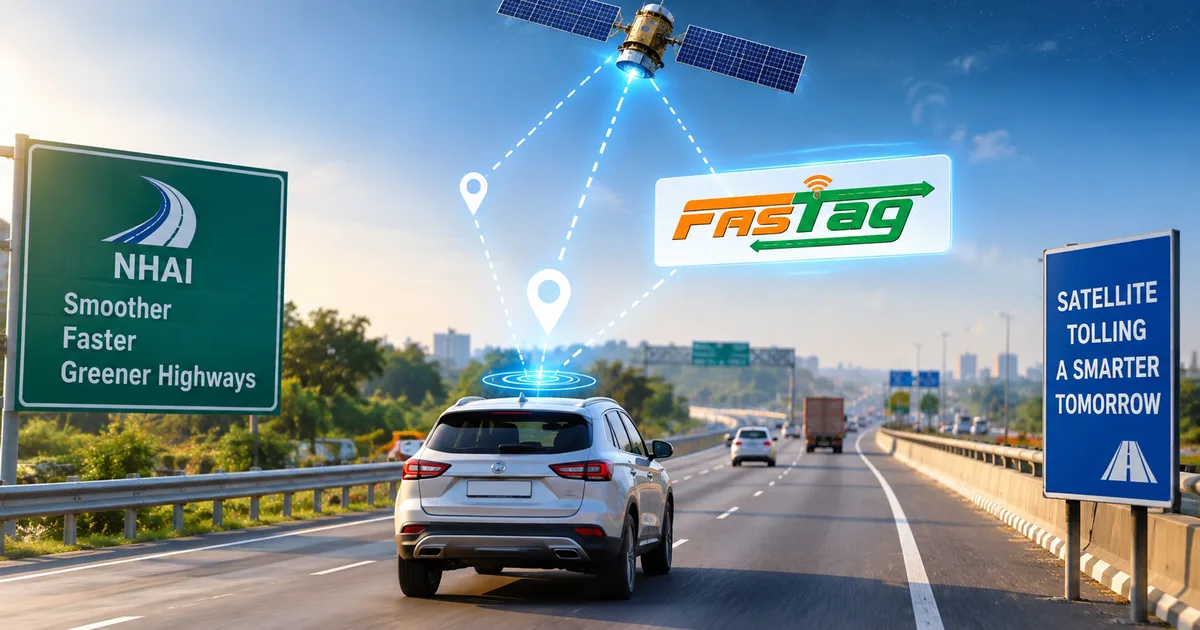
Satellite tolling fixes this mess. It tracks exactly where you enter the highway and exactly where you exit. It calculates the exact distance. And it charges your linked bank account or UPI only for those specific kilometers. If you drive 10 kilometers, you pay for 10 kilometers.
Nitin Gadkari has been pushing this hard. He recently said that highway agencies shouldn't charge tolls for pothole-filled or muddy roads.
"We cannot expect people to pay premium toll rates when the service provided is subpar. If a road is full of potholes, the toll collection must stop until it is fixed."
And that ties perfectly into this new tech. The NHAI is setting up a system where precision matters. They recently organized a workshop on global navigation satellite system-based tolling to get stakeholders on the same page. If you ask me, this is long overdue. If you follow our Latest Tech News, you know the government has been hinting at barrier-free roads for a while. They say barrier-free tolling could save the country around Rs 7,000 crore just in wasted fuel and time.
How GNSS actually works in your car
This is where people get confused. They think the government is just going to track their phone's GPS. Nope. That would be a privacy nightmare. Phone batteries die. And network drops happen all the time.
Instead, your car will need an On-Board Unit, or OBU. Think of it as a much smarter hardware version of your FASTag. This OBU talks to satellites constantly. It specifically uses India's own NavIC satellite constellation along with standard GPS and GLONASS systems.
Here is the step-by-step of what happens when you take a road trip:
- You merge onto a national highway. Virtual trip wires, created by software coordinates, detect your OBU crossing onto the tolled road.
- The system logs your entry point securely.
- As you drive, the system tracks your distance on that specific highway corridor without needing physical gates.
- You take your exit. The virtual trip wire logs you out of the toll zone.
- The backend software calculates the exact distance down to the meter, multiplies it by the per-kilometer rate for your vehicle class, and deducts the money straight from your linked wallet.
No stopping. No slowing down to 10 km/h so the scanner can read your tag. No barriers hitting the roof of your car because the sensor failed. Just a smooth drive.
The rumors versus the facts on the timeline
A few weeks ago, headlines went wild claiming FASTag would be completely replaced by May 2025. Then it became May 2026. Then the government stepped in and calmed everyone down.
The truth? The government officially denied any nationwide rollout replacing FASTag.
What they're actually doing is a hybrid approach. When you drive up to a toll plaza in 2026, you'll probably see a dedicated GNSS lane on the extreme left or right. If you have the new OBU installed, you zip through that lane at normal speed without stopping. But if you still have a regular FASTag, you just go through the normal lanes like you do today. They're going to coexist for a long time.
It makes total sense. You can't just force 300 million drivers to buy new hardware in six months. In my experience, government tech timelines always stretch out anyway. We saw how long the original FASTag rollout took (which was a mess at first, let's be real). For a deep dive into the timeline, I suggest checking out our GNSS Satellite Toll Collection in India: The 2026 Guide to see how they plan to phase it in. First commercial vehicles, then private cars.
What changes for Indian commuters
If you commute daily via a tolled road, this is mostly good news.
First, the traffic jams at plazas will shrink. The NHAI is already testing AI toll booths without barriers. They use advanced cameras to read license plates as a backup. When you combine AI cameras with satellite OBUs, you get a highway where nobody hits the brakes. This means less fuel burnt while idling. And that's great for your wallet.
Second, the cost factor. Right now, if you live near a toll plaza but work on the other side, you pay a heavy price for a short commute. Unless you get a local monthly pass, which requires paperwork and Aadhaar verification. Under GNSS, your short trip costs exactly what it should cost. Five rupees instead of fifty.
But there are serious concerns.
Privacy is the big one. If a government system is tracking your exact highway movements, where does that data go? How long is it stored? The upcoming DPDP Act will have a lot to say about this. We cover these policy shifts heavily in our Tech Explainers section, and believe me, the data storage rules for GNSS are going to be hotly debated. The government claims they only track you on the designated highway. But people are rightfully skeptical.
Then there's the hardware cost. Who pays for the OBU? Will the transport ministry subsidize it? I'm not exactly sure how that part will play out. New cars will probably come with it pre-installed. But if you drive a 2012 Maruti Swift, you'll have to buy it aftermarket. Expect a wave of fake OBU scams once this goes mainstream, which we'll track in our Scam Alerts & Safety hub. Scammers will definitely send SMS messages saying 'Your GNSS OBU is blocked, click here to update via DigiLocker' and drain your bank account.
The messy reality of enforcement and tech failures
Technology is easy in a lab. Enforcement on Indian roads is incredibly hard.
What happens if someone unplugs their OBU mid-journey? Or wraps it in aluminum foil to block the satellite signal? Or what if the battery simply dies? The NHAI has thought of this. This is exactly why they're keeping the physical plazas with Automatic Number Plate Recognition (ANPR) cameras as a failsafe.
If your OBU suddenly goes dark between Delhi and Jaipur, the cameras mounted on gantries along the highway will catch your license plate. The backend software will cross-reference the gap in your satellite data with the camera timestamps. And they'll fine you heavily for tampering. The tight integration with the national Vahan database means they know exactly who you are and what car you drive.
There's also the issue of heavy rain. Anyone who uses Google Maps during the monsoon knows GPS can get weird. The dual system of NavIC and GPS should help. But there will absolutely be days where the system charges someone wrong. The numbers here are a bit fuzzy, but we know signal drops happen. I think the dispute resolution mechanism better be bulletproof. Otherwise, consumer courts are going to be flooded.
Commercial transport gets the biggest upgrade
While private car owners are debating privacy, the trucking industry is watching this closely. Truckers lose days every month just waiting at borders and plazas.
With a fully integrated GNSS system, a truck carrying goods from Chennai to Mumbai can theoretically do the entire run without stopping for a single toll barrier. Fleet managers will love this. They get exact route tracking baked right into the tolling system. They pay exact distance tolls, making their cost calculations way more accurate.
The government will likely mandate OBUs for commercial vehicles long before they force private cars to adopt them. It's the easiest way to test the system at scale. Plus, they're dealing with a smaller, more regulated group of users.
Processing the payments behind the scenes
We also need to look at how the payment deductions will actually process. Right now, FASTag uses a prepaid wallet model for most people. You can link it directly to a bank account, too. But with GNSS, the volume of micro-transactions will explode. If you pass through three different tolled sections in a city, the system has to make a choice. Does it hit your bank account three times for small amounts? Or does it batch them together at the end of the day?
The RBI and the National Payments Corporation of India (NPCI) are setting up the clearinghouse for this. We'll likely see a system where your UPI auto-pay mandate handles a daily settlement. You won't get pinged with an SMS for every five rupees spent (which is a huge relief, honestly). Think about how smooth UPI has made buying groceries. The government wants that exact same friction-free experience for driving on national highways.
Why FASTag is sticking around for the long haul
Let's be real. FASTag works. It collects over Rs 150 crore a day. The government isn't going to throw away a system that prints money reliably just because a new shiny toy exists.
FASTag operates on simple RFID technology. It's cheap to produce. The sticker costs barely Rs 100. It doesn't need a battery. It doesn't break unless you physically scrape it off the glass. Satellite OBUs have complex electronics. They need a power source from the car. They can malfunction or suffer from heat damage under the harsh Indian sun.
So, FASTag stays. It will be the fallback. It'll be the default for city tolls and parking lots. It's what you'll use when your GNSS unit breaks down in the middle of nowhere.
The transition will be slow. We'll probably see a pilot program on the Dwarka Expressway or the new Delhi-Mumbai Expressway stretches first. Then a few more greenfield corridors. Then, maybe by 2030 or 2032, we can talk about removing physical plazas entirely.
Until then, just keep your FASTag topped up. Link it to your UPI app and ignore the WhatsApp forwards telling you to peel it off. The satellite system is definitely coming. But it's taking the slow route, so you have plenty of time.