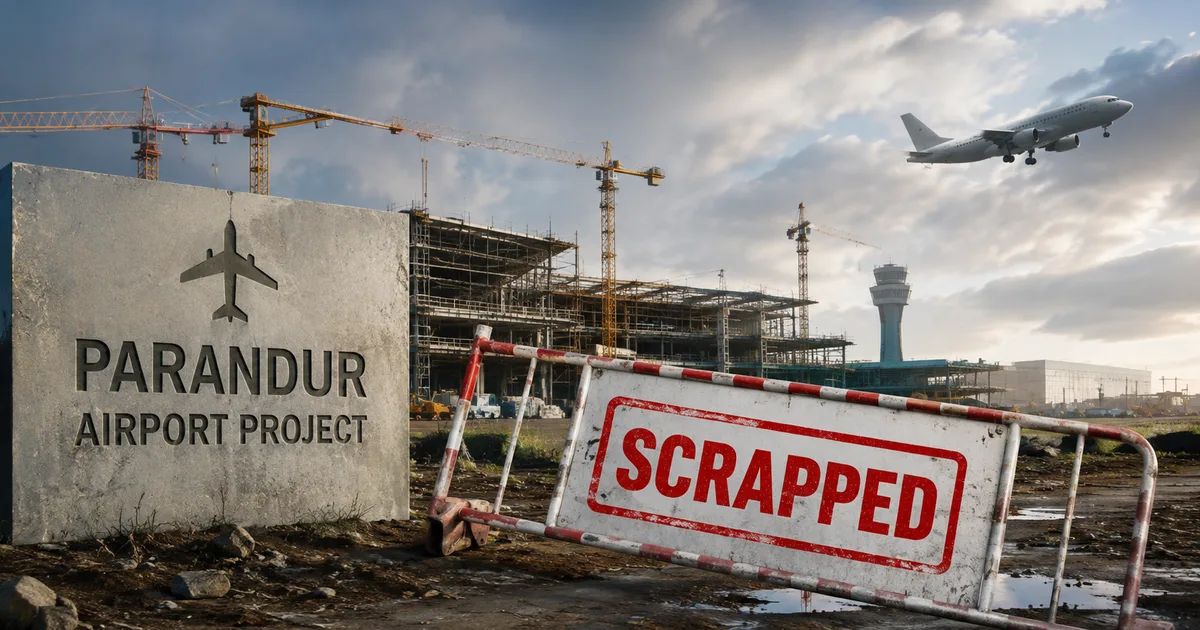
If you bought a plot of land near Sunguvarchatram or Sriperumbudur hoping for a windfall from the new airport, you're probably making some stressed phone calls right now. On August 24, 2026, the Tamil Nadu government officially dropped the massive infrastructure plan. Yes, the Parandur Airport Project Scrapped 2026 news is completely real. And it's sending shockwaves through Kancheepuram district.
I've been following this saga since 2022. But the story actually starts way earlier. The proposal for a second airport dates back to 1999 (wild, right?) when the DMK government first conceived the idea. They knew Meenambakkam would eventually run out of space. Decades passed. Various sites were debated. Finally, Parandur was selected.
Honestly, it was always a bit of a mess. The government wanted a shiny new greenfield airport to handle 100 million passengers a year. But the locals in Eganapuram and surrounding villages just wanted to keep their farms. They wanted to keep their waterbodies. Chief Minister C. Joseph Vijay finally pulled the plug in the Assembly. He stated that while Chennai desperately needs a second airport to manage cargo or passenger growth, it can't come at the cost of farmers' livelihoods. In my experience, these mega-projects always underestimate local resistance.
When the announcement dropped, the political fallout was immediate. The erstwhile DMK government started the land acquisition process. So they heavily criticized the move. They slammed the cancellation. They argued that dropping a ₹27,400 crore project sends a terrible signal to foreign investors or manufacturing giants looking at Tamil Nadu. They've got a point.
Global companies want reliable infrastructure. When a state cancels its largest ongoing infrastructure project, it makes boardrooms nervous. I think it's a messy political fight that's far from over.
This decision is a huge deal. We're talking about a project that was supposed to redefine the state's economy. It completely rewrites the script for real estate development west of Chennai.
So, what actually went wrong? And more importantly, what happens to all that land they already acquired?
Why the Parandur airport project was scrapped in 2026
You don't just cancel a ₹27,400 crore infrastructure project overnight without a massive fight. The pressure had been building for four solid years. When Parandur was selected for Chennai's second airport, the blueprint called for acquiring about 3,000 acres of land. A huge chunk of that was fertile agricultural land. It also included essential local waterbodies.
The residents of Eganapuram and surrounding villages started protesting almost immediately in 2022. They refused to move. They argued the project would destroy their environment. It would wipe out generations of farming heritage. The protests never stopped. They just got louder.
People refused to give up their ancestral homes for a runway.
Then politics happened. During the run-up to the elections, C. Joseph Vijay visited Eganapuram on January 20, 2025. He sat down with the locals. He heard their grievances directly. And he even spoke against the Parandur site at a public meeting in Vikravandi later that year.
Once his TVK-led government took power, he had a promise to keep. During the Assembly session on August 24, Vijay made it official.
"To fulfill the promise I made to the people that day... the steps taken to establish a new airport in Parandur will be abandoned by this government. I stand firmly with the people protesting against the airport to be established in Chennai's Parandur and 12 surrounding villages."
He didn't mince words. He backed the farmers completely. He noted that while he supports industrial development, this specific location was wrong. The cost to the environment was simply too high. Same goes for the displacement of families.
The immediate impact on Chennai real estate
This is where things get incredibly complicated for investors. Whenever a massive infrastructure project is announced in India, land prices nearby skyrocket. Parandur was no exception. From 2022 onwards, real estate promoters flooded Kancheepuram district. They bought up parcels of land. They carved them into plots. Then they sold them with the promise of huge returns once the airport opened. I think a lot of people got caught up in the hype.
Now, that speculative bubble has burst.
If you look at the areas around Sriperumbudur or Sunguvarchatram, property values are going to see a sharp correction. People bought agricultural land at inflated commercial rates. But without the airport to drive demand for hotels or logistics hubs, those plots are suddenly just regular land. They're located far from the city center. It reminds me a bit of the uncertainty we saw when reading about the Tata Motors Demerger 2026: Investor Impact Explained, where sudden massive shifts leave retail investors holding the bag.
The secondary market for these plots is basically frozen right now. Nobody wants to buy land near a cancelled airport. The developers who hoarded large tracts are probably sweating. Some might try to hold on. They're hoping the alternative airport site will still be close by. But the reality is that the guaranteed return on investment has vanished (annoying, I know).
Think about the people who bought small parcels of land for their retirement. They trusted the government announcements. They looked at the massive highway expansions being planned to connect Parandur to the city. Now, they're stuck. The banks that offered loans against these speculative land purchases might also be looking at their risk exposure.
Real estate is heavily sentiment-driven in India. The sentiment around the Kancheepuram corridor just took a massive hit. If you were banking on an early retirement from flipping a half-acre plot, you might need a backup plan. Speaking of which, the recent Chennai Woman Early Retirement Viral Story 2026 Explained shows there are other ways to plan your finances. But speculative real estate is always a huge gamble.
What happens to the 1,700 acres already acquired?
This is the biggest administrative headache the state government faces right now. The previous DMK government didn't just draw lines on a map. They actually acquired roughly 1,700 acres of agricultural land for the project.
So, what does the government do with it?
They can't easily give it back. Land acquisition under the law is a complex, finalized process once compensation is paid. Reversing it involves massive legal and bureaucratic hurdles.
Will they use it for a different industrial park? Will they try to establish a massive solar farm? Will they just leave it vacant? The Chief Minister hasn't provided a clear answer on this yet. I'm not sure exactly why. It's a huge chunk of real estate sitting in limbo. The farmers who took the compensation and moved on are probably relieved. But the ones who fought to stay have won a major victory.
Where will the new second airport go?
Chennai absolutely needs a second airport. There's no debating this fact. Chief Minister Vijay acknowledged this in his assembly speech. He pointed out that the current airport handles around 30 million passengers annually. Even with the new Terminal 3 coming online to push that capacity to 34 million, the city will run out of space very soon.
Passenger demand is trending upwards. Industrial growth is too. Chennai is a massive manufacturing hub. Cars or electronics need to move fast. Air cargo is essential for the supply chain.
The government is actively looking for an alternative site. When searching for a new site, they'll have to balance several strict requirements:
- At least 3,000 acres of contiguous land
- Minimal impact on agricultural lands and existing waterbodies
- Reasonable connectivity to central Chennai and major highways
- Clear airspace devoid of existing defense restrictions
They'll have to compromise. They might have to build further out. Maybe push towards the southern corridor near Chengalpattu. Or look further north past Tiruvallur. Wherever they point their finger next, you can bet technical feasibility studies will be scrutinized like never before. Same with environmental impact assessments. The public won't accept another half-baked plan. If you ask me, finding 3,000 acres is going to be incredibly tough.
Expanding Meenambakkam in the meantime
Because a new greenfield airport is now at least a decade away, the Airports Authority of India and the state government have to expand the current setup. The Chief Minister mentioned plans to expand the airport on its north-western side.
This will likely involve acquiring some land from the adjacent defense establishments. Or pushing into heavily populated neighborhoods. Expanding an airport in the middle of a dense urban center is a total nightmare. It means more traffic congestion on GST Road. It means more noise pollution for residents in Pallavaram or Chromepet. And it's a very tight squeeze for airlines.
It also means airlines can't easily add new international routes. They simply don't have the runway slots or parking bays available during peak hours (a logistical nightmare, to be honest). If you want to keep up with the latest updates on infrastructure policies or how they affect tech companies, you can always check our Latest Tech News section.
The bigger picture for infrastructure in Tamil Nadu
Let's talk about the logistics sector too. The whole Chennai-Bengaluru industrial corridor relies heavily on quick freight movement. The cancellation of Parandur means logistics companies have to rethink their warehouse locations. They had planned massive facilities anticipating air cargo access within a thirty-minute drive. Now, those plans are basically scrapped. They've got to wait for the new site announcement. That delays thousands of jobs or billions in investment.
And the public transportation links that were planned are now completely in question. This includes the proposed Metro Rail extension to Parandur. Will the Metro still expand out that far? Probably not. The funds will likely be diverted to wherever the new airport is built. That completely changes the future transport map of the Chennai suburbs.
There's also a broader question about how Tamil Nadu handles large infrastructure. The state has a history of long delays. Look at the Maduravoyal elevated expressway or the various desalination plants. When you add a cancelled ₹27,400 crore airport to that list, it builds a sketchy narrative. It makes getting big things done here look exceptionally difficult.
The government has to counter this narrative fast. They need to identify the new land. They need to fast-track the environmental clearances. And they must get shovels in the ground before the next election cycle.
There's a massive lesson here for how infrastructure is planned in India. You can't just draw a massive circle on a map and expect people to quietly pack up their lives. The resistance at Parandur was incredibly well-organized. They used social media effectively. They held continuous sit-ins. Then they turned it into a primary political issue during the elections.
The days of quietly bulldozing through environmental concerns are fading fast. I think the government learned a very expensive, very public lesson.
For real estate investors, the lesson is equally harsh. Speculative buying based on government announcements carries massive risk. Until the first brick is laid or the runway is paved, nothing is guaranteed. You might buy a plot expecting a booming logistics hub. And you end up with a patch of dirt next to a cancelled project.
The focus now shifts entirely to the government's next move. They have to find a new site quickly. Chennai is competing with Bengaluru or Hyderabad for major investments. Both of those cities have massive, functional international airports. They've got plenty of room to grow. Chennai is currently fighting with one hand tied behind its back.
We'll be watching closely to see where the next site is proposed. The numbers here are a bit fuzzy, but I just hope they pick a spot with fewer farms. And more empty space this time. If you want to understand more about how these large scale policy shifts work, browse our Tech Explainers for detailed breakdowns.