If you have ever tried buying a plot of land in India, you know the headache. The endless visits to the local registrar office. The confusing revenue maps. The nagging fear that someone else might actually hold a claim to the piece of dirt you just paid 50 lakh rupees for.
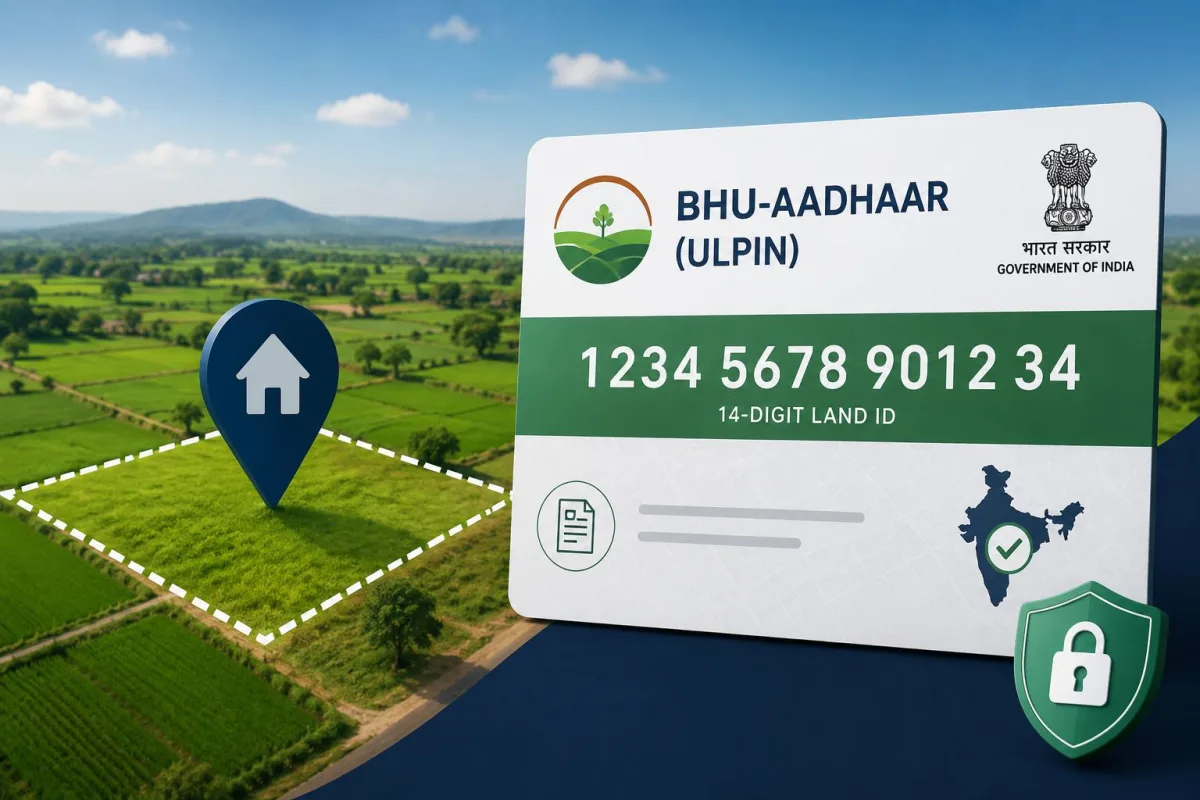
This is exactly what Bhu-Aadhaar (ULPIN) is trying to fix. The government is basically giving your land its own Aadhaar card.
It sounds like just another government acronym, but this one actually matters if you own property or plan to buy some. The system has been rolling out slowly over the last few years. Now, in 2026, it is picking up serious speed. Delhi just announced that every single land parcel in the city will get this ID.
So what is this 14-digit number, and how does it change the way we manage real estate in India? Let me break it down.
What exactly is Bhu-Aadhaar (ULPIN)?
ULPIN stands for Unique Land Parcel Identification Number. Most people just call it Bhu-Aadhaar. It is a 14-digit alphanumeric code assigned to a specific piece of land.
Think about how your personal Aadhaar card works. Your 12-digit number is tied to your fingerprints and iris scans. It proves you are you. Bhu-Aadhaar does the same thing for a plot of land, but instead of fingerprints, it uses geography.
The 14-digit code is generated using the exact latitude and longitude coordinates of the land's corners. This means the number is mathematically tied to a specific spot on planet Earth. You cannot pick up a plot of land and move it to another city. The code locks the ownership records to those exact GPS coordinates.
When you look at traditional land records in India, they rely on survey numbers, khata numbers, or khasra numbers. These systems were created by the British. They vary wildly from state to state. A survey number in Punjab looks completely different from a survey number in Tamil Nadu.
Bhu-Aadhaar creates one single standard for the entire country. If a bank in Mumbai wants to verify a property in rural Bihar, they just check the 14-digit code in a central database.
The technology mapping our backyards
You might be wondering how the government actually knows the exact borders of every farm and empty lot in the country. They are doing it from the sky.
Under a massive program called SVAMITVA, the government has been flying survey drones over thousands of Indian villages. These drones map the boundaries of properties with incredible accuracy. Once the map is generated, the local administration verifies who owns what, and then the software spits out the 14-digit ULPIN.
If you split your land into two pieces to give to your children, the original Bhu-Aadhaar number is retired forever. The system generates two brand new 14-digit codes for the newly created plots. This prevents old paperwork from confusing new ownership.
It is a massive upgrade from the old system where village accountants maintained fragile paper maps tied up in red cloth. Those maps were easily altered or damaged by termites. They often mysteriously disappeared when someone paid a bribe. A digital, coordinate-based ID cannot be eaten by insects.
Why the sudden push in 2026?
The project has been crawling along, but 2026 is shaping up to be the deadline year. According to recent reports, about 30% of rural land parcels finally have their Bhu-Aadhaar codes. The central government is pushing states hard to finish the remaining 70% by the end of this year.
We are also seeing urban areas jump on board. In early 2026, Delhi Chief Minister Rekha Gupta launched the scheme for the national capital. The goal is to stamp out boundary disputes in one of the most expensive real estate markets in the country.
The end goal is a completely digitized land registry where buying property is as simple and transparent as buying mutual funds.
This is a massive administrative shift. Property disputes are choking the Indian justice system. Millions of civil cases currently pending in Indian courts are just people fighting over property lines. A standardized digital ID could drastically cut down future lawsuits. Honestly, if this works even half as well as intended, it will save everyday Indians decades of court battles.
How this protects you from property scams
Real estate fraud is unfortunately common here. You can read our detailed breakdown of property scams to see how creative fraudsters get. But one of the oldest tricks in the book is the double sale.
A fraudster takes a vacant plot of land and creates fake registry papers. They sell the same piece of land to two different buyers over the span of a week. By the time the buyers realize what happened, the fraudster has taken the cash and vanished.
Bhu-Aadhaar makes this nearly impossible. Because the land is tied to a central digital ledger, the moment a sale is registered against that 14-digit code, the system updates everywhere. A sub-registrar office will instantly see that the ULPIN changed ownership two days ago. They will block the second sale immediately.
It also links property directly to your personal Aadhaar and PAN. This prevents people from registering properties under fake names or non-existent relatives to hide black money.
Getting loans will become much faster
Taking a loan against property today is a miserable experience. You have to submit thick files of old sale deeds and encumbrance certificates. You also have to dig up years of property tax receipts. The bank then hires an independent lawyer to verify the physical documents. This takes weeks and you pay the legal fees.
Bhu-Aadhaar connects property records directly to the broader financial system. It integrates perfectly with newer lending frameworks. Just like how UPI changed payments, we are seeing new credit networks change loans.
When you apply for a loan, you will just give the bank your 14-digit ULPIN. The bank's software will talk directly to the government's land record database. They will instantly see your name, the exact size of the land, and whether there are any existing loans or legal disputes attached to it. Approval times could drop from three weeks to three minutes. I tested a similar digital verification process last month, and the speed difference is staggering.
How to find your Bhu-Aadhaar number
You do not need to stand in a queue at a government office to get this done. The entire rollout is digital.
The process varies slightly depending on where you live, because land is a state subject in India. But the general steps are the same across the board. Look for the right digital government tools in your state.
- Go to your state's official land records portal. For example, Bhoomi in Karnataka, Bhulekh in Uttar Pradesh, or AnyRoR in Gujarat.
- Look for the option that says "View Property Card" or "Check ULPIN".
- You will need your basic property details to run the search. Have your district, taluk, village name, and your old survey number ready.
- The portal will pull up your digital record. If your area has been mapped, the 14-digit Bhu-Aadhaar number will be printed right at the top of the document.
- Download the PDF.
You can also link this directly to your DigiLocker account. Once it is in DigiLocker, you never have to carry physical property papers to a government office again. Just open the app on your phone and show them the verified digital document.
What happens if your name is spelled wrong?
If you find your property on the portal but notice an error in your name or the land area, do not ignore it. Since this 14-digit code will be the ultimate source of truth for your property, any mistakes now will cause massive headaches when you try to sell.
Most state portals have an online grievance redressal system. You can raise a ticket, upload your original registered sale deed as proof, and request a correction. If the online system fails, you will need to physically visit the local tehsildar office. Bring your Aadhaar card, the original property documents, and a printout of the incorrect digital record. Get it fixed while the system is still in the rollout phase. I know, sounds like exactly the kind of chore we are trying to avoid. But a misspelled name on a digital land record will definitely stop a future sale.
The reality check on the rollout
I like the idea behind ULPIN. It is a huge upgrade for India. But it is not a perfect system yet, and the rollout is facing serious friction on the ground.
For starters, drones cannot see through thick tree cover. In heavily forested areas or dense agricultural belts, generating accurate boundary maps is proving very difficult. Sometimes the satellite data mismatches the physical reality on the ground by a few meters. This leads to arguments between neighbors who never had a problem before.
Then you have the legacy disputes. Bhu-Aadhaar can only be assigned to a property with clear ownership. If you and your cousins are currently fighting in a civil court over who inherited an ancestral house, the government cannot issue a ULPIN. That property just sits in limbo until the court decides.
And we have to talk about the servers. State land portal websites are notoriously buggy. They go down for maintenance frequently or simply crash when too many people try to download their records at once. If property registration becomes entirely dependent on a central server verifying a 14-digit code, a server crash means no property can be bought or sold that day.
Still, these are growing pains. The transition from paper maps to digital coordinates is messy, but it is entirely necessary. The 14-digit Bhu-Aadhaar is going to become just as routine as your PAN card or your bank account number. If you own property, you should probably check your state's portal this weekend and see if your land has been tagged yet. It takes five minutes, and it might save you a lot of paperwork down the line.