Picture this. You are traveling in a crowded local train. You are trying to catch the final overs of a cricket match on your phone. The moment a crucial wicket falls, the stream drops to an unwatchable blur or starts buffering endlessly. You just stare at the spinning circle on your screen. The cell towers near the station simply cannot handle thousands of people streaming video at the exact same time. This is a daily frustration for most of us living in crowded Indian cities. Now imagine opening an app and watching that same high-definition broadcast without using a single megabyte of your daily data limit. Imagine a video feed that never buffers, even if a million people in your city are watching it at the exact same second. That is exactly what Direct-to-Mobile (D2M) broadcasting promises to do.
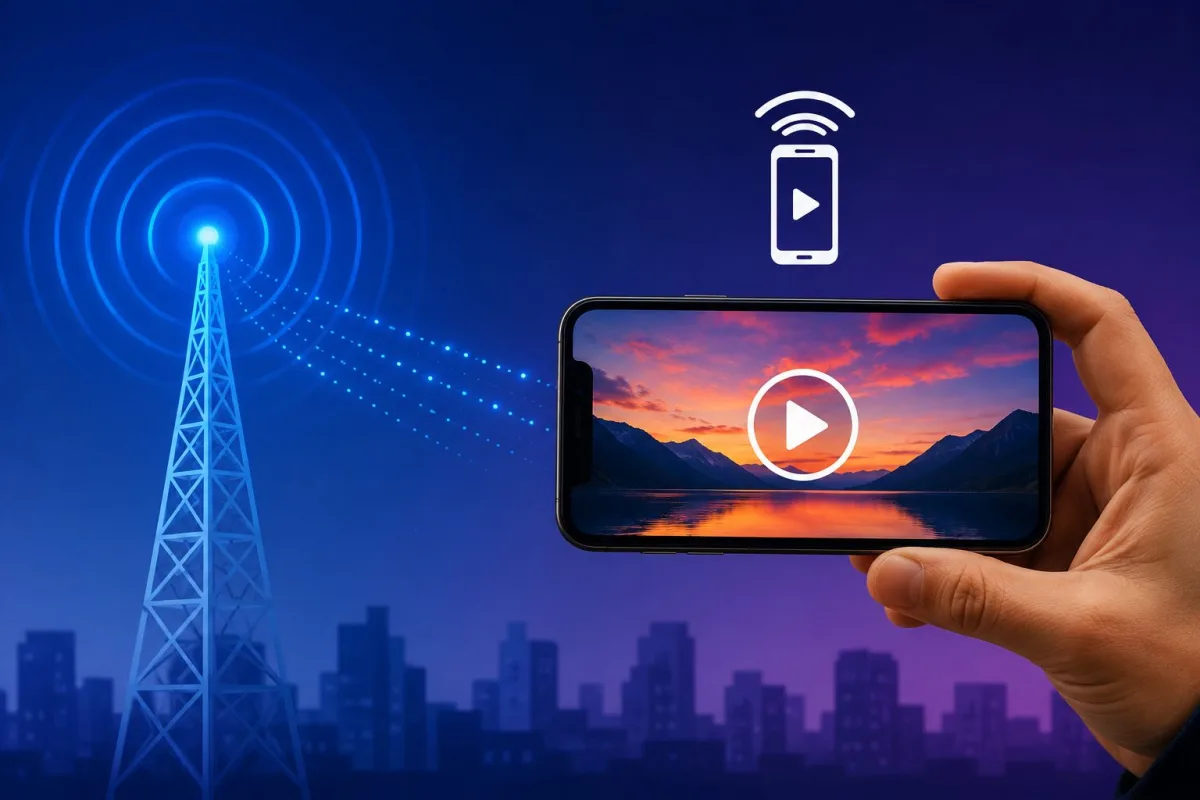
Direct-to-Mobile (D2M) broadcasting is a technology that allows your smartphone to receive video and audio feeds directly from broadcasting towers. It bypasses the internet entirely. It is a massive shift in how we consume content, and the Indian government is heavily pushing it in 2026. Let me explain exactly how this works and why it matters for your daily phone usage.
What is direct-to-mobile (D2M) broadcasting?
Think about how you listen to FM radio on your phone. You plug in your wired earphones to act as an antenna, open the radio app, and listen to music. You do not need an Airtel or Jio data pack for this. The radio station broadcasts a signal over the air, and your phone simply catches it. D2M is essentially that exact same concept, but designed for high-quality video and data.
Right now, if one million people in Mumbai watch a live news channel on their phones, the telecom networks have to send one million individual data streams to those devices. This is called a unicast system. It creates massive traffic jams on cellular networks. With D2M, a broadcasting tower sends out just one single, powerful video signal. Any compatible phone within range can pick up that signal simultaneously. It does not matter if ten people or ten million people are tuning in. The network will never slow down, and your video will never buffer.
How does the technology actually work?
You might be wondering how your phone can pull high-definition video out of thin air. It relies on digital terrestrial broadcasting. For decades, Doordarshan used terrestrial towers to beam television channels into our homes through those old metal rooftop antennas. D2M uses modern broadcast standards to send digital signals to miniature antennas placed inside smartphones.
This means you cannot just download a software update or a new app to get D2M on your current smartphone. The device needs a specific hardware chip designed to receive these broadcast frequencies. Mobile brands are currently working on entirely new models to support this standard. Recent reports confirm that HMD and Lava are preparing to launch the first batch of D2M-compatible phones in India as field trials begin.
When you buy one of these new phones, you will likely find a built-in application for broadcasting. You open it, select the broadcast channel you want to watch, and the hardware takes over. Your regular SIM card and Wi-Fi connection go completely unused for that specific video stream.
Why the Indian government is pushing this in 2026
India consumes more mobile data per person than almost any other country. A massive chunk of that data goes toward video streaming. The Ministry of Information and Broadcasting (MIB) realized that pushing all this video through standard telecom networks is highly inefficient.
A multi-ministry panel recently cleared the rollout path for D2M. The government has several major reasons for wanting this technology in everyone's hands.
- Emergency communication: When internet services are suspended during local unrest, or when natural disasters knock out cell towers, the government has no way to alert citizens. A direct broadcast system bypasses the internet entirely. It allows authorities to send real-time video warnings, weather alerts, and text updates directly to every phone in an affected area.
- Educational access: Millions of students in rural India still struggle with spotty 4G coverage. D2M can broadcast educational content and recorded lectures to remote villages without forcing families to pay for expensive broadband plans.
- Decongesting networks: Moving heavy video traffic off the telecom networks frees up bandwidth for things that actually require the internet, like UPI payments and messaging.
Dr. L. Murugan, Minister of State for Information and Broadcasting, recently stated that this technology creates a robust data pipe for content delivery, which has the transformative potential to reshape mass communication.
To make this a reality, Prasar Bharati has appointed the consulting firm EY to spearhead the nationwide rollout strategy. We will see the first major public rollout by mid-2026, with commercial services expanding later in the year.
The telecom companies are pushing back
If you can watch live sports and news without using your mobile data, telecom companies lose money. This is the main reason D2M has faced heavy delays. Telecom operators argue that they spent billions of rupees buying 5G spectrum and building infrastructure. If a parallel network suddenly takes away their heaviest data users, their business model takes a massive hit.
They also argue that broadcasting video directly to phones creates an uneven playing field. Telecom operators are subject to strict data laws and heavy licensing fees. They want D2M operators to face the exact same regulatory burdens. Despite these objections, a government Committee of Secretaries officially approved the broadcasting rollout. The government firmly believes that the public benefit of offline video access outweighs the telecom industry's financial concerns.
Will D2M replace YouTube or OTT apps?
Parag Naik of Tejas Networks recently commented that this technology can augment or disrupt platforms like YouTube and Facebook. That is a massive claim. The reality for the average user is a bit more grounded.
D2M is a one-way street. It is a traditional broadcast. You cannot use it to watch highly personalized content like Instagram Reels or specific YouTube tutorials. Those platforms require a two-way internet connection because their algorithms serve a unique feed to every single user based on their search history.
Where D2M will dominate is live, shared events. Think of the IPL finals, Republic Day parades, live election results, or prime-time news broadcasts. Instead of an app streaming a cricket match over the internet and risking a server crash, the app could partner with a D2M network. The application would seamlessly switch to the broadcast signal for the live match. You get an uninterrupted match, and the streaming company saves millions in server hosting costs. You can read more about how internet infrastructure handles high loads in our explainer section.
How much money could you save?
We pay heavily for daily data. While Indian telecom rates are lower than global averages, the prices have been steadily creeping up. Most prepaid users rely on 1.5GB or 2GB daily limits. Watching a single football match in high definition can easily drain that entire daily allowance in two hours. Once your data runs out, you either suffer through incredibly slow speeds or pay extra for a top-up voucher.
If major broadcasters move their live feeds to D2M, your daily data consumption drops drastically. You could theoretically downgrade your telecom plan to a basic 1GB pack just for messaging and quick browsing. For a family of four, these small savings on monthly recharges add up significantly over a year. If you want to know more about saving money digitally, check out our guides on managing tech budgets.
What happens next for mobile buyers?
Right now, there is no need to run out and buy a new phone. The technology is just entering its real-world trial phase in India. The government is heavily focused on getting the broadcast infrastructure ready across major cities first.
When you buy your next smartphone in late 2026 or 2027, you should check the specifications sheet for D2M support. Budget and mid-range phones from Indian manufacturers will likely be the first to adopt this, driven by government incentives. Premium global brands usually wait a few years to see if a regional technology becomes standard before adding new hardware to their flagship models.
A quick warning. If you receive a WhatsApp message or SMS offering an app download to activate D2M on your current phone, ignore it immediately. Since the hardware is not widely available yet, these are fake links and cyber scams designed to install malware and steal your banking details. You cannot download hardware.
Direct-to-mobile broadcasting will not eliminate your need for a standard data plan. You still need the internet for messages, banking, and social media. But if you spend hours watching live TV or sports on your phone, this upcoming technology will make your viewing experience cheaper and infinitely more reliable.