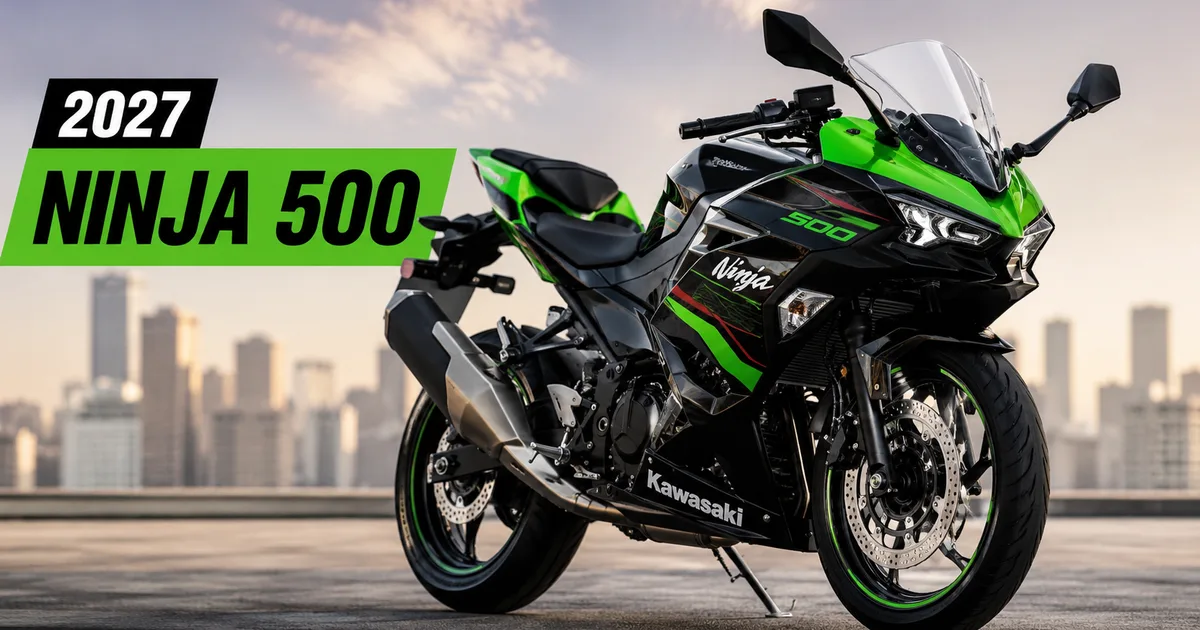
Following the 2027 Kawasaki Ninja 500 India Launch, the expected price and specs, along with the features explained by the company, paint a very clear picture of who this motorcycle is for. The ex-showroom price is Rs 5.76 lakh. I know this sounds steep for a 500cc twin. But the Indian market is highly price-sensitive, and Kawasaki decided to stick to its premium pricing strategy.
This isn't some brand-new bike built from the ground up. Kawasaki basically took the existing Ninja 400 platform, stroked out the engine, and updated the bodywork. They also fixed a major regulatory headache. The older 2026 model had rumors swirling that it'd be axed because it lacked E20 fuel compliance. Now? The 2027 version runs perfectly on E20 petrol.
I've watched international brands adapt to Indian regulations for years now. It usually takes them a year to get their engines ready for ethanol blends. If you read our Tech Explainers, you know E20 compliance isn't optional anymore for vehicle makers in India.
Decoding the Rs 5.76 lakh price tag
Honestly, that Rs 5.76 lakh sticker price is only the beginning. Once you cough up for RTO registration and road tax, plus insurance, the on-road price hits around Rs 6.6 lakh in cities like Bengaluru or Hyderabad. States with cheaper road tax like Gujarat might see numbers closer to Rs 6.3 lakh. (Which makes sense, actually, given the tax brackets.)
So why is it so pricey? The Ninja 500 gets here via the Completely Knocked Down (CKD) route. That means they import the parts and put them together at the India Kawasaki Motors plant in Chakan, Pune. I'm not entirely sure why import duties on CKD kits are still so high, but they're definitely a lot. Local manufacturing would've slashed the price by at least a lakh.
I rang up a few dealerships in Mumbai and Delhi to check on finance schemes. Most banks have a 9% to 10% interest rate on premium bikes. Drop a Rs 1.5 lakh downpayment, and your EMI for a four-year loan lands around Rs 13,000 a month. That puts the bike squarely in territory where buyers are mostly corporate professionals or established business owners, if you ask me.
Just look at the recently launched Realme 16x 5G India Launch to see how tech brands aggressively price for the masses. Kawasaki is doing the complete opposite here. They're totally protecting their brand.
Engine specifications and real-world performance
The Ninja 500 has a 451cc liquid-cooled parallel-twin engine. It pumps out 45 horsepower at 9,000 RPM and 42.6 Nm of torque at 6,000 RPM. Those numbers might not sound totally insane. But they're basically perfect for Indian roads.
I've ridden bikes with over 100 horsepower on our highways. You almost never get to use all that juice. What you really need is solid mid-range torque to blast past a long line of trucks on a two-lane state highway. The Ninja 500 brings that torque a lot earlier in the rev range than the old Ninja 400. And you don't have to keep shifting gears constantly in city traffic.
The six-speed gearbox has a slip and assist clutch. It's a mechanical setup that makes the clutch lever super light. Trust me, when you're stuck in an hour-long jam at Bengaluru's Silk Board junction, a light clutch keeps your left hand from totally cramping up. The assist function also stops the rear wheel from hopping if you downshift hard right before a corner.
E20 fuel compliance explained
Look, this is a big deal. E20 petrol has 20% ethanol mixed with 80% regular fossil fuel. Ethanol is naturally corrosive. If an engine isn't built for it, the fuel lines and rubber seals will degrade. The 2027 Ninja 500 has updated fuel lines and engine mapping to handle the blend safely.
You can top off this bike at any Indian Oil or Bharat Petroleum pump and not stress about engine knocking. That brings serious peace of mind on long interstate runs. Fuel quality out there can be a complete mess sometimes.
Design updates and the return of lime green
Kawasaki finally listened. The 2027 model brings back the classic Lime Green colour. For a long time, they were only selling these darker, muted colours in India. But let's be honest here. If you buy a Ninja, you want people to know it's a Ninja. The bright green paint and KRT (Kawasaki Racing Team) graphics make that happen instantly.
The front end has sharp and angular dual headlamps. They're LED projectors, and they have excellent illumination. I've tested these lights on pitch-black rural roads. The throw is wide enough to catch stray dogs or cattle way before they become a problem.
The side fairings have a layered design. It's actual functional aerodynamic engineering. The layers drag cold air in and push engine heat down, right away from your legs. That kind of heat management is a big deal when you ride a multi-cylinder bike in the brutal Indian summer.
Features and electronics
This is where things get a little disappointing. For nearly six lakh rupees on-road, the feature list is really short.
You get a 5-inch TFT colour instrument cluster. It has Bluetooth connectivity through the Kawasaki Rideology app. You can check notifications and call logs, plus riding logs right on your phone. It's nice to have, but it feels super basic for the money.
There are no riding modes. It doesn't have lean-sensitive traction control. You don't even get a quickshifter. The bike just relies on mechanical grip and standard dual-channel ABS. Kawasaki clearly wants to keep that raw, unfiltered riding experience intact. But in my experience, buyers really expect more tech at this price. We actually see identical cost-cutting tricks across the whole tech space, which we cover in our Latest Tech News section.
Ninja 500 versus Aprilia RS 457
You really can't talk about the Ninja 500 without bringing up the Aprilia RS 457. Aprilia builds theirs completely in Baramati, Maharashtra. Thanks to that heavy localization, Aprilia priced it way lower than the Kawasaki.
The engines have completely different personalities. The Aprilia has a 270-degree crankshaft. That makes it fire unevenly, so it gets this deep, guttural exhaust note that sounds exactly like a V-twin. The Kawasaki sticks to a traditional 180-degree crank. It's quiet and refined at low speeds. But it screams like a banshee when you push it near the redline.
If you're a spec-sheet buyer, the Aprilia RS 457 wins easily with its modern electronics and lower price. But Kawasaki has a major advantage in after-sales support and long-term reliability across India.
Kawasaki has been in India for over a decade now. Their service network is already locked in. Spare parts are definitely expensive, but they're mostly available when you need them. Aprilia is still rolling out its premium dealership network. So if you plan to tour a lot across India, finding a Kawasaki mechanic in a tier-2 city is just much easier than hunting down an Aprilia service center.
Suspension and braking hardware
The suspension is basic but it works. You get 41mm telescopic front forks and a preload-adjustable rear monoshock. Kawasaki tuned the damping purely for comfort. Hit a nasty pothole or one of those unmarked speed breakers, and the suspension just absorbs the impact. It doesn't send a massive jolt up your spine. It's not stiff like a track-focused bike, which is exactly what you want for daily commuting.
Braking is handled by a 310mm single disc up front and a 220mm disc at the rear. Both have Nissin calipers. The front brake has a strong bite and a really progressive feel. You can scrub off triple-digit speeds with just two fingers on the lever. And the dual-channel ABS jumps in smoothly on wet tarmac or gravel to keep the wheels from locking.
The bike rolls on 17-inch alloy wheels wrapped in Dunlop Sportmax GPR-300 tyres. They're radial tyres, and they have decent grip in the dry. They do take a few kilometres to warm up. But once they do, they hold a line through corners nicely. In heavy monsoon rain, though, they feel a bit sketchy over painted white lines and metal expansion joints on flyovers (annoying, I know). A lot of owners just swap them out for Michelin Road 6 or Pirelli Diablo Rosso tyres after the first 10,000 kilometres.
Ride comfort and practicality
Sportbikes are notorious for causing terrible back pain. But the Ninja 500 is an exception. It's technically a sport-tourer. The clip-on handlebars sit raised above the triple clamp, and the footpegs aren't aggressively rear-set. You sit with a slight forward lean. That takes the wind pressure off your chest, but it doesn't destroy your wrists.
The seat height is 785mm. That's incredibly accessible for most Indian riders. If you're 5 feet 5 inches tall, you can flat-foot both boots on the ground without a problem. It gives you a ton of confidence when you're navigating broken roads or just trying to reverse out of a tight parking spot.
Pillion comfort is practically non-existent. The rear seat is basically a small, hard pad. It's fine for a quick 10-minute dash to a coffee shop. But you can't take a passenger on a weekend trip. If you ride with a partner often, you'll need to look at adventure bikes instead.
Maintenance and running costs
Owning a premium bike in India demands a solid maintenance budget. Kawasaki recommends a service interval of 6,000 kilometres or one year, whichever hits first.
If you're mapping out your ownership budget, keep these three main expenses in mind:
- Annual service costs ranging from Rs 6,000 to Rs 8,000.
- Zero-depreciation insurance renewal, which will cost about Rs 12,000 a year.
- A premium tyre replacement set every 15,000 kilometres, costing around Rs 25,000.
Fuel efficiency really depends on how you ride. In city traffic, expect around 20 to 22 kmpl. On the highway, if you hold at 100 kmph, the engine can easily hit 26 to 28 kmpl. The bike has a 14-litre fuel tank. So you get a realistic highway range of about 350 kilometres before you have to start hunting for a petrol pump.
Final thoughts on the Ninja 500
The 2027 Kawasaki Ninja 500 is a fantastic bike. It just suffers from a pricing problem. It does everything you ask of it. It looks sharp. It handles beautifully, and it has an engine that won't break down on you. And that E20 compliance means it won't run into regulatory trouble on Indian roads anytime soon.
If you have the budget and you want a reliable Japanese twin-cylinder bike, it's a great choice. You pay a premium for the brand and the peace of mind that comes with it. But if you're strictly chasing the absolute best value for your money? The Indian market has heavily localized competitors right now, and they are really hard to ignore.