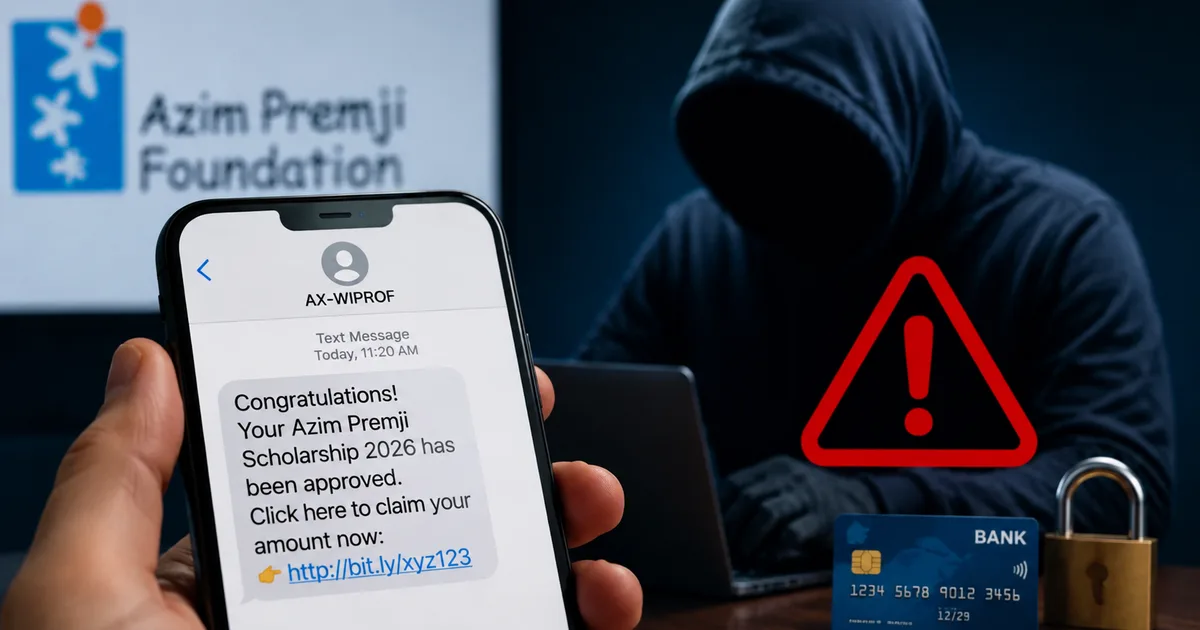
You probably got the text message this morning. It says your application for the Fake Azim Premji Scholarship 2026 Approval SMS Scam is approved and asks you to click a link to claim your funds. Look, I need you to pause right there. Don't click that link. Over the past few weeks, we've seen a massive spike in students and parents falling for this specific fraud. They think they are securing money for college. But they end up emptying their bank accounts instead.
Honestly, it makes me angry. Scammers specifically target the back-to-school season across India because they know people are desperate for financial help with rising education costs. The Azim Premji Foundation does offer real scholarships. But they never operate like this. I want to break down exactly how this fake Azim Premji scholarship trap works. So you can protect your bank account and your family's savings.
How the fake Azim Premji scholarship SMS trap works
This isn't some clumsy phishing attempt with terrible spelling. The people running this racket are professionals. They use spoofed sender IDs, so the message might actually show up on your phone under a name like "APF-SCHOLAR". It feels real. The message usually reads something like: "Dear Applicant, your Azim Premji Scholarship 2026-27 is approved for Rs 50,000. Click here to complete KYC and receive funds."
And that's where the trap snaps shut.
If you click the link, you're taken to a website that looks exactly like the official Azim Premji Foundation portal. They've stolen the logos and the fonts. But the URL is slightly off. Maybe it's azimpremjifoundation-kyc.in or something similar. They ask for your Aadhaar number and your bank account details. Finally, they ask you to complete a "test transaction" of Rs 10 or Rs 50 to verify your UPI ID.
Think about it. Why would a foundation giving you money ask you to send them money first? If you ask me, it makes no sense at all. But in the panic and excitement of getting a scholarship, people miss this red flag (which makes sense, actually). Once you enter your UPI PIN on their fake payment page, they don't take Rs 10. They drain everything they can. We've seen cases in Bhopal recently where a massive nexus diverted lakhs in scholarships using ghost accounts and fake KYC. You can read more about similar tactics in our scam alerts and safety updates section.
They register domain names that look incredibly close to the real thing. To the untrained eye, seeing a padlock icon next to the URL feels secure. But that padlock just means the connection is encrypted. It doesn't mean the site is legitimate. Once you land there, the psychological manipulation ramps up. They'll show a countdown timer: "Only 14 hours left to claim your funds." They might even have a fake live feed of "recent recipients" popping up in the corner of the screen.
Warning signs of this fake scholarship approval fraud
You need to know how to spot these fakes instantly. Thing is, real organizations have strict protocols for giving out money.
- They demand money to give you money. This is the absolute biggest giveaway. No legitimate scholarship program in India will ever ask you for a processing fee. They won't ask for a KYC verification deposit. And they will never ask for a UPI PIN to transfer funds to you. You use a UPI PIN to send money, never to receive it.
- You never actually applied. Did you fill out a long application form for the Azim Premji Scholarship 2026? Did you submit your mark sheets and income certificates? If you didn't, you aren't randomly winning a scholarship. It isn't a lottery.
- The timing is suspiciously urgent. The SMS will say you have 24 hours to claim the funds or they go to someone else. They want you panicked. They want you moving too fast to think critically.
- They want sensitive documents on WhatsApp. Legitimate foundations use secure portals like DigiLocker or their own encrypted upload systems. They don't ask you to send photos of your PAN card or bank passbook to a random WhatsApp number.
Another massive warning sign is the sudden demand for "processing fees". Legitimate scholarships give you money. They don't charge you to process the application. Scammers will claim you need to pay a Rs 500 "document verification fee" or a Rs 1000 "registration charge" before the Rs 50,000 scholarship can be released. It's a classic advance-fee scam adapted for students. If you see this, block the sender immediately. (I know, it sounds obvious when you read it here, but when you're holding your phone and thinking about college fees, it's easy to get confused).
How they get your phone number in the first place
I know what you're thinking. How did they know I'm a student? How did they know I was looking for scholarships? The reality is that Indian student data is heavily weaponized right now. There's a whole ecosystem for phishing and social engineering. Whenever you sign up for random free mock tests online or drop your details into unchecked college admission portals, your data gets sold. Scammers buy these lists of millions of students for pennies.
Then they blast out these fake approval SMS messages. Even if only one in a thousand people clicks, they make a massive profit. We saw the exact same data-harvesting technique used in the fake CBI digital arrest scam that targeted so many people last month.
I'm not exactly sure how they got the specific list this time. But the cybersecurity firm Cyfirma recently showed how student data is traded on underground forums. It's a complete mess. You enter your phone number to download a PDF of old exam papers. And next thing you know, you're on a target list for financial fraud.
Protect your bank account from this SMS scam
First, take a breath. Don't act on any urgent financial SMS. If you actually think you might have qualified for a real scholarship, open your browser and type in the official website address yourself. Don't use the link in the text message. The real Azim Premji Foundation website is simply azimpremjifoundation.org. Go there. Look for their official announcements.
Second, educate your parents. A lot of these messages are sent to the parents of students. Scammers know parents will do anything to fund their child's education. They might also be slightly less tech-savvy. Sit down with them and explain that nobody gives out money via a random SMS link. Explain that a UPI PIN is only for sending money. This is just as important as knowing how to spot a fake income tax refund SMS scam, which operates on the exact same psychological triggers.
Use the official resources. If you're a student looking for financial aid, rely on verified portals. The National Scholarship Portal (NSP) is the official government hub. Even then, be careful of fake NSP websites. Always double-check that the URL ends in ".gov.in". If you want to check if a private scholarship like Azim Premji's is active, go directly to their official careers and grants pages.
In my experience, you really need to talk to your younger siblings or children about this too. Teenagers are constantly on their phones looking for opportunities. They might click a link on Instagram or WhatsApp without thinking twice. We've seen a huge rise in fake scholarship ads running on social media platforms. They click an ad and fill out a form. Weeks later they get the fake approval SMS. It's a coordinated effort. Teaching them digital hygiene now is basically just as important as teaching them how to cross the street.
What to do if you clicked the fake scholarship link
If you clicked the link but didn't enter any information, you're probably fine. Close the browser tab. Clear your browser history and cache just to be safe.
If you entered your bank details or UPI PIN, you have a massive problem. You need to act right this second.
- Call your bank immediately. Get them to freeze your account. Do not wait until morning. Do it right now. Tell them you suspect fraudulent activity.
- Block your UPI ID. Open your UPI app (Google Pay or PhonePe) and block the ID connected to the compromised bank account.
- Report the fraud to the authorities. Go to cybercrime.gov.in immediately. Register a complaint. You must also call the national cybercrime helpline at 1930. The faster you report this, the higher the chance they might be able to freeze the stolen funds in the scammer's account before they withdraw it as cash or crypto.
- Change your passwords. If you used the same password on that fake site that you use for your email or banking apps, change them all. Right now.
Don't feel embarrassed. Scammers are very good at what they do. I talk to people every single week who have lost money to these frauds. They are always smart, capable individuals. The criminals rely on shame to keep you silent. If you stay quiet, they get away with it. By reporting it to the 1930 helpline, you aren't just trying to get your own money back. You're helping the police map the scam network. You're potentially saving the next person from falling for the exact same trick.
"The speed at which you report UPI fraud to the 1930 helpline determines whether you get your money back. Criminals move these funds across multiple dummy accounts within minutes."
The larger problem with scholarship fraud in India
This isn't an isolated incident. The exact numbers are a bit fuzzy, but Bitdefender recently warned about school scams spreading rapidly across the Asia-Pacific region. And it isn't just individual scammers operating out of a basement. Sometimes it is institutional. Just recently, the CBI unearthed a massive Rs 1-crore scholarship scam in Bhopal involving fake accounts and false OTPs. Colleges and banks were allegedly working together to divert government funds using ghost student accounts. It's totally sketchy.
When the systems designed to help students are compromised from the top down, it's no wonder everyday people fall for SMS scams. The Indian Computer Emergency Response Team (CERT-In) regularly issues warnings about these types of phishing attacks. But they just keep coming. Scammers evolve their tactics daily. Today it's the Azim Premji Foundation. Tomorrow it will be a fake Tata scholarship or a fake government scheme.
The only real defense is skepticism. Assume every unsolicited text message offering you money is a lie. Assume every link is malicious until proven otherwise. It's a cynical way to live. But it's the only way to keep your money safe in 2026. Stay alert. Warn your friends. Don't let these criminals steal your hard-earned savings. If you want to stay updated on the latest threats, keep checking our latest tech news section where we track these outbreaks daily.