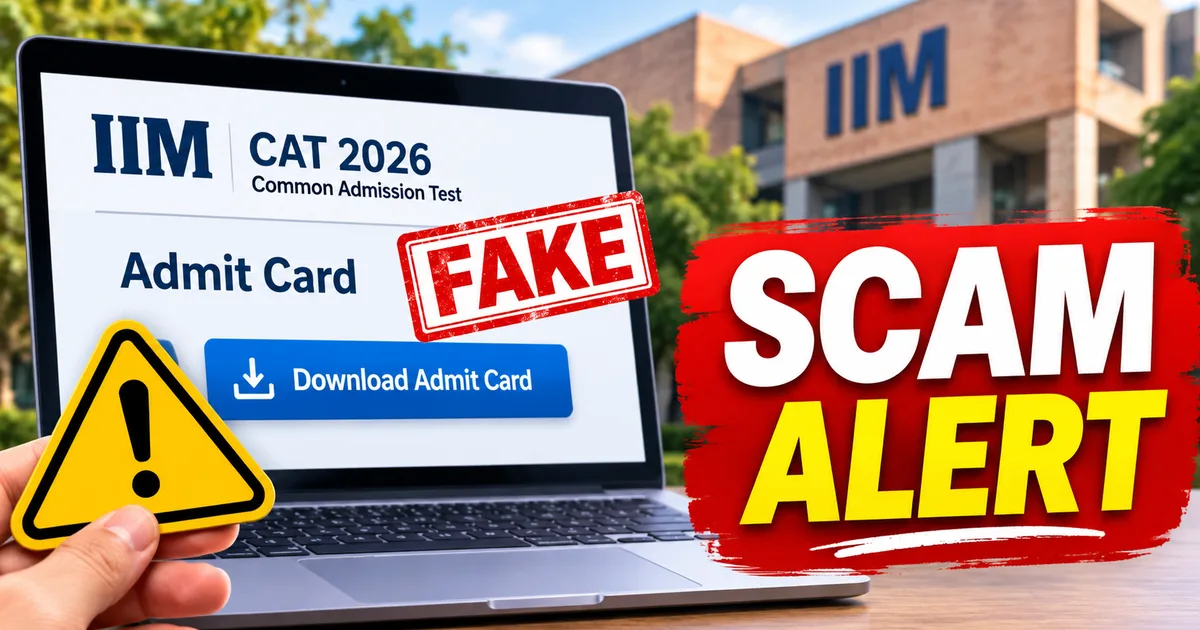
Over 3.3 lakh MBA aspirants across India are refreshing their screens right now. It's November 6, 2026, the official release date for the Common Admission Test hall ticket, and tension is running high. Predictably, online fraudsters didn't miss the date. A malicious fake IIM CAT 2026 admit card download link has started spreading across student WhatsApp groups, Telegram exam communities, student forums, and fraudulent search ads. Candidates rushing to verify their test city and exam slot are walking straight into credential harvesting traps and fraudulent UPI payment requests.
Don't tap that link.
Look, I checked the official candidate portal earlier today, and the traffic spike was brutal. Pages took minutes to respond. Some users ran into standard gateway timeout errors (annoying, I know, but completely typical for admit card release day). In my experience, that server lag creates the exact window scammers rely on. When students can't access their documents through official routes, panic sets in really fast. Common sense just goes out the window.
What the fake IIM CAT 2026 admit card scam actually is
Here's the deal: scammers haven't breached the Indian Institutes of Management databases. Not even close. Basically, they run impersonation attacks that exploit candidate anxiety.
Fraudsters register sketchy lookalike web domains that mimic the real exam address. You might see URLs like iimcat-admitcard-2026.in, cat2026-hallticket.live, cat-admitcard.in, or iim-cat-login.org. If you ask me, to an anxious applicant checking their phone on a crowded metro commute, those addresses look convincing enough. The criminals copy the official branding, layout, color palette, and institutional badges of the organizing IIM. And they replicate the candidate login box right down to the input fields for your User ID and password.
We saw this exact same playbook earlier this year during the fake SSC exam APK scam, where thousands of government job applicants got text messages claiming their test city had changed. The core trick hasn't changed at all across exam seasons. Fraudsters simply count on the fact that candidates are way too stressed to inspect the address bar.
Once you type your information into that cloned form, nothing downloads. It's an empty trap. Instead, your login data goes straight into a private database controlled by the fraud ring.
How the fake admit card download link scam works step by step
Scammers don't just wait around for students to stumble upon fake websites through Google. They push these links directly into the rooms where students gather.
The initial bait on WhatsApp and Telegram
The operation begins on social messaging platforms. Scammers join public preparation groups on Telegram and WhatsApp, often using automated bots or burner SIM cards. Then they drop urgent alerts claiming: 'CAT 2026 admit card direct download link active now. Avoid server crash, check your exam slot and center immediately.'
Some messages go even further, claiming that the primary site has crashed permanently and that the organizing IIM has provided a temporary mirror link. I think that's why so many fall for it. For an applicant sitting in Pune, Jaipur, Patna, or Kolkata who has spent an hour staring at a blank screen, that forward feels like a genuine relief (which makes sense, actually). So they click.
The clone portal and credential theft
Clicking the link redirects the user to a clone of the official candidate dashboard. The page asks for your registration number, date of birth, password, and registered phone number.
You fill out the form and tap submit. The page displays a fake loading animation for ten seconds and then throws an error: 'Server busy, session timed out, please try again in 15 minutes.' You assume the system glitched. In reality, the attacker just captured your login credentials.
Thing is, students rarely use unique passwords for their exam portals. If your CAT password matches the password on your primary Gmail account, DigiLocker, college admission profile, or bank login, the attackers now have an open doorway to your digital life. They can access personal identification documents, phone numbers, email logs, and academic records.
The APK malware and UPI payment trap
And then there's the mobile package variation. It's even more dangerous.
Instead of sending users to a web portal, some phishing messages instruct candidates to download an Android application named CAT_Admit_Card_2026_Viewer.apk or IIM_HallTicket_FastServer.apk. The message claims the app bypasses web server congestion and renders your admit card instantly offline (which is a total lie, obviously).
I'm not sure exactly why so many applicants trust random APKs on WhatsApp, but if you download and install that file, you hand total control of your device to cyber criminals. These malicious APKs request invasive permissions, including access to read incoming SMS messages and log your keystrokes. With SMS access, scammers can intercept one-time passwords sent by your bank and drain your accounts.
Other cloned portals demand a nominal 'document delivery fee' or 'instant verification charge' of ₹49 or ₹99. They display a QR code or redirect you to a spoofed UPI gateway rigged for PhonePe and Google Pay. When you approve that payment, you authorize a recurring auto-debit mandate or give away direct control over your bank balance.
The organizing IIM already collected your exam registration fee months ago. You must never pay any fee to download or view your CAT admit card.
Warning signs of a fake CAT admit card link
Spotting a fraudulent download link isn't difficult if you know what red flags to look out for before interacting with any page. In my experience, fraudsters always rush these campaigns and leave sloppy mistakes behind.
Here are the warning signs you should watch for:
- The website address doesn't match iimcat.ac.in. If you see hyphens, extra words like 'portal' or 'download', or strange top-level domains like .xyz, .top, or .info, close the tab immediately.
- The message prompts you to download and install an APK file on your Android phone instead of opening a standard PDF in your browser.
- The page asks for payment of any kind, whether it is ₹10 or ₹99, to view your exam hall ticket.
- The message arrives via an unsolicited WhatsApp forward, private Telegram direct message, or SMS from a regular 10-digit mobile number rather than an official institutional sender ID.
- The webpage contains broken internal links, spelling errors, low-resolution logos, or missing terms and conditions in the footer.
According to advisories from CERT-In and past warnings by the Press Information Bureau, official exam bodies never distribute admit cards through third-party download APKs, shortened links, or WhatsApp broadcasts. Genuine downloads happen exclusively on authenticated academic portals.
How to safely download your real IIM CAT 2026 admit card
Waiting for slow servers is frustrating. I get it, especially when you need to book train tickets or arrange hotel stays for out-of-town exam centers. But taking shortcuts on security can cost you your exam attempt and your savings (a terrible trade-off, if you ask me).
Follow this safe routine to get your legitimate hall ticket:
- Open a clean browser window on your computer or mobile device. Never click a link sent to you inside a chat group or email forward.
- Manually type the full official domain into your browser address bar: iimcat.ac.in. Bookmark this address so you don't rely on search engine results.
- Click the registered candidate login button on the official homepage.
- Enter your registered CAT User ID and password. Complete the security captcha carefully.
- If the page takes long to load or returns a server error, close the tab and wait 20 to 30 minutes. Peak traffic always subsides as the evening progresses.
- Once your dashboard loads, download the official PDF file directly to your local storage. Verify your photograph, signature, roll number, test city, and reporting time.
- Save a copy to your personal cloud storage and print at least two hard copies on clean white paper for exam day.
Under no circumstances should you ever bypass this process. You must never install APK files from unverified sources, no matter how convincing the accompanying WhatsApp message sounds.
We see the exact same pattern across other major Indian exams. In our coverage of the fake banking admit card scam, we documented how cyber criminals deployed identical APK files against banking candidates across Maharashtra, Uttar Pradesh, Bihar, and Rajasthan.
What to do if you entered details on a fake link
If you already clicked a suspicious link and entered your information, don't waste time blaming yourself. Fraudsters design these pages specifically to trick smart applicants who are under heavy stress. Honestly, what matters right now is moving fast to shut them out.
First, open a fresh browser session, go directly to the official CAT portal, and change your password immediately. If you can still log into your account, updating your credentials prevents the attacker from modifying your registration details or viewing your personal data.
Second, review every other service where you used that exact same password. If your email, DigiLocker, banking portal, or social accounts share that password, change them now. Turn on two-factor authentication on your primary email account so no one can log in with just a stolen password (which helps tremendously, in my experience).
Third, if you downloaded an APK file to your phone, turn on Airplane mode right away to disconnect mobile data and Wi-Fi. Check your downloads folder and delete the file. Go to your device settings, look under installed apps for unfamiliar entries, and uninstall them. If your device behaves erratically or displays persistent pop-ups, back up your essential photos and perform a complete factory reset.
Fourth, if you entered bank account information or authorized any UPI transaction, contact your bank's fraud department immediately to block your debit card and freeze your UPI ID.
If you need step-by-step instructions on securing your smartphone after downloading malicious software, check our practical tech guides library for complete device recovery protocols.
Where to report exam cyber fraud in India
Reporting these incidents helps you recover your money. And it gets malicious domains shut down before other students get trapped. The recovery numbers across the board are a bit fuzzy, but if you ask me, moving fast is always your best bet.
If you suffered financial loss or shared sensitive identity documents, call the national cybercrime helpline number 1930 immediately. The Indian government established this helpline specifically to stop fraudulent money transfers in real time. Police teams can place a temporary freeze on recipient accounts if you report the transaction within the first two hours.
Next, submit a formal complaint online through the National Cyber Crime Reporting Portal at cybercrime.gov.in. When filing your report, provide as much evidence as possible:
- The exact website link or URL you clicked.
- Screenshots of the fake webpage, WhatsApp message, or Telegram post.
- The phone number or Telegram handle that shared the fraudulent link.
- Transaction reference numbers, UPI transaction IDs, and bank account statements if money was deducted.
You can also report suspicious technical infrastructure and phishing websites directly to the Indian Computer Emergency Response Team via CERT-In (https://www.cert-in.org.in/). They coordinate the technical takedown of malicious servers operating across Indian network providers.
For ongoing alerts on newly discovered digital traps and exam-related scams targeting Indian citizens, explore our scam alerts and online safety section.