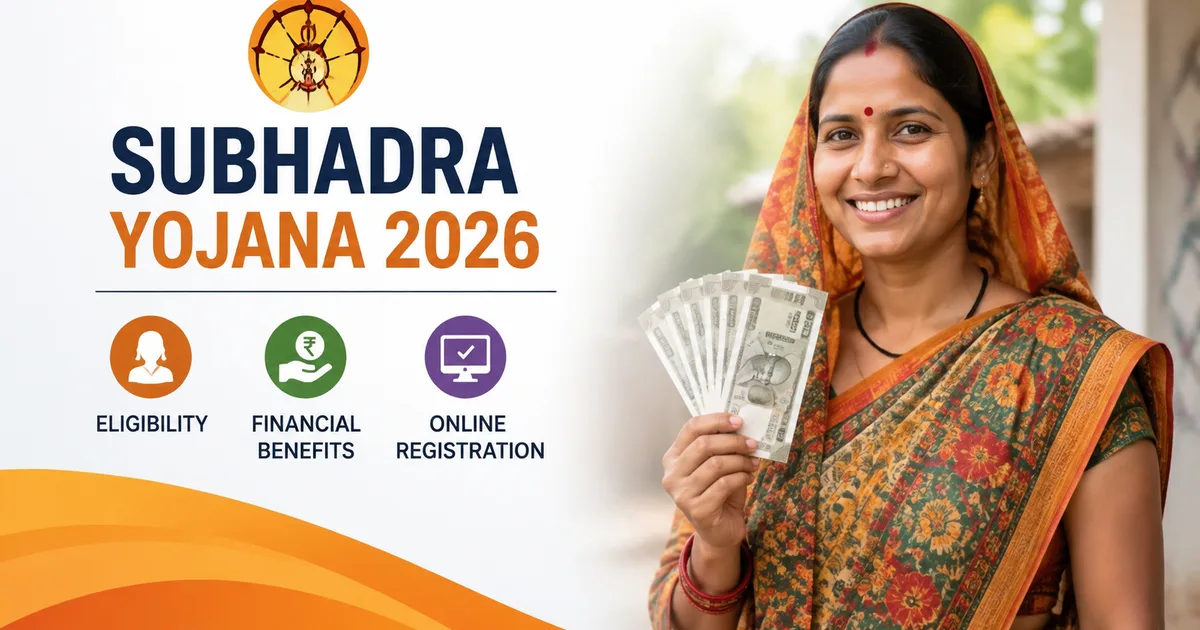
Look, government schemes in India usually mean standing in long lines, filling out endless paperwork, and praying your file doesn't get lost in some dusty office. The Subhadra Yojana in Odisha is actually trying to do things differently. If you're a woman living in Odisha, or you have family there, you've probably heard the name flying around WhatsApp groups recently. And for good reason.
Right now, as we head into late 2026, the state government is gearing up for the fifth installment of the Subhadra Yojana. They've already given out over ₹20,648 crore to more than one crore women. That's a massive amount of money. It goes straight into the hands of people who need it to run their homes. In my experience, a lot of women are still confused about the exact eligibility rules. Maybe they missed the first few rounds and want to know if they can still get in. Yes, you can. Fresh registrations opened up recently. But there are specific rules you have to follow so your application doesn't get rejected.
I spent some time reading through the official documents. I also spoke with a few folks who successfully got their payments. Here's the honest breakdown of how the Subhadra Yojana 2026 actually works. I'll cover the financial benefits and show you how to register online or offline without losing your mind.
What exactly is the Subhadra Yojana?
Basically, it's a welfare scheme started by the Government of Odisha. The goal is to give direct financial support to women from economically weaker sections. The name comes from Goddess Subhadra, Lord Jagannath's sister. This makes it feel deeply connected to the state's culture. But beyond the name, the mechanics are pretty straightforward.
The core promise is simple. Eligible women get ₹10,000 every single year. But they don't give it to you all at once. The government splits it into two equal payments of ₹5,000 each. The timing of these payments is set to specific days.
- The first ₹5,000 drops around Rakhi Purnima (usually in August).
- The second ₹5,000 is sent on March 8, which is International Women's Day.
This isn't handed out as cash by local leaders (which makes sense, actually). The money goes through a Direct Benefit Transfer (DBT) straight into your bank account. No middlemen take a cut. If you want to understand how these large-scale DBT programs fit into the bigger picture of our digital infrastructure, you can check our Tech Explainers section where we break down Aadhaar-linked payment bridges.
The financial benefits aren't just cash
Yes, the ₹10,000 is the main draw. But there are a couple of smart additions to the scheme that push digital literacy. Honestly, if you ask me, these are the most interesting parts of the whole setup.
When you get approved, you don't just get a message saying the money is deposited. You get a specific Subhadra Debit Card. You can use this card at ATMs or shops just like a regular bank card. The government has a clear goal here. They want women to start using digital transactions instead of pulling out all the cash at once.
They even added a reward system. The top 100 women in every single gram panchayat or urban local body who make the most digital transactions get an extra ₹500 bonus. It's a small amount, sure. I'm not sure exactly why they settled on ₹500, but it gamifies the process of learning digital payments. If you read the Latest Tech News, you know India is pushing UPI and card payments everywhere. This is how you get millions of rural women comfortable with a swiping machine or a PIN pad.
"The scheme is designed to empower women financially through regular cash transfers, promote digital literacy, and ensure economic independence. The scheme runs over five years (2024-25 to 2028-29) to cover a wide base of beneficiaries."
Who is actually eligible in 2026?
Not every woman in Odisha gets this money. The government has drawn some hard lines on who qualifies. If you're applying, you need to check these boxes first.
You have to be a permanent resident of Odisha. That's non-negotiable. You also must be a woman between the ages of 21 and 60 years old.
The income rule is where many people get confused. Your family's annual income has to be under ₹2.5 lakh. The numbers here can be a bit fuzzy if you run a small business, but if you hold a ration card under the National Food Security Act (NFSA) or the State Food Security Scheme (SFSS), you're generally considered eligible right off the bat.
But who gets rejected?
- Government employees are out.
- Income tax payers are out.
- If you are already receiving more than ₹1,500 per month from another government welfare scheme (like a heavy pension), you cannot get the Subhadra money.
The system strictly cross-checks this data. They check your Aadhaar against PAN records and other state databases. If you pay income tax and try to apply, the system flags it immediately. It rejects the application.
The online registration process explained step-by-step
If you missed the initial waves, the government opened up fresh registrations. This started April 1 for the 2026-27 financial year and runs until April 30. You have two routes: offline and online. For those comfortable with a smartphone, the online route is faster.
Here is exactly how you apply online.
First, you need to visit the official Subhadra portal. I recommend doing this on a laptop if possible. Government websites can be clunky on mobile screens (annoying, I know). You can also go to a Common Service Centre (CSC) or an Ama Seva Kendra (ASK) if you don't have internet access.
You need specific documents ready before you start typing. Don't sit down to apply until you have these physical items in your hands.
- Your original Aadhaar card
- A bank passbook showing your account number and IFSC code
- Address proof (like an electricity bill or voter ID)
- A passport-size photograph
- Income proof if you don't have a qualifying ration card
- The mobile phone that is linked to your Aadhaar card (this is critical for the OTP)
Step one is filling out your basic personal details. Name and Aadhaar number. It has to match your Aadhaar exactly. If your name is spelled "Sushmita" on your Aadhaar and you type "Sushmitha" on the form, you'll get rejected. It happens all the time.
Step two is putting in your bank details. Make absolutely sure your bank account is active. If your account is dormant because you haven't used it in a year, the DBT transfer will bounce back.
Step three is uploading photos of your documents. Make sure the photos are clear. They can't be blurry.
Step four is the e-KYC verification. You'll get an OTP on your Aadhaar-linked mobile number. Enter it to confirm your identity. Once submitted, the screen shows an Application Reference Number. Take a screenshot of this. Write it down in a notebook. You need this number to track your status later.
The offline route for applications
If the online portal is down (which happens), the offline process works just fine. Honestly, some people just prefer paper. The forms are completely free. Do not pay anyone for the blank form.
You can pick up a physical form from your local Anganwadi Centre or the CDPO Office. Fill it out clearly in block letters. Attach photocopies of your Aadhaar and your bank passbook. Also attach a photo. You can submit the finished bundle at any Common Service Centre or Ama Seva Kendra. The operator there will enter your details into the system. Then they'll give you a receipt.
While you're dealing with government paperwork, it might be a good time to sort out other documents. For instance, if you're dealing with taxes, check out our guide on ITAT Penalty Relief for Unfiled ITR 2026. It might save you a headache later.
Why e-KYC and Aadhaar mapping are causing headaches
Here is where things get to be a mess for a lot of applicants. The government made face authentication-based e-KYC compulsory for the 2026 installments.
What does this mean? It means the system needs to verify you're a real, living person who matches the Aadhaar photo. If your e-KYC is marked "incomplete" in the system, they freeze your ₹5,000 payment. No exceptions. They do this to weed out fake accounts and dead beneficiaries.
You can complete this verification on the official portal. Or you can visit a designated facilitation centre. If you're waiting for the fifth installment this August and haven't done your face authentication e-KYC, you need to do it immediately.
The second major hurdle is NPCI mapping. This is technical banking stuff, but it matters. Your bank account must be Aadhaar-seeded and enabled for Direct Benefit Transfer. Just giving them a bank account number isn't enough. The bank account must be digitally linked to your Aadhaar on the backend. This goes through the National Payments Corporation of India (NPCI).
Go to your bank branch. Tell the teller: "I need to check if my account is DBT enabled and Aadhaar seeded for the Subhadra Yojana." If it isn't, fill out the form right there. I think this single issue is the reason millions of transactions fail across India every month.
Checking your application and payment status
Waiting for the money is stressful. I know I'd be checking my phone every day. Luckily, you can track exactly where your application is stuck.
Go to the Subhadra Yojana portal. Log in using your Aadhaar number or that 16-digit Application Reference Number you saved earlier. The dashboard shows one of three things. It could be Pending. It might be Approved. Or it might say Rejected.
If it says Approved, you're just waiting for the next payout date. If it says Pending for months on end, your district-level verification might be delayed. The government stated they are actively reviewing cases of women who were left out of the fourth installment due to pending verification.
If it says Rejected, the portal usually tells you why. It's almost always a mismatch in Aadhaar details or a bank account issue. Or the system found out you pay income tax. Fix the error and see if you can reapply during the open windows.
The scale of this scheme is massive. Disbursing ₹5,000 crore to 1.02 crore women in a single day back in March is a serious logistical operation. As the fifth installment approaches this August, double-checking your details is the smartest move you can make. The money is there. You just have to make sure the digital pipes connecting it to your bank account are clear.