Imagine you run a small homestay in a remote part of Himachal Pradesh. You have guests who want to pay via UPI, but your mobile network drops out every five minutes. Laying a broadband cable up the mountain costs lakhs of rupees. This is the exact problem Reliance wants to solve. If you have been seeing the news about internet beaming down from space, you might be wondering exactly what is JioSpaceFiber and whether it will actually reach your neighborhood.
Let us break down India's first satellite internet service and see if it matters for the average internet user in 2026. We will look at how the technology works, what equipment you need, and how much it might cost compared to your current broadband connection.
What is JioSpaceFiber exactly?
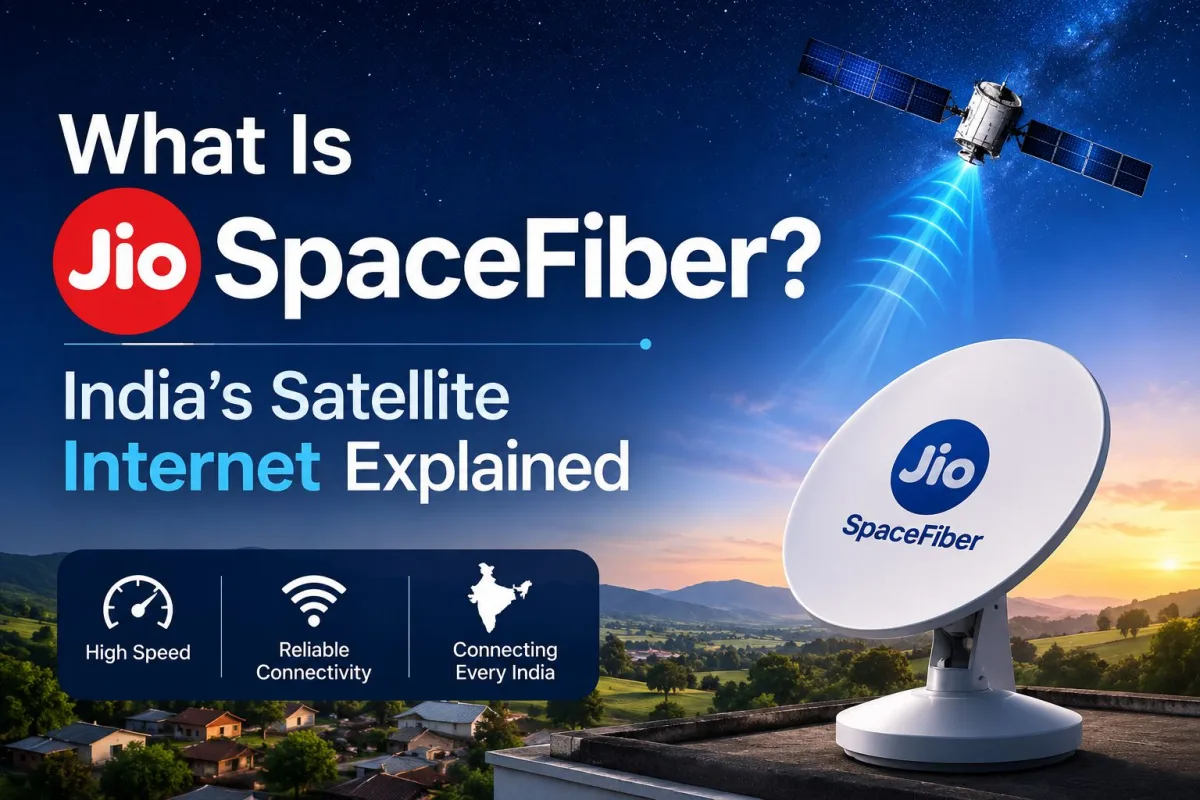
It is a broadband service from Reliance Jio that uses satellites instead of underground cables to deliver internet to your home or business. Most of us use standard broadband services like JioFiber or Airtel Xstream. Those rely on thousands of kilometers of physical fiber optic cables buried under our streets. If a construction crew digs up the road, your Wi-Fi stops working.
Satellite internet skips the ground entirely. Jio uses a constellation of satellites in space to beam the internet signal directly to a receiving dish placed on your roof. Reliance Jio announced this technology back at the India Mobile Congress in 2023. They successfully demonstrated the service by connecting four highly remote locations in Gujarat, Chhattisgarh, Odisha, and Assam. Now in 2026, the technology is moving from a demonstration to a commercial reality.
How does satellite internet work?
Think of how Tata Play or Dish TV works. A satellite in space beams television channels down to a small dish on your terrace. JioSpaceFiber uses a similar concept, but with a major difference. Television is a one-way street. The satellite broadcasts the channel, and your TV receives it.
Internet requires a two-way conversation. When you click a YouTube video, your equipment has to send a request up to space. Here is the exact path your data takes:
- You tap a video on your phone, which is connected to your home Wi-Fi router.
- The router sends that request to the JioSpaceFiber dish mounted on your roof.
- The dish beams a radio signal up to a satellite orbiting the Earth.
- The satellite receives the signal and bounces it down to a massive ground station connected to the main internet backbone.
- The ground station fetches the YouTube video data and sends it back to the satellite.
- The satellite beams the video down to your roof dish, which sends it to your phone.
All of this happens in milliseconds. You can read more about how different internet networks communicate to understand the backend infrastructure.
Low earth orbit vs medium earth orbit
Most conversations about satellite internet mention LEO, which stands for Low Earth Orbit. Elon Musk's Starlink uses LEO satellites. These fly about 550 kilometers above the Earth. Because they are so close, the data travels very fast. This results in lower latency, meaning there is almost zero delay when you make a WhatsApp video call.
Jio took a different route for its initial network. They partnered with SES, a global satellite communications company, to use Medium Earth Orbit satellites. These satellites sit much higher, around 8,000 kilometers above the planet. The main advantage is that you need far fewer satellites to cover a massive country like India. A handful of satellites can provide coverage across the entire subcontinent.
The disadvantage is a slight increase in latency. Because the signal has to travel further into space, it takes a fraction of a second longer to hit the satellite and come back. For downloading large files, streaming movies, or browsing websites, you will never notice the difference. For competitive online multiplayer games where milliseconds matter, regular fiber is still the better choice.
Why India needs internet from space
India has incredibly difficult geography. We have dense forests in Madhya Pradesh, high-altitude deserts in Ladakh, and remote islands in the Andamans. Telecom companies lose heavy amounts of money trying to lay physical cables in these areas. Maintenance is nearly impossible.
Satellite internet fixes this problem entirely. You plug in a router, point the dish at the sky, and you immediately have gigabit-speed internet. This is completely separate from standard telecom network expansions.
Reliance Jio states their primary goal with SpaceFiber is digital inclusion, connecting remote geographies where laying physical fiber optic cables is economically and physically impossible.
Consider a government primary health center in a rural Uttarakhand village. Doctors there need to upload patient data to government health portals. Or think of a merchant in a small Northeastern town who loses business because the UPI machine stops working during monsoon network outages. A satellite connection provides a highly reliable backup that keeps essential digital services running.
The 2026 space race: Jio vs Starlink
Jio is not the only company trying to control the sky over India. You have probably read about Elon Musk's Starlink. Recent industry reports confirm Starlink is conducting security tests with the Indian government ahead of a planned retail launch. Amazon's Project Kuiper is also pushing to enter the Indian market to offer competing services.
Jio has a specific advantage in this fight. They already control the largest telecom network in India. They can bundle satellite internet with existing mobile plans or enterprise packages. If you want to know how these companies handle consumer data, check out our guide on internet privacy and tracking.
The fight over spectrum allocation
Before any company can beam internet to your house, they need permission from the Indian government to use specific radio frequencies. This is known as spectrum. For the last two years, telecom companies argued over how this space spectrum should be handed out.
Jio argued the government should auction the satellite spectrum to the highest bidder, just like they do for 5G mobile networks. Starlink and other foreign operators argued against auctions, pushing for administrative allocation, which is the global standard. The government decided against auctions. This decision allowed Starlink and Amazon to continue their entry into the Indian market without spending billions upfront on spectrum rights.
Hardware requirements and internet speeds
Do not expect to use your current Wi-Fi router to catch signals from space. You will need specific hardware. This includes a satellite dish that you mount outside with a clear view of the sky, along with a specialized modem for the inside of your house.
Jio claims the service will offer gigabit connectivity. Early users and enterprise clients should expect speeds between 100 Mbps and 500 Mbps in real-world conditions. This speed is more than enough to stream 4K video, trade stocks, run a small business, or attend video conferences without buffering.
Expected pricing for Indian users
Will space internet be as cheap as standard Jio fiber plans? Probably not immediately. Setting up a satellite connection requires expensive hardware. In global markets, equipment for services like Starlink costs upwards of INR 25,000 to INR 40,000, plus a high monthly subscription fee.
Indian consumers are highly price-sensitive. Jio knows this better than any other telecom operator. They might subsidize the initial cost of the hardware to lock users into their ecosystem. However, until hardware prices drop significantly, the primary buyers will be local internet service providers, businesses, and government departments.
A local village entrepreneur could buy one JioSpaceFiber connection and distribute the internet via standard Wi-Fi to the rest of the village for a small monthly fee. If you live in a major city like Bangalore or Delhi, you should stick to your current underground fiber connection. It will be cheaper and slightly faster.
Internet during natural disasters
India faces severe cyclones on the eastern coast and heavy flooding in several states every monsoon. When a major flood hits, the first thing to fail is communication. Cell towers lose power. Underground cables snap. Rescue operations suffer because response teams cannot communicate with local authorities.
Satellite internet survives these terrestrial disasters. Because the core infrastructure is floating in space, ground-level floods do not affect the signal. As long as you have a clear view of the sky and a solar panel or generator to power the receiving dish, you remain connected to the outside world. Government agencies and disaster response teams are expected to use this technology heavily for emergency communications.
Final thoughts
JioSpaceFiber is a massive technical achievement for Indian telecom. It solves the hardest problem in networking, which is reaching the last few million people who live in challenging terrain. While city dwellers will likely ignore it, satellite internet fundamentally changes how rural businesses, remote schools, and distant healthcare centers operate in the digital economy.