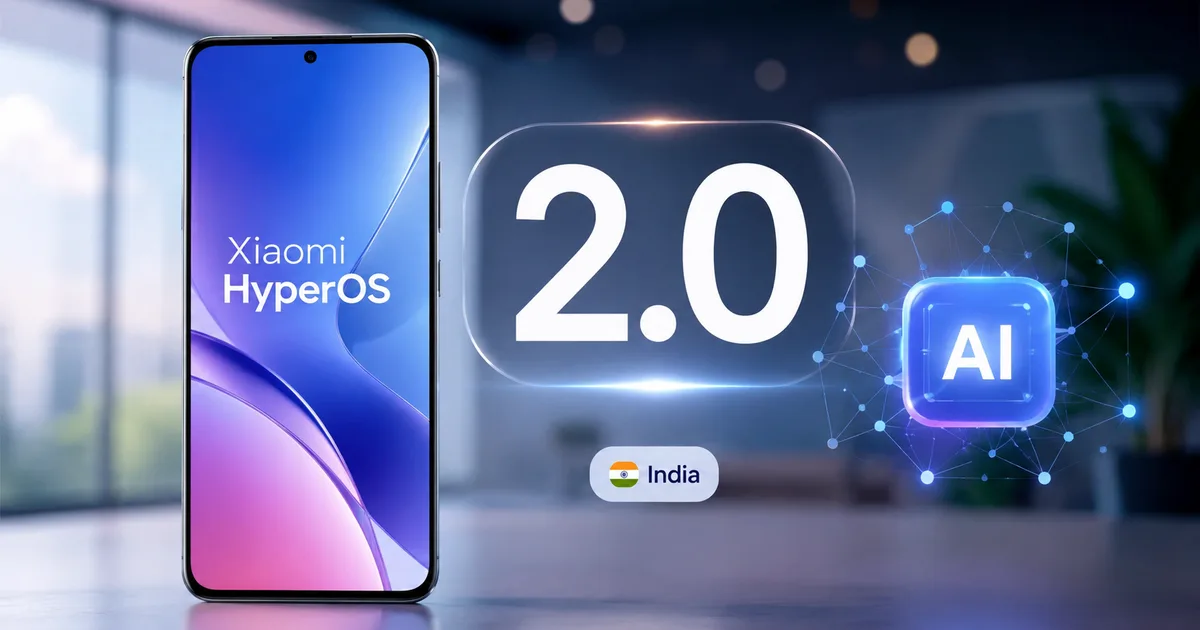
Look, if you bought a Xiaomi, Redmi or Poco phone recently, you're probably wondering when the next big software update drops. The Xiaomi HyperOS 2.0 India Rollout 2026 is officially the talk of the town, though honestly, Xiaomi's naming conventions are a bit of a mess right now. Some leaks call it HyperOS 4 because it runs on Android 17. But whether you call it 2.0, 3.0 or 4.0, the actual changes hitting your device are what matter. I dug through the firmware leaks and server data to see what Indian users are actually getting this year. And frankly, it's a mixed bag of genuinely impressive engineering and some sketchy design choices.
We've seen Android skins come and go.
Remember the old MIUI days? It was heavy, packed with ads and honestly a bit of a battery hog. HyperOS was supposed to fix all that when it launched. Now, with the new update cycle, they're taking things in a totally different direction. If you read the Latest Tech News, you know everyone is obsessed with AI. Xiaomi is no different. But they're also doing something strange with the visual design. If you ask me, I'm not sure everyone will love it.
The glass UI: love it or hate it
Let's talk about the way this thing looks. The new update has a liquid glass-inspired UI. Basically, everything on your screen gets this transparent, frosted glass effect. The system actively renders realistic-looking light refraction in real time. Is it necessary? Not at all. Does it look cool? Actually, yes. But I worry about what all that rendering does to the battery life on older budget phones.
A high-end Xiaomi 17 can handle real-time light refraction without breaking a sweat. A two-year-old Redmi Note might struggle. And we all know battery life is a massive priority for Indian users who commute long hours.
You finally get real customization for the lock screen. You can move the clock and arrange your notifications how you want. It sounds basic, but we've been asking for this for years. Also, if you use floating apps (keeping WhatsApp open in a small window while watching YouTube or paying a bill on Paytm, for example), the UI now switches seamlessly between portrait and landscape. The app window just rotates with you. It's a small quality-of-life change. It makes multitasking significantly less annoying.
Speed, optimization, and under-the-hood changes
Nobody wants a pretty phone that stutters when you open your UPI app at the grocery store. The server data shows Xiaomi has done serious optimization here. They claim that after nine hours of continuous use, the phone will load apps about 18 percent faster than it does on the current software. I'll believe it when I see it on a budget device. But the method they're using is interesting.
They built a predictive AI. It preloads resources into your RAM before you even tap the app icon. It guesses what you're going to do next based on your habits. So if you always open Instagram after checking your email, the phone gets Instagram ready in the background. It's smart, assuming it doesn't aggressively kill your background apps to free up that RAM. We've seen Xiaomi do that in the past. It caused people to miss important WhatsApp messages or email notifications.
The camera gets a massive speed boost too.
HDR photo processing drops from 310ms to 240ms. They also shaved 200ms off the camera app's cold startup time. For Indian users who rely heavily on WhatsApp for sharing family photos and business documents, this camera speed is a big deal. Faster HDR processing means less blur when you take a photo in challenging lighting conditions like a dimly lit restaurant. And reducing the cold startup time by 200ms means you're less likely to miss a moment while waiting for the viewfinder to load. It's the kind of practical upgrade that actually improves how you use your phone every single day (which makes sense, actually). Video playback is also supposed to be completely free of dropped frames now. That's great news for anyone who watches entire movies on their commute.
Super AI assistant 2.0 and the inspiration ball
You can't talk about a 2026 software update without hitting the AI features. Xiaomi is using its own in-house language model called MiMo to power the Super AI Assistant 2.0. It handles the boring stuff. Think about transcribing voice notes or searching your photo album for specific things. I tried something similar on another device recently. Being able to just ask your phone to find a specific screenshot from three months ago is actually game-changing.
The smart home integration is huge. Xiaomi sells a ton of smart TVs and air purifiers in India. The new Super AI Assistant 2.0 is supposed to be a central hub for all of these. You can theoretically tell your phone to turn on the air purifier in the bedroom and dim the living room lights in one sentence. It'll figure it out without needing exact command phrases. In my experience, if you've heavily invested in the Xiaomi ecosystem, this update makes all your gadgets talk to each other much more efficiently.
If you ask the AI a complicated question, it uses the Super Island. That's the little popup interface around the selfie camera. It shows a thinking animation. It only takes over your full screen when it actually has the answer.
Then there's the Inspiration Ball.
It's a floating pointer you can drag around the screen to give the AI context. Drag it over a physical address in a text message, say 'navigate here' and it opens Google Maps. Drag it over a pair of shoes in an Instagram post and ask the AI to find them online. It's very similar to Google's Circle to Search. We've discussed similar tools in our Tech Explainers section. Usually, Google pushes hard to keep their own tools front and center on global Android devices. I'm curious to see if this feature makes it to the Indian software builds intact. Maybe Google forces Xiaomi to strip it out. The numbers here are a bit fuzzy, honestly.
Privacy concerns for Indian users
Whenever a company announces a system-level AI that reads your screen and organizes your photos, privacy becomes a massive question. The MiMo LLM is doing a lot of this processing on the device. That's good. But it still needs to phone home for complex queries. In India, our phones hold our entire lives.
We have Aadhaar PDFs and active UPI accounts linked directly to our phone numbers. I want to see clear opt-out toggles for these AI features. If I don't want the Inspiration Ball reading my screen while I'm looking at a bank statement, I need to know I can turn it off permanently (annoying, I know, when companies bury these settings).
Xiaomi HyperOS 2.0 eligible phones list (India)
So, who actually gets this update? The firmware server data gives us a pretty clear picture. We've seen early stable branches labeled OS4.0.0.x for the Indian variants of several major devices. Remember, if your phone is on the internal testing list, it's basically guaranteed to get the public release eventually.
Here's the list of devices currently in active testing for the Indian market.
- The Xiaomi 17 Ultra specifically has stable Indian firmware in testing right now, and the rest of the 17 line will follow shortly.
- We are seeing firmware for the Redmi K90 series across multiple global regions, including India, which is great news for performance enthusiasts.
- POCO's flagship killer, the POCO F8 Pro, is confirmed to be on the active development branch for Indian users.
- The new Xiaomi Pad 8 tablet line is part of the first wave of testing, suggesting Xiaomi is serious about the Android tablet market.
- Since the Redmi Note 15 5G is launching in January with the new software likely pre-installed or ready for a day-one patch, it is definitely on the list.
There are also a bunch of older devices sitting on the .PRE firmware branches. That means Xiaomi is developing the update for them. They aren't close to a stable release yet. If you have a Xiaomi 14 or a Redmi Note 13, you're likely in this second or third wave. Honestly, it's frustrating that buyers of mid-range phones have to wait months for updates that flagships get immediately. But that's the reality of the Android ecosystem.
Release date and timelines for Indian users
The Chinese beta programme kicked off on August 14. More waves are scheduled for August 27 and September 17. But what about the Indian rollout?
Typically, India gets the stable update about two to three months after the initial Chinese beta. Based on the server data and historical patterns, we expect the first public rollout in India to start in November 2026. The Xiaomi 17 Ultra and POCO F8 Pro will likely be the first to get the over-the-air notification. The wider rollout for the Redmi Note series will probably drag on into early 2027. It's a slow process. They do this to catch bugs before they accidentally brick millions of phones.
If you're waiting for this, keep an eye on your updater app. Go to Settings, tap on About Phone and hit the HyperOS logo to check for updates. Don't bother downloading sketchy APKs from Telegram groups promising early access. That's a great way to install malware and compromise your bank accounts. Just wait for the official push.
Should you actually upgrade on day one?
When the notification finally pops up, should you hit download right away? My advice is always to wait a week. Let someone else deal with the day-one bugs. The new glass UI looks heavy. I want to see how it performs on a standard Redmi Note before recommending it to everyone. But the camera speed improvements and the AI assistant are genuinely useful additions. It's not a fresh coat of paint. They've rebuilt parts of the core engine.
The smartphone market is getting incredibly competitive right now.
With upcoming releases like the Oppo A7 Pro Max 2026 pushing hard on AI camera features, Xiaomi had to deliver a strong software experience to keep its massive Indian user base happy. They can't afford another buggy rollout. I'm not exactly sure why they rushed some of the older updates, but they can't do that again.
They've done enough to keep people interested. We'll keep tracking the server data and update the eligible devices list as more firmware drops over the coming weeks.