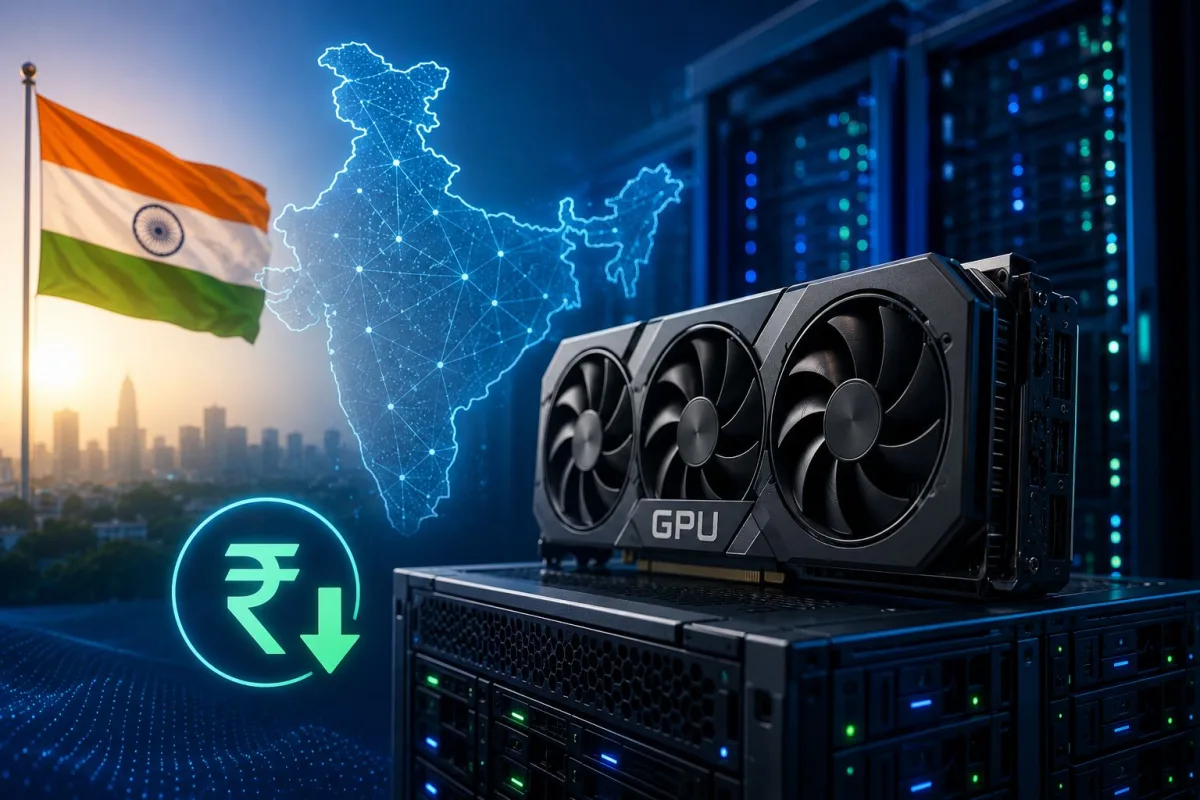
If you're trying to build an AI application in India right now, you know the exact pain I'm talking about. Renting good graphics processing units from foreign tech giants costs an absolute fortune. It's crazy. A small development team can burn through lakhs of rupees in just a few days of training a basic machine learning model. But the government has finally pushed the IndiaAI Compute Capacity program into high gear. To be honest, they're now actively offering subsidized GPUs to Indian companies and researchers. Students have access too.
We've been hearing about the national AI mission for a couple of years. The initial rollout was slow. Only Rs 400 crore was released in the first two years of the initiative. That's changing fast.
The Ministry of Electronics and Information Technology recently confirmed they've secured a pool of 38,000 GPUs. IT Minister Ashwini Vaishnaw stated at a recent summit that this capacity will more than double in the next six months.
This is not just abstract government policy anymore. You can actually get your hands on this hardware right now. Fourteen different service providers are facilitating access at a highly subsidized rate of Rs 65 per GPU per hour.
Basically, I think this has massive potential. Let me break down exactly what this means for ordinary developers. I'll also show you how you can get your startup in line for these resources.
The reality of AI compute costs in India
Look, to understand why this subsidy matters, you just have to look at standard market rates. Go to Amazon Web Services or Google Cloud today to rent an Nvidia H100 or an older A100 GPU. You're paying strictly in US dollars. The exchange rate alone eats into your runway. Add on the premium these companies charge for on-demand access. it is brutal. A modest local startup simply can't compete with Silicon Valley firms. They have millions in funding.
Indian builders have historically been forced to compromise. You either train your models on smaller datasets, or you try to optimize your code aggressively. You waste weeks of engineering time just to save a few hundred dollars on cloud bills. It's a mess, frankly. I've spoken to founders who literally set alarms for 3 AM. They do this to spin up instances in random global server regions where the spot pricing briefly drops (which makes sense, actually).
The IndiaAI Compute Capacity initiative changes this math completely. By capping the cost at Rs 65 per GPU per hour through partnered local cloud providers, the government is absorbing the massive premium. This premium is usually associated with AI hardware. You get to keep your compute costs predictable. You pay in Indian rupees. You don't have to worry about a sudden currency fluctuation wiping out your monthly infrastructure budget.
How the 65 rupee subsidy actually works
A lot of people are confused about how the government is managing this price point. The IT ministry didn't just buy 38,000 graphics cards and put them in a massive basement in Delhi. Instead, they built a marketplace.
The government partnered with 14 approved private service providers. These are data center operators and local cloud companies that physically host the hardware. When you access a GPU through the IndiaAI portal, you're routing your workload to one of these partners. The provider bills you the subsidized rate of Rs 65 per hour. The government pays the rest. They cover the difference between that subsidized rate and the actual commercial cost of running that server. I'm not sure exactly why they chose this exact split. But it works.
This model is smart. It prevents the government from having to manage server maintenance and cooling. They don't have to worry about software patching either. You just interact with a standard cloud interface.
You upload your containers or code. Then you run your training jobs. If you're looking for more details on cloud architecture, the setup feels very similar to standard enterprise clusters.
Steps to access subsidized GPUs in 2026
You can't just sign up with a Gmail account and instantly get twenty GPUs. There's a verification process.
Look, the government wants to make sure this highly subsidized hardware is used for actual development. They definitely don't want people using it for cryptocurrency mining. Or running basic web servers.
The first requirement is your organizational status. You need to be a DPIIT-recognized startup or an academic institution. Registered MSMEs are eligible. Individual students can apply too. But you usually need to route your application through your university's research department.
- Register your entity on the official IndiaAI portal using your company PAN and DPIIT recognition number.
- Submit a brief technical proposal explaining your AI workload. You need to specify what kind of model you are training, the estimated dataset size, and how many compute hours you realistically need.
- Wait for the technical committee review. They usually process standard requests within a few weeks.
- Once approved, you will be allocated a specific quota of GPU hours and assigned to one of the 14 partnered service providers.
- You then create an account with that specific provider, link your IndiaAI approval token, and start provisioning your instances.
Honestly, the hardest part is accurately estimating your compute needs upfront. Don't ask for ten thousand hours if you're just fine-tuning a small open-source model.
The review board prioritizes realistic requests. If you need help figuring out your requirements, check out our compute estimation calculators.
Are 38,000 GPUs actually enough for India?
This is where things get complicated. Yes, 38,000 GPUs sounds like a massive number. It is. For the thousands of college students and early-stage founders trying to build basic generative AI apps, it makes a massive difference. But if we look at the global picture, it's barely a drop in the ocean. The numbers here are a bit fuzzy, honestly.
Analytics India Magazine recently published a piece. It pointed out that India's AI dream falls short of a million GPUs. Tech giants in the US and state-backed entities in China are hoarding hundreds of thousands of top-tier accelerators. Meta alone bought over 350,000 H100s last year. If an Indian company wants to build a frontier model from scratch, 38,000 distributed GPUs shared across the whole country won't cut it. Especially if they want something that competes directly with GPT-4.
But in my experience, criticizing the program for not having a million GPUs misses the point. India doesn't necessarily need to build the next trillion-parameter frontier model right now. We need hundreds of localized models. We need AI that understands regional dialects perfectly.
We need models trained specifically on Indian legal documents and local healthcare data. Agricultural patterns are another huge use case. You don't need a massive Silicon Valley supercomputer to build those. You just need affordable compute. And that is exactly what this program provides.
What happens when your startup outgrows the subsidy?
The subsidy is a launchpad. It gets your product off the ground. But what happens when you secure major funding or your user base explodes? The IndiaAI Compute Capacity program has strict quotas. You can't rely on Rs 65 per hour pricing forever.
This is where local infrastructure development comes in. The government recently selected 10 Indian AI startups for a global acceleration program. It's a clear push to move successful companies into commercial-tier operations.
If you ask me, over the next few years, we're going to see more private data centers popping up across the country. They will serve these graduating startups.
There's also the hardware side of the equation. Right now, we import every single GPU we use. It's a reality. But the groundwork is being laid for domestic manufacturing. The new Tata semiconductor fab is coming online, and various Make in India chip initiatives are taking shape too. The long-term goal is to manufacture these accelerators locally. That is years away. But it's the only permanent solution to the compute shortage (annoying, I know).
The current IndiaAI program is a bridge. It keeps our domestic talent from moving to Delaware just to afford server costs while the country builds out its permanent technological infrastructure.
If you're a builder sitting on a good idea, stop worrying about the cost of AWS. Get your DPIIT registration sorted out. Write up your technical proposal. Get into the IndiaAI queue. The hardware is finally here, and the pricing is unbeatable. Now it's just up to you to build something useful.
We'll keep tracking the wait times and provider reliability on this program. Keep an eye on our latest tech updates for any changes to the 65-rupee pricing tier as the year goes on.