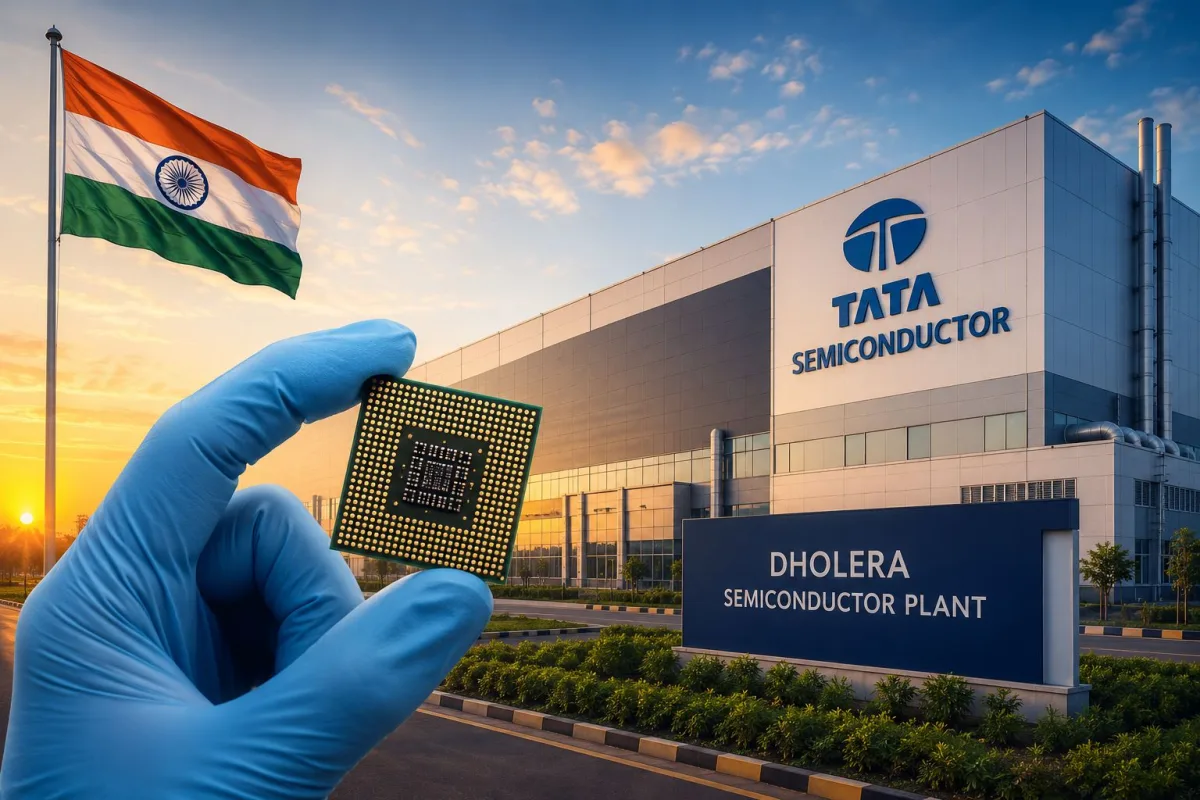
The central government just cleared the final bureaucratic hurdle for the Tata Semiconductor Dholera plant. They officially notified a 66-hectare Special Economic Zone in Gujarat exclusively for this project. If things go according to schedule, the first 'Made in India' chips will leave this facility in late 2026. And this completely changes the hardware manufacturing math for the entire country.
Look, getting an SEZ tag means tax benefits and smoother import processes. Tata Electronics needs this. A semiconductor fab requires highly specialized machinery, and you can't buy extreme ultraviolet lithography machines at a local hardware store. They cost hundreds of millions of dollars. They ship from very specific companies in Europe or the US. So clearing customs quickly and avoiding heavy import duties on this equipment makes the project financially viable.
The Gujarat government is already building 1,500 residential units nearby. Factories need workers. Chip fabs need thousands of highly skilled engineers working around the clock in multiple shifts. (Which makes sense, actually, given the constant operational demands.) They need places to sleep and eat. I think building the factory is just half the battle here. Building the township around it is the rest of the equation.
What 'Made in India' chips actually mean for your wallet
Right now, almost every silicon brain in your phone or car is imported. It's mostly coming from Taiwan and China. Sometimes South Korea. When global supply chains broke down a few years ago, wait times for cars in India stretched to almost two years. Companies simply couldn't get the chips they needed.
Local production fixes that dependency. It reduces import duties and cuts down shipping logistics. But mostly, it gives Indian hardware startups a local supplier. Honestly, if an Indian electric vehicle startup needs power management chips, they won't have to wait in line behind American tech giants. They can source them locally.
You probably won't see smartphone prices drop overnight. The numbers here are a bit fuzzy. But a stable local supply chain prevents the sudden price hikes we saw during recent shortages. Check out our recent tech guides on how hardware pricing actually works if you want the full breakdown on that.
The difference between a fab and packaging
I need to clarify something because the news often mixes this up. There are two main parts to making a chip. First is the fabrication. This is where you take a blank silicon wafer and print microscopic circuits on it. The Tata Semiconductor Dholera plant is a fab. It does the hard part.
The second part is called Assembly, Testing, Marking, and Packaging. (ATMP for short.) You take the printed wafer and cut it into individual chips. Then you put them in those black plastic squares with metal pins that you see on a circuit board. Companies like Micron are setting up ATMP facilities in India. CG Power is also working on a packaging plant. But Tata is building the actual fab. That's a much bigger deal.
The Taiwan connection and PSMC
Tata isn't doing this alone. They partnered with Powerchip Semiconductor Manufacturing Corp. PSMC is a Taiwanese company. And Taiwan basically runs the global semiconductor industry. In my experience, trying to build a fab from scratch without Taiwanese or American expertise right now is almost impossible.
They are targeting mature nodes first. We're talking about 28-nanometer to 50-nanometer chips. These aren't the cutting-edge processors inside the newest iPhone. Instead, these are the chips that control power management and run automotive displays. They also manage telecommunication networks.
That's actually a smart business move. The world needs millions of these basic chips every day. Every new electric scooter on Indian roads has dozens of them. Every smart meter the government installs has one. The market for mature nodes is massive. It's also highly profitable.
"Building a 28nm fab makes more economic sense for India's first attempt than chasing sub-3nm technology. The domestic demand for power and telecom chips guarantees a steady market from day one."
The 91,000 crore rupee math
Setting up this plant costs around Rs 91,000 crore. Tata isn't paying all of that out of pocket. The Indian government is covering up to 50% of the project cost through the India Semiconductor Mission. The state government kicks in another 20%. So Tata only has to arrange about 30% of the total capital.
Why is the government giving away thousands of crores to a massive corporation? National security. It's really that simple. Running a modern economy without a secure supply of semiconductors is a massive vulnerability. If a geopolitical conflict disrupts shipments from Taiwan, the Indian economy would grind to a halt within months. The government views this subsidy as an insurance policy for the industrial sector.
Are we actually getting chips in 2026?
I'm cautiously optimistic. But the reality of building a fab is that it takes serious time. We might see some timeline adjustments for these Indian semiconductor projects.
A wafer fab needs an uninterrupted power supply. Even a one-second power dip can ruin millions of dollars worth of silicon wafers. It requires millions of liters of ultra-pure water daily. Setting up this underlying infrastructure in the Dholera Special Investment Region takes intense coordination between state agencies and private contractors.
Then there's the talent gap. India has brilliant chip designers. We write the software that designs the chips for global tech giants. But physical chip manufacturing requires a completely different skill set. Tata is sending batches of Indian engineers to Taiwan for hands-on training right now. Until that local talent pool grows, scaling up operations will be slow.
If you've been following Indian tech policy news, you know that big infrastructure projects often face delays. The 2026 timeline is aggressive. Expect the first few batches of chips to be pilot runs.
The ecosystem effect in Gujarat
You can't drop a massive factory in a field and expect it to run in isolation.
A semiconductor fab needs an ecosystem. It needs specialized chemical suppliers and companies that make ultra-pure gases. It also needs precise logistics companies to transport fragile silicon wafers. By notifying the 66-hectare SEZ, the government is creating a designated zone where all these supporting companies can set up shop next to the Tata plant.
Here is what this localized ecosystem creates:
- Direct employment for thousands of chemical, electrical, and mechanical engineers
- Indirect employment in logistics, facility management, and construction
- A ready local market for Indian startups building testing equipment or software for fab management
- A massive boost to local real estate and services in the Dholera region
We are looking at a generational shift in how hardware is made in this country. It will be a mess. There will be delays. Budgets might overrun.
Keep an eye on the upcoming Union Budget. How the government allocates the next round of funding for the India Semiconductor Mission will tell us exactly how fast this ecosystem is going to grow. For a broader look at how the government handles digital infrastructure, read our explainer on the DPDP Act and how data localization ties into all of this.