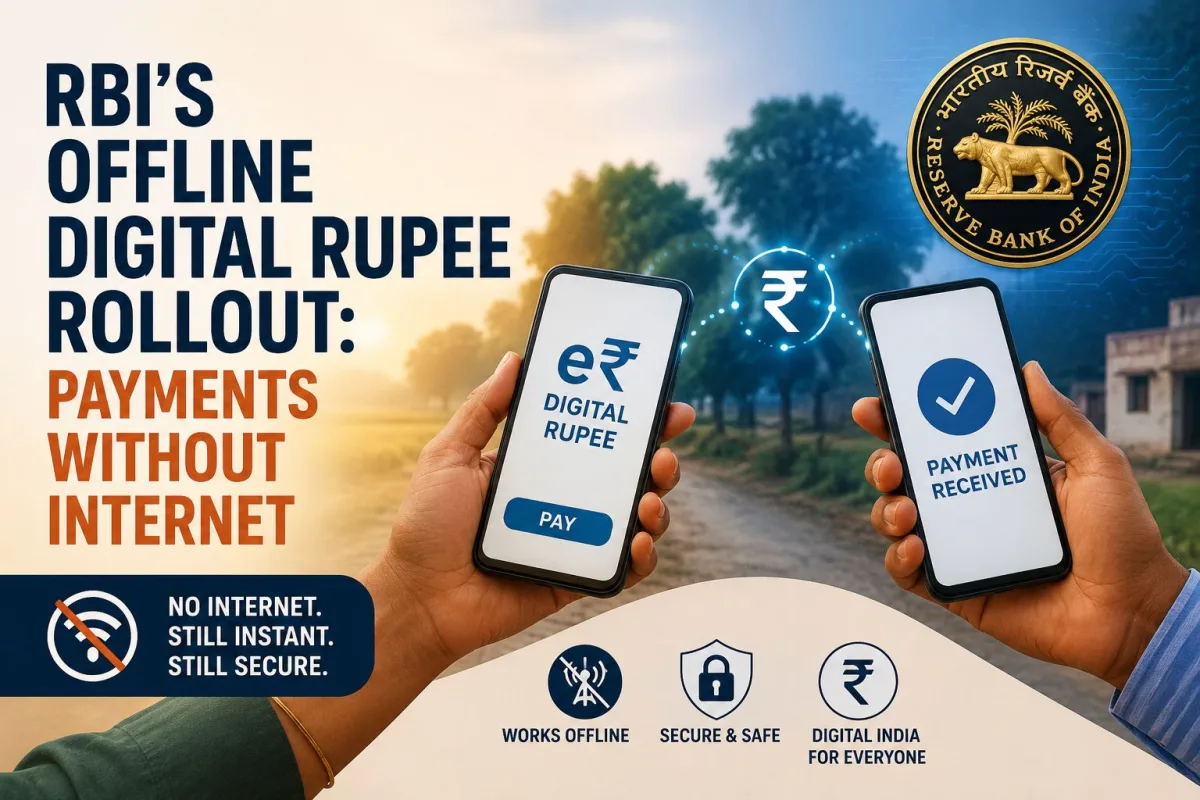
Have you ever tried to pay for groceries in a basement supermarket only to realize your phone has zero signal? You hold your phone up to the ceiling. You restart your mobile data. The shopkeeper looks at you with impatience while a queue forms behind you. Network dead zones remain a frustrating reality for millions of smartphone users across India. This is the exact problem the RBI's offline digital rupee rollout addresses. The Reserve Bank of India has introduced a method to make e-Rupee payments without internet access.
This is a practical solution for a problem every Indian faces regularly. While we have excellent digital public infrastructure, complete reliance on active network connectivity creates a single point of failure. If your telecom operator faces an outage, your money is effectively frozen. The central bank recognized this vulnerability and shifted its focus toward offline capabilities. If you regularly read our digital payment guides, you know that solving the offline payment puzzle is the next major hurdle for financial regulators worldwide.
Understanding the offline digital rupee
The digital rupee is technically known as a Central Bank Digital Currency. You can think of it as the exact digital equivalent of the physical paper notes in your wallet. When you hold a physical two hundred rupee note, you possess a direct claim on the Reserve Bank of India. The e-Rupee works the same way. It is not a private company's wallet balance. It is sovereign currency.
Until recently, testing for the e-Rupee required an active internet connection. You opened your bank application, scanned a code, and the system verified the transaction with the bank servers. That defeated the purpose of calling it a true digital equivalent of cash. When you hand a paper note to a vendor, you do not need to check with a bank to verify the transfer. The offline digital rupee rollout attempts to replicate that exact physical cash experience using mobile hardware.
The fundamental difference with offline e-Rupee is that the transaction validation happens entirely on your local device. The bank servers are completely out of the loop during the actual payment moment.
The RBI has clarified that their focus is shifting heavily toward these offline use cases. According to recent statements covered by business news networks, the RBI sees no systemic risk from recent probes into specific banks like IDFC First, and is instead channeling its energy into finalizing this offline e-rupee framework. They want to ensure the system works perfectly before a wider public release.
How to make e-Rupee payments without internet
The mechanics of the offline digital rupee are surprisingly straightforward. You need a smartphone with Near Field Communication technology or Bluetooth. Most modern smartphones sold in India over the last few years have these hardware features built in.
The process happens in two distinct phases. The first phase requires you to be online. You open your participating bank application and load digital tokens into your secure mobile wallet. This is similar to walking to an ATM to withdraw physical cash. You move funds from your main savings account into your offline-ready wallet on the device. Once those tokens are loaded onto your phone's secure element, you are ready to transact anywhere.
The second phase is the actual payment. You walk into a shop with a dead network zone. You select the items you want to buy. The shopkeeper enters the amount into their point-of-sale device or merchant application. You bring your phone close to the shopkeeper's device. The two devices communicate directly using local radio frequencies. Your phone securely hands over the digital tokens to the merchant's device.
There is no loading screen. There is no waiting for a bank server to respond. The merchant's device instantly verifies the cryptographic signature of your digital tokens and accepts them. The transaction is final immediately. Later, when the merchant connects their device to a Wi-Fi network or steps out of the dead zone, their application will sync with the banking system to deposit those collected tokens into their main account.
Why not just use UPI for offline payments?
People naturally ask why we need a completely new currency system when we already have UPI. UPI processes billions of transactions a month and is deeply ingrained in Indian commerce. However, standard UPI is fundamentally an online messaging system. It sends an instruction from your bank to the receiver's bank. If the banks cannot talk to each other over the internet, the transaction fails.
The National Payments Corporation of India did introduce solutions like UPI Lite. This feature allows small value transactions without requiring a PIN. But UPI Lite still heavily relies on an internet connection for the merchant side of the transaction. There is also a USSD-based offline UPI system using the *99# shortcode, but it requires basic cellular network coverage to send SMS-like messages. If you have absolutely zero network bars, USSD will not work.
The offline e-Rupee bypasses the telecom network entirely. It is true peer-to-peer technology. You are literally moving digital files representing money from your hard drive to the merchant's hard drive. Check our latest tech news section for updates on how telecom operators are reacting to this shift in payment architecture.
The security of offline digital cash
Moving money offline introduces unique security challenges. If your physical wallet is stolen, you lose the paper cash inside it. The offline digital rupee operates on a similar risk model. Because the money lives locally on your device's hardware, losing the device means you could lose the offline balance loaded onto it.
The RBI mitigates this risk by enforcing strict holding limits. You cannot store lakhs of rupees in your offline wallet. The system is designed for everyday small purchases, similar to the pocket money you carry for transit and tea. If your phone is stolen, the thief still has to bypass your device's screen lock and the payment app's biometric security to spend the funds. Unlike a physical leather wallet, your digital cash remains heavily encrypted.
Another technical challenge is the double-spending problem. In a purely offline environment, a malicious user might try to copy the digital tokens and spend them twice before the system syncs to the central server. The RBI handles this by using secure hardware enclaves within the phone. These enclaves act like digital vaults. The tokens cannot be copied or backed up to a cloud service. Once a token leaves the secure enclave to pay a merchant, it is permanently deleted from the sender's device.
The global context and RBI strategy
India is taking a deliberate and measured approach to the full rollout. News reports indicate that the government may go slow on a total, nationwide implementation, preferring to track global cues. Many central banks worldwide are experimenting with digital currencies, but very few have achieved mass adoption. By focusing strictly on offline functionality, the RBI is creating a unique value proposition that actual users need.
The ambition goes beyond local grocery stores. India recently proposed linking the digital currencies of BRICS nations. This suggests a future where digital currencies could facilitate cross-border trade without relying on traditional international banking networks. If this integration happens, an Indian trader could potentially settle accounts with international partners using sovereign digital currencies efficiently.
What to expect next
The offline digital rupee is currently available through closed pilot programs with select banks. You cannot just download an app and start using it today unless you receive an invitation from your banking provider. Banks like State Bank of India, HDFC, and ICICI are actively testing the infrastructure in specific cities.
When the full public rollout happens, you will likely see an update within your existing mobile banking application. You will have an option to activate the e-Rupee wallet and allocate a small portion of your balance for offline use. This tool provides a reliable backup plan. It gives you the confidence to leave your physical wallet at home, knowing that even if the mobile network fails, your ability to pay for a rickshaw ride or a bottle of water remains intact.
If you want to understand more about how these financial technologies interact with your privacy, we recommend reading our resources on data protection and digital rights. The intersection of offline money and digital tracking is an area we will monitor closely as the RBI expands this program.